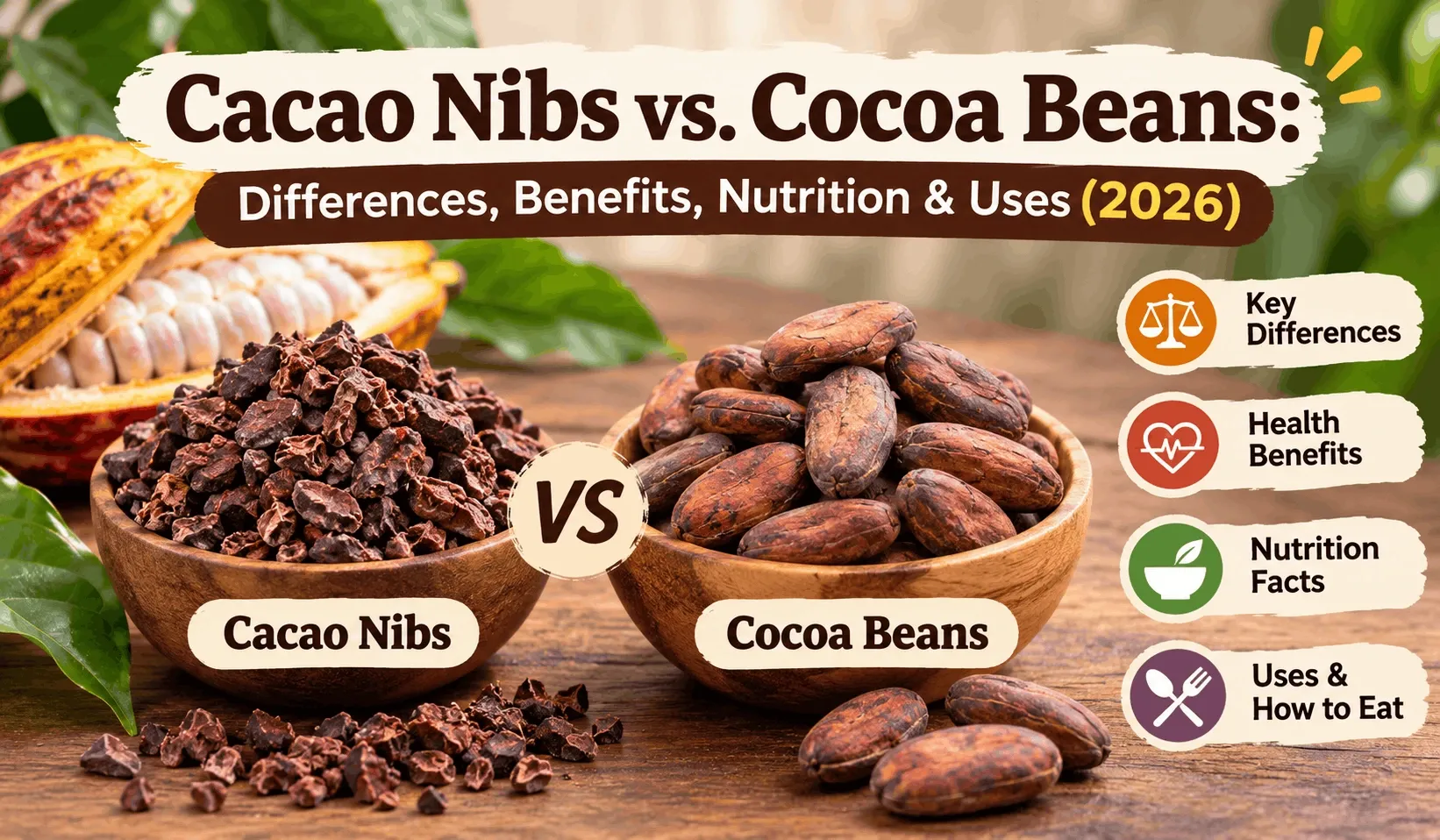
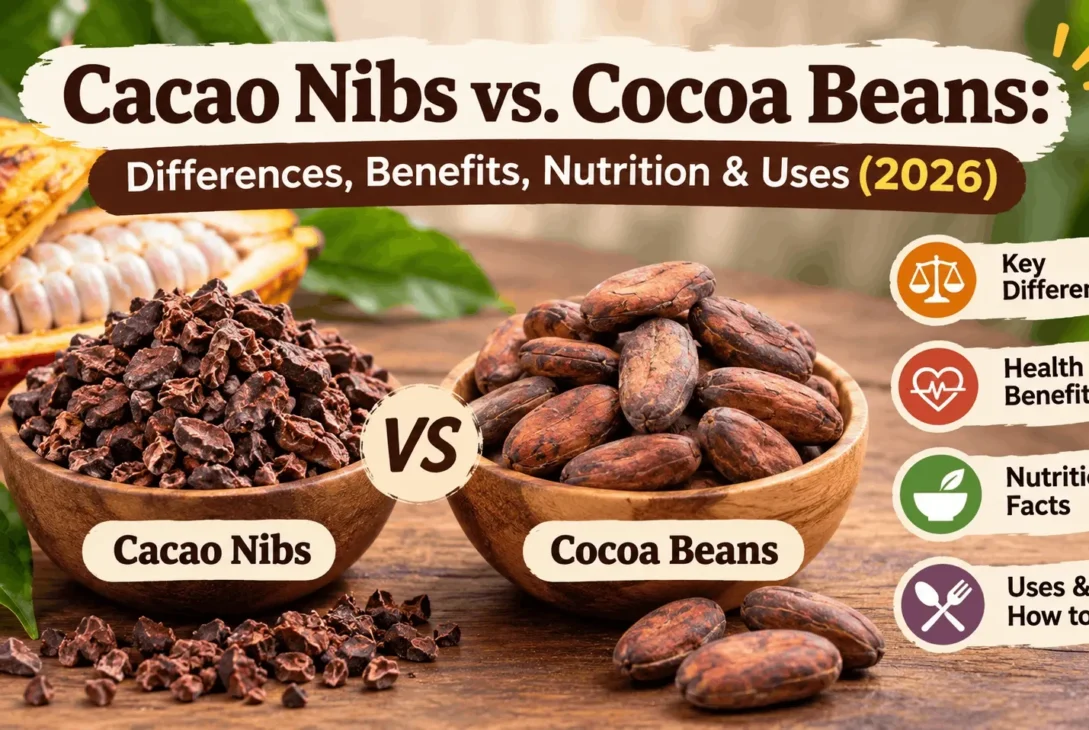
Cacao nibs are small pieces of the cocoa bean’s edible interior after producers remove the outer shell. They come from the same ingredient, so comparing nibs with beans mostly means comparing different stages of preparation.
If you searched for “nibs cocoa beans,” you may be trying to work out which one belongs in your kitchen. For a crunchy topping, ready-to-eat nibs are the convenient choice. Whole beans make more sense when you want to control the preparation yourself.
The distinction matters more than the spelling on the bag. “Cacao” alone doesn’t tell you whether a product is raw, roasted, or more nutritious.
How cocoa beans become cacao nibs
Cocoa beans are seeds from the cacao tree, Theobroma cacao. Farmers remove them from the pods, then typically ferment and dry them before further processing. The beans still have an outer shell at this stage.
Producers crack the beans and separate the shell from the edible center through a process called winnowing. Those pieces of the center are the nibs. The International Cocoa Organization’s processing guide explains that manufacturers can roast whole beans or nibs, depending on their equipment and flavor goals.
That means “nib” describes the part and form of the bean. It doesn’t establish a single roasting method.
The distinction also appears in U.S. cacao product standards, which recognize cacao nibs, cocoa nibs, and cracked cocoa as names for the same food.
| Feature | Cacao nibs | Whole cocoa beans |
|---|---|---|
| Form | Small pieces of the edible center | Whole seeds, commonly with the shell attached |
| Preparation | Shell already removed | Check whether shell removal or further processing is necessary |
| Roasting | Can vary by product | Can vary by product |
| Kitchen role | Convenient crunchy ingredient | Starting material for preparing nibs or making chocolate |
| Nutrition comparison | Compare the edible portion by weight | Exclude the shell for a meaningful comparison |
Check a seller’s description carefully. A bag of beans intended for chocolate production is a different purchase from a packaged snack labeled ready to eat.
Does cacao mean raw and cocoa mean roasted?
You’ll often see that explanation online, but it oversimplifies the labeling.
Some brands use “cacao” to describe unroasted or less processed products. Others use it for chocolate ingredients more broadly. Healthline’s terminology review notes that manufacturers use these words inconsistently.
Read the processing description and ingredient list before paying more for one spelling. If avoiding roasting matters to you, look for an explicit statement from the manufacturer. Don’t infer it from “cacao” on the front.
Also, raw cacao products don’t necessarily contain beans straight from the pod. Fermentation and drying can precede a product marketed as raw. For buying purposes, the useful questions are what treatment the food received and whether the manufacturer intends you to eat it as sold.
Cacao nibs nutrition: compare equal amounts
Breaking a bean into pieces doesn’t create a separate nutritional category. When the edible interiors come from the same batch and receive the same processing, whole kernels and nibs should have broadly similar composition by weight. This is an inference from what nibs are, rather than evidence that every retail product has identical nutrition.
Comparing different brands, different serving sizes, or beans weighed with their shells can produce misleading results.
For a concrete label example, Navitas Organics currently lists these values for one teaspoon, weighing 3 grams, of its unsweetened cacao nibs:
| Nutrient | Per 1 teaspoon (3 g) |
|---|---|
| Calories | 20 |
| Total fat | 1.5 g |
| Saturated fat | 1 g |
| Carbohydrate | 1 g |
| Dietary fiber | 1 g |
| Total sugar | 0 g |
| Added sugar | 0 g |
| Protein | 0 g |
These are rounded label values for one product, not a universal cacao nibs database. A listed zero doesn’t necessarily mean the food contains none of that nutrient. Avoid multiplying a tiny serving’s rounded figures to create a supposedly precise value per 100 grams.
The serving size deserves attention, too. A teaspoon sprinkled over breakfast and a handful eaten from the bag represent very different quantities.
Unsweetened nibs can contribute fiber without added sugar, but they also contain fat and calories. That combination matters when deciding how much to use. “No added sugar” doesn’t mean unlimited portions.
Benefits worth separating from marketing
A useful reason to choose plain nibs is that they add cocoa flavor without the sugar in sweetened chocolate toppings. They also contribute dietary fiber. Those are straightforward food characteristics; claims about preventing disease require different evidence.
Cocoa flavanols have promising but limited evidence
Cocoa contains flavanols, plant compounds that researchers have studied for effects on blood vessels and blood pressure.
A Cochrane review of cocoa and blood pressure included 35 studies involving 1,804 mainly healthy adults. It found a small average blood pressure reduction of about 1.8 mmHg with flavanol-rich cocoa products.
Most trials lasted only a few weeks. Researchers used different products and flavanol amounts, and the review’s evidence search ran through November 2016. Its findings don’t establish that a spoonful of supermarket nibs produces the same result.
That distinction becomes especially important with heart disease claims. The FDA’s qualified health claim announcement describes the supporting evidence as very limited and restricts the claim to qualifying high-flavanol cocoa powder and foods containing it.
It doesn’t extend that claim to every food made from cocoa beans. Ordinary cacao nibs therefore shouldn’t inherit a heart protection promise from research on a different preparation.
A useful topping still needs a sensible portion
Choose nibs because you enjoy their flavor or want an unsweetened topping. There’s no need to treat a food choice as a treatment plan.
For portion control, measure a small amount into your bowl before putting the bag away. That makes it easier to judge both the bitterness and how much you actually use. It also avoids turning a garnish into an accidental second snack.
What do cacao nibs taste like?
Expect an unsweetened cocoa flavor with a noticeable crunch. Nibs can taste bitter, and the exact flavor depends on the beans and processing. They won’t deliver the sweetness of ordinary chocolate chips.
Try them alongside something you already enjoy rather than judging a large mouthful on its own. A little crunch can work well in a creamy breakfast bowl.
If you prefer sweet chocolate, start sparingly. You don’t have to train yourself to like an ingredient just because a package calls it a superfood.
How to use nibs without spoiling a recipe
Treat nibs as a textured ingredient. They’re particularly useful where you want small, distinct cocoa pieces.
Serious Eats’ cooking guide suggests using them in baked goods and as dessert toppings. For a first experiment, try one of these:
- Sprinkle a little over a serving of ice cream.
- Add a small amount to cookie dough for crunch.
- Fold them into brownies where you would otherwise use chopped nuts.
- Use them as a finishing sprinkle on cupcakes.
These are culinary suggestions, not recommended medical serving sizes.
Be careful with substitutions. Replacing sweetened chocolate chips with unsweetened nibs changes both sweetness and texture. Start with a partial swap if you’re adapting a familiar recipe.
Cocoa powder is a different ingredient again. Producers press cocoa liquor to separate out cocoa butter, then process the remaining cake into powder. Nibs retain their cocoa butter, so grinding them doesn’t produce the same ingredient as commercial cocoa powder. Follow a recipe written for nibs when you want predictable results.
What to check on the bag before buying
Start with the ingredient list. For plain nibs, look for cacao or cocoa nibs as the sole ingredient. Sweetened or coated versions need a separate nutrition comparison.
Then check the serving weight and intended use. Choose a product explicitly sold for eating if you plan to sprinkle it straight onto food. Whole beans may require more preparation than their appearance suggests.
Caffeine is another detail worth checking if you’re sensitive to it. Navitas reports approximately 14 mg per tablespoon for its nibs; that figure applies to its product and shouldn’t serve as a fixed value for every brand.
For your first purchase, a small bag of ready-to-eat, unsweetened nibs is a practical choice. Try a light sprinkle on one serving before committing to a larger bag or changing an entire baking recipe.