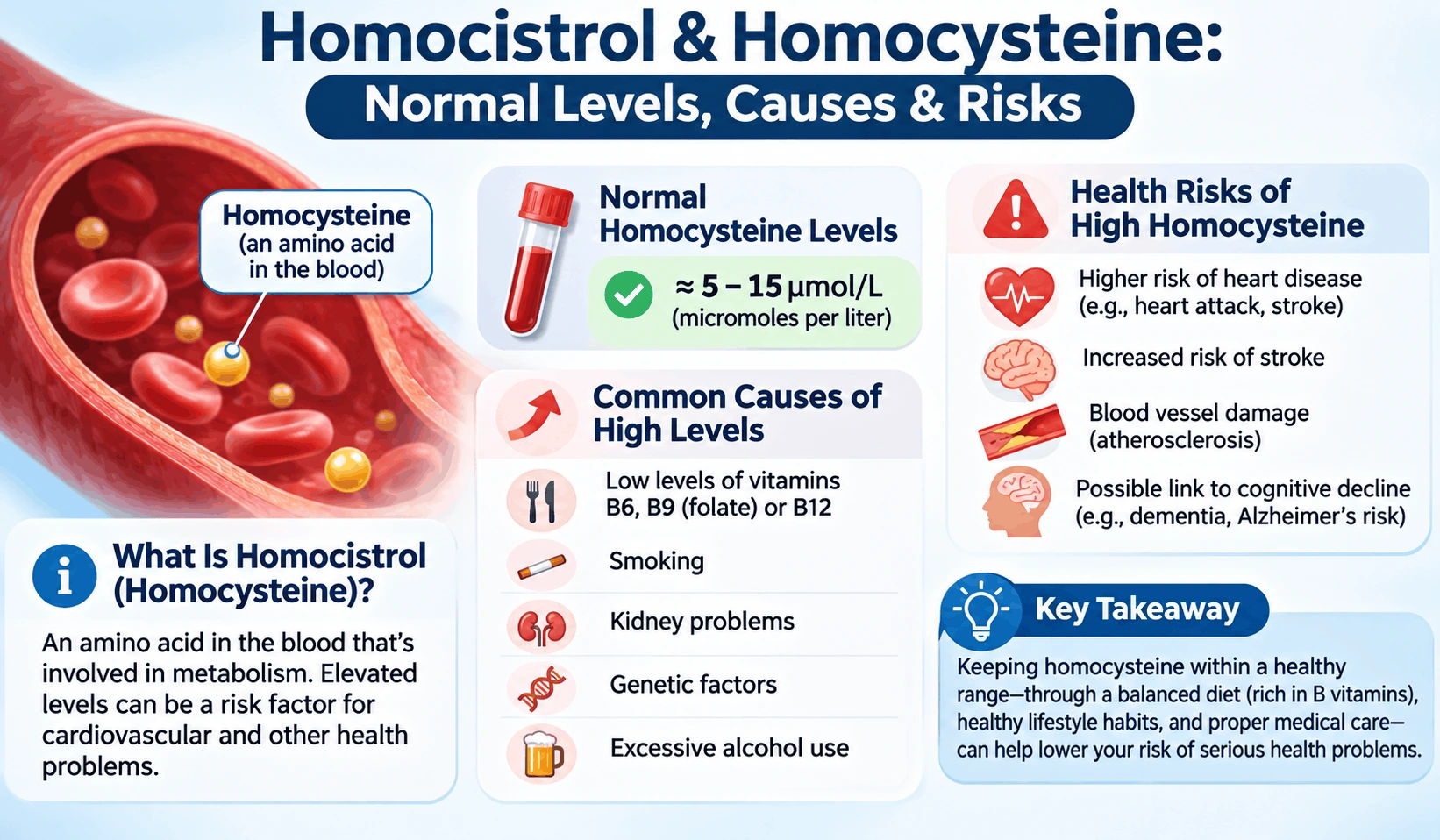
Searching for homocistrol can lead to confusion. The term appears in supplement listings, while homocysteine is the substance measured in a blood test. A supplement name and a blood marker mean different things.
If you want to understand an elevated homocysteine result, the useful questions concern its cause, your laboratory’s reference range, and whether you need further testing. Buying a supplement before answering those questions can leave the underlying problem unexplained.
This guide provides general information; a clinician should interpret your result alongside your medical history.
What Is Homocistrol, and How Does It Relate to Homocysteine?
Retailers use names such as Homocistrol and Homocystrol for supplements marketed to support homocysteine metabolism. Products with similar names can contain different ingredients, so check the exact label rather than assuming they are interchangeable. A product listing also does not establish that a supplement prevents disease.
Homocysteine is an amino acid involved in the body’s chemical processes. Your body normally converts it into other substances with help from B vitamins. When that processing does not work properly, its concentration in the blood can rise.
What Does Homocysteine Do in the Body?
Homocysteine participates in pathways involving methionine and cysteine. B vitamins help these reactions work, including folate, vitamin B12 and vitamin B6.
A small amount normally remains in the blood. An elevated result can signal a problem with nutrient availability or metabolism, but the number alone does not identify the cause.
What Causes High Homocysteine Levels?
Possible causes include inadequate B vitamins, chronic kidney disease and an underactive thyroid. Smoking and increasing age can also influence the result.
Vitamin deficiency deserves closer attention because eating enough of a nutrient does not always mean absorbing enough. For example, pernicious anaemia, certain digestive conditions and some stomach operations can interfere with vitamin B12 absorption. People who avoid animal foods also need a reliable B12 source, such as appropriately fortified foods or supplements.
Rare inherited disorders can disrupt homocysteine processing. One example is homocystinuria, which requires specialist care. Doctors may use homocysteine testing when they suspect an inherited disorder of methionine metabolism, as well as when investigating B12 or folate deficiency.
These possibilities require different treatment decisions. A high result should prompt an investigation, rather than an automatic assumption that everyone needs the same vitamin combination.
Signs and Symptoms of High Homocysteine
There is no symptom checklist that reliably tells you your homocysteine level. A blood test measures it.
People searching for “homocysteine symptoms” often encounter symptoms of an accompanying vitamin deficiency. B12 deficiency, for example, can cause:
- Tiredness or weakness.
- Pale skin or heart palpitations.
- Tingling in the feet or numbness in the hands.
- Balance difficulties.
- A sore mouth or tongue.
These symptoms do not establish that homocysteine is high. They warrant assessment on their own, especially persistent numbness or balance changes.
What Are Normal Homocysteine Levels?
Cleveland Clinic gives approximately 5 to 15 micromoles per litre (µmol/L) as a general homocysteine normal range. It describes progressively higher concentrations as follows:
| Homocysteine concentration | General description |
|---|---|
| Approximately 5 to 15 µmol/L | Typical range |
| Approximately 15 to 30 µmol/L | Mild elevation |
| Approximately 30 to 100 µmol/L | Moderate elevation |
| Above 100 µmol/L | Severe elevation |
These are broad categories, with approximate boundaries. Use the reference interval printed on your own report when discussing an individual result.
Avoid treating an online “optimal” target as a diagnosis. Ask what your result means in your clinical context and whether further investigation would change your care.
Health Risks: Does Lowering the Number Prevent Disease?
High homocysteine levels have associations with cardiovascular disease and blood clots. However, an association does not mean that lowering the marker will necessarily prevent the associated illness.
That distinction matters when evaluating supplement claims.
A Cochrane review covering 15 studies and 71,422 participants found no evidence that homocysteine-lowering B vitamin interventions prevented heart attacks or reduced deaths among people at risk of, or living with, cardiovascular disease. The evidence did not support a broad promise of cardiovascular protection from taking these supplements. Stroke findings require more context and do not justify a universal prevention claim.
Treating a documented vitamin deficiency still matters. But a falling laboratory value does not, by itself, prove that someone’s overall cardiovascular risk has fallen.
Routine homocysteine screening for heart disease risk is therefore not recommended for everyone.
For broader information about routine checkups and screening discussions, read our preventive health guide.
How Is Homocysteine Tested?
A homocysteine blood test measures the concentration in a blood sample, usually collected from a vein in your arm.
Your provider may ask you to fast for 8 to 12 hours, depending on the testing instructions. Tell them about your medicines and supplements, especially B vitamins. Do not stop prescribed treatment unless they instruct you to do so.
Doctors can use the result to support an investigation into vitamin deficiency or an inherited metabolic disorder. The test does not independently explain why the concentration is abnormal.
Bring the full laboratory report to your appointment, including its units and reference interval.
How to Lower High Homocysteine Levels
Treatment should follow the cause. A clinician may recommend dietary changes or vitamin replacement when deficiency contributes to the result.
Before starting a high-dose supplement, consider two practical cautions:
- Large amounts of supplemental folate can correct the anaemia associated with B12 deficiency while its nerve damage continues.
- Long-term high supplemental intake of vitamin B6 can cause serious nerve damage.
These are reasons to check ingredients and doses with a clinician, particularly when combining several products.
B12 absorption problems may also require a treatment plan that food changes alone cannot provide. For example, clinicians commonly use B12 injections for pernicious anaemia, although sufficiently high oral doses may sometimes work.
Foods and Vitamins That Support Healthy Homocysteine Metabolism
Food can help maintain an adequate supply of the vitamins involved in homocysteine processing.
| Nutrient | Food sources | Practical consideration |
|---|---|---|
| Folate, or vitamin B9 | Spinach, asparagus, beans, peas and fortified grains | Check labels to identify added folic acid |
| Vitamin B12 | Fish, meat, eggs, dairy and B12-fortified foods | Unfortified plant foods do not provide a reliable B12 source |
| Vitamin B6 | Poultry, fish, potatoes and non-citrus fruit | More supplemental B6 is not automatically better |
These examples come from the NIH Office of Dietary Supplements’ guidance on folate, vitamin B12 and vitamin B6.
For a practical way to include beans in your meals, see our dried lima beans preparation and nutrition guide.
A varied diet supports nutrient intake. It does not replace treatment for an absorption disorder or establish that an elevated blood result has resolved.
When Should You See a Doctor?
Arrange a review if your laboratory flags an elevated result or you have persistent symptoms suggesting a vitamin deficiency. You do not need to identify the correct supplement before seeking advice.
Sudden facial drooping, weakness in one arm or difficulty speaking require emergency help because they can indicate a stroke. In the UK, call 999 immediately, even if the symptoms stop. Do not wait for a homocysteine test.
Frequently Asked Questions
Does a high result mean I have homocystinuria?
No. Nutritional deficiencies and other conditions can also elevate homocysteine. Doctors need further assessment to diagnose an inherited metabolic disorder.
Should everyone take a homocistrol supplement?
A product name cannot establish whether you need its ingredients or doses. Treatment decisions should reflect the cause of the abnormal result, and B vitamin supplements do not offer guaranteed protection against cardiovascular disease.
Are methylated B12 supplements always better?
The NIH Office of Dietary Supplements says research has not shown that one supplemental form of B12 is better than the others. Choose treatment based on your needs and clinical advice rather than assuming a particular label means better results.
What should I ask at my appointment?
Start with: “What could explain my result, and what should we investigate before deciding on treatment?” Bring your supplement labels as well as the blood report.