
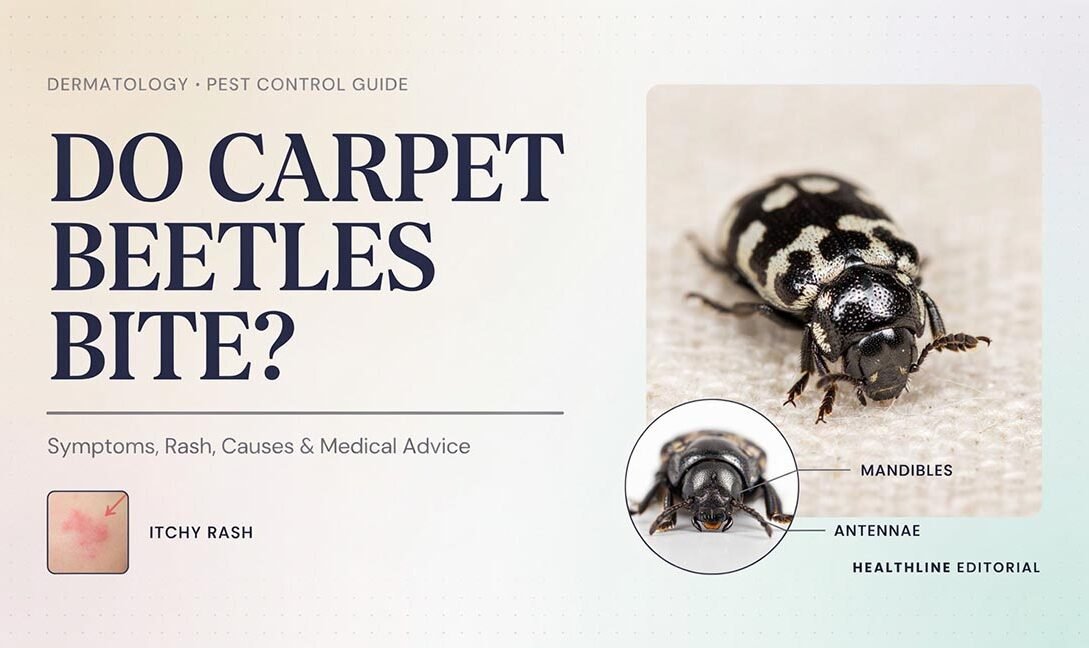
If you’ve spotted tiny, oval-shaped bugs crawling across your carpet or windowsill, you’ve probably already typed “do carpet beetles bite” into a search bar out of pure worry. It’s a fair question. Skin irritation is unsettling, especially when you can’t immediately tell what’s causing it.
Here’s the short answer: carpet beetles don’t bite. But before you close this tab, know that these insects can still cause real skin reactions — and understanding the difference matters for your health and your peace of mind.
Let’s break down exactly what’s happening, why it happens, and what you should do about it.
What Are Carpet Beetles?
Carpet beetles are small household insects that belong to the family Dermestidae. They’re common in homes across the world, and most people never notice them until an infestation grows large enough to damage fabric, carpets, or stored clothing.
There are a few common species homeowners encounter:
- Varied carpet beetle – small, mottled with white, brown, and yellow scales
- Black carpet beetle – dark brown to black, slightly larger and more elongated
- Furniture carpet beetle – similar in size to the varied beetle, often found near upholstered furniture
Adult carpet beetles are harmless in terms of physical contact. It’s actually the larvae — not the adults — that cause most of the trouble in homes, both in terms of fabric damage and skin reactions.
Do Carpet Beetles Bite? The Direct Answer
No, carpet beetles do not bite humans. Unlike mosquitoes, bed bugs, or fleas, carpet beetles have no biological need to feed on human blood or skin. Their mouthparts aren’t designed for biting people at all — adult beetles feed on pollen and nectar, while larvae feed on natural fibers like wool, silk, fur, and feathers.
So if you’re dealing with red bumps, itching, or a rash, something else is going on. That “something else” is usually contact dermatitis caused by the beetle larvae, not a bite in the traditional sense.
Why Do People Think Carpet Beetles Bite Them?
This is where confusion creeps in, and honestly, it’s understandable. Carpet beetle larvae carry a coat of tiny bristles, scientifically referred to as setae. When these hairs come into contact with human skin, they can cause irritation that looks and feels a lot like a bite.
Here’s what typically happens:
- Larvae shed their hairy skin as they grow (a process called molting).
- These shed hairs, along with live larvae, can end up on bedding, clothing, or furniture.
- When these hair-like fibers rub against the skin, their microscopic barbs can catch and lodge just beneath the surface.
- The body identifies the protein as foreign and reacts with swelling, redness, and an itchy sensation.
This reaction is medically known as carpet beetle dermatitis, and it’s the real culprit behind what people assume are bites.
Carpet Beetle Rash: What It Looks Like
Since the rash is often mistaken for bites from bed bugs, fleas, or mosquitoes, it helps to know the specific signs.
Common Symptoms of Carpet Beetle Dermatitis
- Small, raised red bumps, often in clusters
- Intense itching, sometimes worse at night
- Mild swelling around the affected area
- Skin that feels rough or slightly inflamed to the touch
- Bumps that may appear on exposed skin like arms, neck, and legs
How It Differs From Actual Insect Bites
| Feature | Carpet Beetle Reaction | Typical Insect Bite |
|---|---|---|
| Cause | Contact with larval hairs | Puncture from mouthparts |
| Pattern | Random, scattered | Often in a line or cluster |
| Discomfort Level | Mostly itching, little to no pain | Immediate sharp or stinging pain |
| Timing | Can appear hours after contact | Often immediate |
| Marks | No puncture wound visible | Visible bite mark or welt |
If you look closely at your skin and don’t see an actual puncture mark, that’s a strong clue you’re dealing with a dermatitis reaction rather than a genuine bite.
What Causes the Skin Reaction?
The irritation isn’t an allergic reaction in every case, but for some people, it functions like one. The setae (hairs) on carpet beetle larvae contain proteins that the immune system may interpret as a threat. This triggers histamine release, which leads to the redness, swelling, and itching associated with the rash.
People with sensitive skin, eczema, or a history of allergic skin conditions tend to react more strongly. Others may come into repeated contact with larvae hairs and barely notice anything at all.
It’s also worth noting that carpet beetle hairs can become airborne in dusty environments, especially in homes with long-standing infestations. This means the reaction isn’t always from direct crawling contact — sometimes it’s from hairs settling on skin from bedding or upholstery.
Where Carpet Beetle Reactions Commonly Occur
Because larvae prefer dark, undisturbed areas, reactions often show up in specific spots:
- Around the neck and shoulders – from contact with infested pillows or bedding
- Arms and legs – from sitting on infested furniture or rugs
- Waistline – from clothing stored in drawers with larvae present
- Scalp – less common, but possible with heavily infested carpets
If you’re noticing a pattern where the irritation appears after sleeping or after wearing certain stored clothing, that’s a meaningful clue pointing toward carpet beetles rather than another pest.
Confirming Carpet Beetles Are Behind Your Symptoms
Before jumping to conclusions, it helps to do a bit of detective work.
Signs of an Infestation
- Small, shed larval skins (they look like tiny, hairy husks)
- Spotting adult beetles on windowsills, since they’re naturally attracted to sunlight
- Irregular holes in wool sweaters, silk, or natural-fiber rugs
- Larvae found in closets, under furniture, or inside vents
Simple Steps to Investigate
- Check dark corners of closets and under furniture with a flashlight.
- Inspect wool or silk clothing for small holes or shedding.
- Look along baseboards and carpet edges for shed skins.
- Vacuum thoroughly and check the canister for larvae or debris.
If you find several of these signs together, it strongly supports carpet beetles as the source of your skin irritation rather than bed bugs or another biting insect.
Medical Advice: What to Do If You Have a Rash
While carpet beetle dermatitis is generally not dangerous, it can be uncomfortable and, in some cases, prone to secondary infection if scratched excessively. Here’s a sensible approach.
At-Home Care
- Wash the affected area gently with mild soap and water
- Keep from scratching the area, since it can open the skin to bacteria
- Apply a cool compress to reduce swelling
- Use an over-the-counter antihistamine cream if itching is significant
- Wash all bedding and garments in hot water, which helps strip away lingering larvae and shed hairs
When to See a Doctor
You should consult a healthcare provider if:
- The rash spreads rapidly or doesn’t improve after a few days
- You experience signs of infection, such as warmth, pus, or increasing pain
- You have difficulty breathing or swelling in the face or throat (a sign of a more serious allergic reaction)
- Over-the-counter treatments provide no relief
A doctor can rule out other causes like scabies, bed bug bites, or allergic contact dermatitis from unrelated sources, and prescribe stronger topical treatment if needed.
Getting Rid of Carpet Beetles to Stop the Reaction
Treating the rash only solves half the problem. To stop future irritation, you need to address the infestation itself.
Practical Removal Steps
- Vacuum thoroughly and often, focusing on carpets, rugs, upholstery, and baseboards
- Wash or dry-clean natural-fiber clothing and bedding
- Store vulnerable fabrics in sealed plastic containers rather than open drawers
- Reduce clutter, since larvae thrive in undisturbed, dark spaces
- Seal cracks and gaps around windows and doors to limit adult beetles entering from outside
- Consider professional pest control for infestations that persist despite cleaning efforts
Persistent infestations, especially ones involving natural-fiber rugs or antique furniture, often benefit from a licensed pest control inspection to identify hidden breeding sites.
Frequently Asked Questions
1. Do carpet beetles bite humans?
No. Carpet beetles don’t bite. Skin irritation is caused by contact with the tiny hairs on their larvae, not by a bite.
2. What does a carpet beetle rash look like?
It typically appears as small, red, itchy bumps in a scattered pattern, without a visible puncture mark, unlike a true insect bite.
3. How long does carpet beetle dermatitis last?
Mild cases often resolve within a few days to a week once contact with the larvae hairs stops and the area is kept clean.
4. Can carpet beetles live on your skin or in your hair?
No. Carpet beetles do not live on human skin or feed on humans. They feed on natural fibers and organic debris, not people.
5. How can I tell the difference between bed bug bites and carpet beetle rash?
Bed bug bites usually appear as raised welts in a line or cluster with a visible bite mark, often on skin exposed while sleeping. In contrast, carpet beetle rash has no visible entry point and spreads more irregularly across the skin.
6. Are carpet beetles dangerous to health?
They’re not medically dangerous, but they can trigger allergic-type skin reactions in sensitive individuals and may worsen asthma or allergy symptoms due to airborne larval hairs and shed skins.
7. Do I need to throw away infested clothing?
Not usually. Most infested clothing can be saved through thorough washing, dry cleaning, or freezing to kill larvae and eggs, though heavily damaged items may not be salvageable.
Conclusion
Carpet beetles don’t bite, but they can absolutely cause skin irritation through contact with their larval hairs. This reaction, known as carpet beetle dermatitis, often gets mistaken for actual bites because of the itching and redness it produces. The good news is that it’s manageable — both the rash and the underlying infestation respond well to prompt cleaning, laundering, and, when needed, professional pest control. If your skin reaction doesn’t improve or seems severe, checking in with a doctor is always the safer choice. Understanding the real cause behind your symptoms is the first step toward getting your home, and your skin, back to normal