
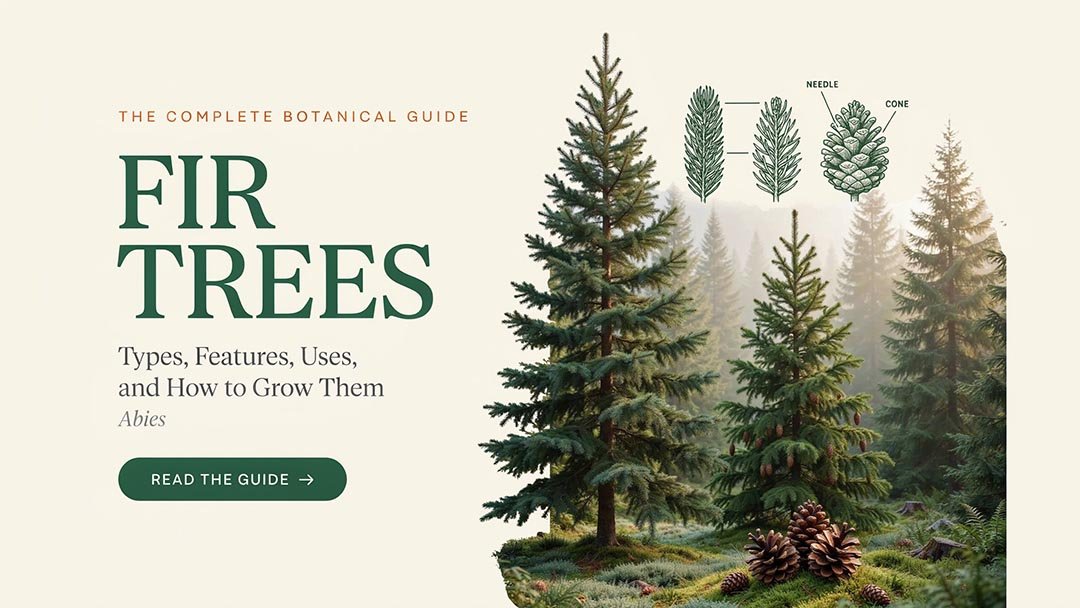
Fir trees are one of the most identifiable of evergreen trees found in forests, gardens, parks and alpine regions. Their shape is elegant, their needles soft-looking, and they are green the whole year round, and thus appeal alike to the nature-lover and the gardener. But what makes a fir tree different from other evergreens?
There are a number of noteworthy things about this tree including its unique cones and its propensity for chilly climates. If you are considering planting one, learning about woodland plants, or are just curious about these beautiful evergreens, knowing their characteristics can help you appreciate them in a new way.
What Is a Fir Tree?
Fir trees are of the genus Abies that is within the pine family, the Pinaceae family scientifically. They are a diversified category with several species and a vast range of sizes, hues, forms and preferred growing conditions.
One of the easiest ways to identify these trees is by their straight, symmetrical growth. They normally need very little pruning but many have a tight, pyramid-like shape as if someone had meticulously pruned them.
Evergreens, for example fir trees, keep their leaves all year long. Unlike other conifers they don’t shed all their needles in autumn, they replace the older needles gradually as new growth comes out.
The evergreen habit gives a continuing green aspect to woods and landscapes even throughout the winter months.
How to Identify a Fir Tree
Knowing what to look for can make identifying a fir lot simpler.
Flat, soft needles Fir needles tend to be flat, not sharply four-sided. The needles of several species are relatively delicate to touch.
Upright cones: Their cones are one of their most recognisable traits. Most fir cones grow vertically from branches, unlike the cones of many other conifers.
Young trees: Young trees normally have relatively smooth bark, but mature trees might have thicker, more textured bark.
Symmetrical crown: A healthy tree has a naturally balanced, conical form.
Another helpful hint is the method of attachment of the needles to the branches. Usually a falling needle has a small circle of attachment, however other related evergreen trees have various attachment patterns.
Common Types of Fir Trees
They occur in multiple species in various parts of the world. Others are very beautiful in shape and for their ability to bloom in appropriate temperate zones.
Balsam fir A North American conifer with thick foliage and a nice smell. It is most often associated with the traditional Christmas tree.
Douglas fir: Despite the name, Douglas fir is not a true fir. It is not a fir, but of a different species, and is commonly enumerated among the firs, on account of its resemblance, and value as a conifer.
Noble fir – appreciated for robust branches, attractive blue-green needles and longevity after cutting.
NORDMANN FIR A Christmas and ornamental tree valued for its full symmetrical shape and moderately soft needles.
White Fir Also called concolor fir, this species has blue-green or silvery foliage and can grow into a large landscape tree if conditions are favourable.
Each species has its own personality, so when choose one for a garden, consider climate, available space and mature size.
Where Fir Trees Naturally Grow
Fir species occur naturally across parts of the Northern Hemisphere, including North America, Europe, and Asia. Many are associated with mountain regions, cool forests, and areas with adequate moisture.
Their natural habitat gives an important clue about their preferences. A fir generally performs better when its growing conditions resemble those found in its native environment.
Some species tolerate relatively warm conditions better than others, but many prefer cool temperatures and consistent soil moisture.
Think of it this way: planting a fir in an unsuitable climate is like asking a winter coat to perform well in a tropical summer. It may survive under certain circumstances, but the conditions are far from ideal.
Fir Tree Needles and Cones
The foliage is one of the main reasons these trees are so attractive. Depending on the species, needles may appear dark green, blue-green, or silvery.
Their arrangement can also give the branches a distinctive appearance. Some species have needles that spread outward from the twig, while others create a denser, layered look.
The cones are especially interesting. They usually develop high within the crown and stand upright on the branches. As they mature, they break apart while still attached to the tree, releasing their seeds.
This is different from many familiar pine cones, which commonly fall intact to the ground.
How Large Can a Fir Tree Become?
Firs vary widely in mature size, depending on species and growing conditions.
Some kinds are manageable enough for home landscaping, while others can become huge forest trees. A species that seems little and cute in a garden center may need significantly more room than you think.
Before you plant a tree, consider yourself: how much room will this tree need in 10, 20, or even 50 years?
Think of its mature height, crown spread, root zone, and spacing from structures, roadways, overhead wires and other plants.
It’s much easier to plan for mature size than to cope with an overgrown tree later.
Soil, Sunlight, and Water Requirements
Most firs like well-drained, healthy soil with plenty of rainfall. They don’t usually want their soil to be soggy for long durations.
Sunlight needs differ slightly among species, although many do well with plenty of light. Young trees may benefit from protection from high heat, particularly in regions outside their native temperate range.
Watering: New trees require constant watering until their roots are established. Depending on rainfall and local conditions, mature trees may need less additional water.
Soil: Deep, well-drained growth space often preferred.
Mulch: Apply a layer of organic mulch around the root zone to conserve moisture and keep the soil temperature down. Keep mulch away from direct trunk touch.
Good growing conditions are like the foundation of a home. When the foundation is good, the tree has a much better chance of producing strong roots and stable growth.
How to Plant a Fir Tree
Planting at the right time and in the right place can make all the difference.
First, choose a place large enough for the tree’s mature size. Test the drainage of the soil and think about how much sunlight the site gets in the daytime.
Dig a hole large enough for the root system without pushing the roots into a tight circle. As a rule the rootball should be level or slightly higher than the surrounding soil, not buried deeply.
When the tree is in place, backfill with original soil and water well.
Do not plant too deep. Planting too deep may prevent adequate root development and lead to long-term health issues.
Mulch can save moisture but leave a tiny gap around the trunk.
Caring for a Fir Tree
Many fir trees require relatively little routine upkeep once established.
Check the foliage regularly for strange colouration, thinning, damaged branches or signs of insects. Water young trees as needed during prolonged dry times.
As a rule remove only dead, damaged or problematic branches. Many firs grow into beautiful shapes by themselves so you seldom need prune them back much.
Protect young trees Newly planted trees may require special attention during periods of drought, extreme heat or high winds.
Watch the moisture. Regular watering is especially vital during establishing.
Maintain a healthy root zone: Don’t repeatedly disrupt the ground at the tree’s base.
In general, a healthy fir should be left to develop its natural shape, rather than shaping it heavily.
Common Problems Affecting Fir Trees
Firs can be long-lived but not trouble free.
Insect pests: Some insects may eat needles, branches or bark. Symptoms may include discolouration, early loss of needles or poor development.
Fungal diseases: Certain fungal disorders might be encouraged by poor drainage, long periods of dampness, or environmental stress.
Drought Stress – Extended periods without water can cause the needles to brown and can weaken the tree.
Heat stress: Too much heat may be hard for species used to cool alpine conditions.
Root issues. Waterlogged soil can harm roots and diminish the tree’s ability to absorb water and nutrients.
If a mature tree suddenly turns brown or loses a lot of needles, it is important to find out why before treating it.
Uses of Fir Trees
Fir trees have been used to benefit people for years.
Depending on the species and locality, their wood is utilised in diverse applications of building, paper, packaging and woodworking. Some varieties are also prized as Christmas trees for their appealing form, scent and needle retention.
Firs are great for privacy, structure, shade, and year-round greenery in the landscape. Larger specimens can also contribute to the character of parks and large properties.
Natural habitats also contain substantial components of fir species. The woodlands they have give shelter and habitat for wildlife and also help to protect the soil and store carbon.
Fir Trees in Gardens and Landscapes
A fir can become an impressive focal point in a landscape, particularly where there is enough room for its mature size.
In bigger residential gardens, smaller acceptable species or cultivars may be used, whereas full-sized forest species are more ideal for expansive properties and naturalised areas.
Try to place the tree such that it may be admired from a distance. A symmetrical evergreen can be particularly beautiful against open grass, woodland margins or winter scenes.
However, picking a tree because it looks good in the nursery can lead to issues later on. Always take into account your local climate and the mature size of the individual species.
FAQ’s
1. Are fir trees the same as pine trees?
No . Fir trees and pine trees are both conifers in the pine family , but they ‘re different genera , and there ‘re many variances in their needles , cones , branches , and growth behaviours .
2. How quickly do fir trees grow?
Growth rates will vary with species, climate, soil, moisture and general growing conditions; Some species have a rapid growth when young, others grow more slowly.
3. Will a fir tree grow in a hot climate?
Some fir species prefer cooler climates, while others are more tolerant of hot circumstances. Select a species that is appropriate for your local climate for long-term growth.
4. Do pine trees shed their needles?
Fir trees are evergreen so they don’t shed all their needles seasonally. But older needles darken and fall off naturally, part of the normal growth cycle of the tree.
5. What space does a fir tree need?
Space needed will vary according on species and mature size. Before planting, research how big the plant will grow in height and width, and provide ample space for it to grow healthy without hitting any structures or utility lines.
Summary
Fir trees are an amazing collection of evergreens that blend natural beauty, ecological significance and practical usefulness. Their smooth needles, erect cones, symmetrical shapes and year-round foliage make them pleasant to enjoy.
If you see one in a mountain forest, or you cultivate one in your landscape, studying its demands will help you grasp why location, soil, moisture and climate are so important. With the correct conditions and careful attention, a suitable fir can become an enduring feature of the landscape.