
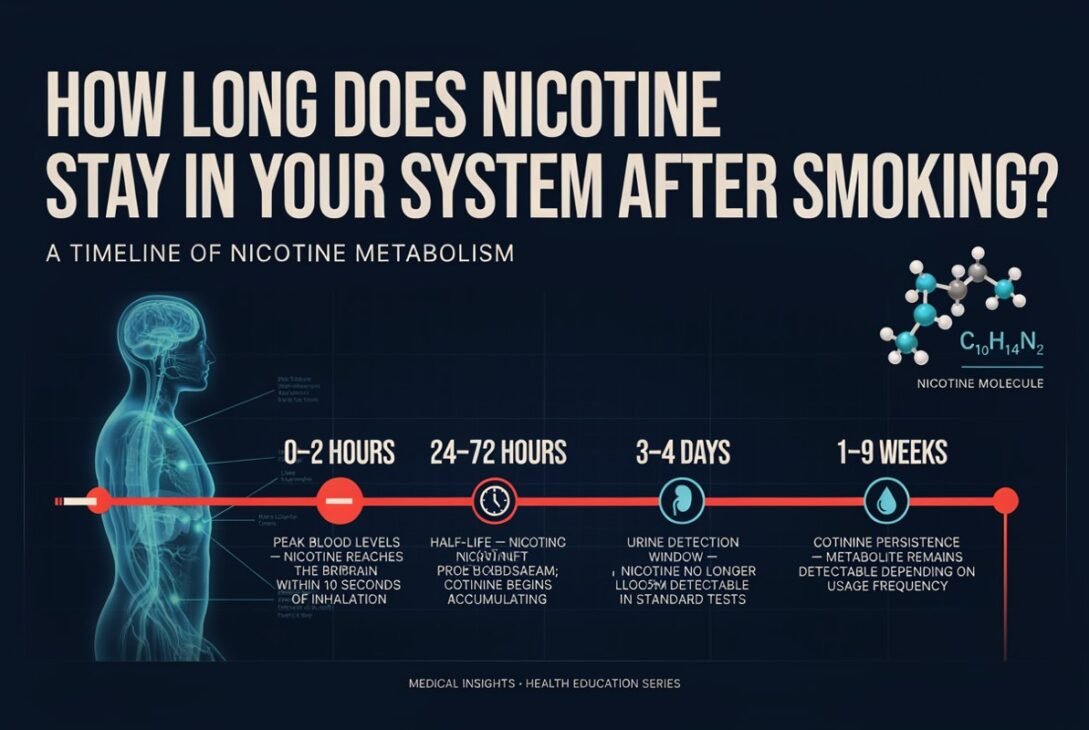
If you’ve ever had to take a nicotine test for a job, an insurance policy, or you’re simply trying to quit and want to know what’s happening inside your body, you’ve probably asked yourself this exact question. The honest answer isn’t a single number — it depends on what kind of test is being used, how often you smoke, and even your genetics.
Let’s break it down in plain language, without the medical jargon overload.
Quick Answer: Nicotine Detection Timeframes
Before diving into the details, here’s the short version people usually search for:
- Blood test: 1 to 3 days
- Saliva test: Up to 4 days
- Urine test: 3 to 4 days for light smokers, up to 3 weeks for heavy smokers
- Hair follicle test: Up to 90 days (3 months)
These numbers reflect nicotine’s main byproduct, cotinine, which is actually what most tests are looking for — not nicotine itself.
Why Cotinine Matters More Than Nicotine
Here’s something a lot of articles skip over: pure nicotine leaves your bloodstream fairly fast, usually within a couple of hours. Its half-life is roughly 1 to 2 hours in most healthy adults.
But your liver breaks nicotine down into cotinine, and cotinine sticks around much longer — its half-life is about 16 to 24 hours. That’s why testing labs almost always screen for cotinine instead of nicotine. It gives a more reliable window into recent use.
So when someone asks “how long does nicotine stay in your system,” what they usually mean, whether they realize it or not, is “how long does cotinine stay detectable.”
Factors That Change How Long Nicotine Stays In Your Body
No two people process nicotine the same way. Several variables can stretch or shrink these timeframes significantly.
1. How Often You Smoke
A person who smokes a pack a day will clear nicotine much slower than someone who smokes occasionally. Frequent use causes nicotine and cotinine to build up in fatty tissue and organs, which extends the time it takes for your body to flush it out completely.
2. Metabolism
Your metabolic rate plays a huge role. People with faster metabolisms tend to break down and eliminate nicotine quicker. Age, genetics, liver function, and even hydration levels all factor into this.
3. Body Mass and Composition
Nicotine is fat-soluble, meaning it can be stored in fatty tissue. Individuals with higher body fat percentages may retain nicotine byproducts a bit longer than leaner individuals.
4. Hydration and Kidney Function
Since most nicotine metabolites exit the body through urine, staying hydrated and having healthy kidney function can speed up clearance. Dehydration, on the other hand, can slow the process down.
5. Type of Tobacco Product
Cigarettes, vapes, chewing tobacco, and nicotine patches all deliver nicotine differently. Smokeless tobacco and vaping products sometimes contain higher nicotine concentrations, which can lead to longer detection windows compared to occasional cigarette smoking.
Nicotine Detection By Test Type — A Closer Look
Blood Tests
Blood tests are the most precise but least commonly used for routine screening because nicotine leaves the bloodstream relatively fast. Cotinine, however, can still be detected in blood for 1 to 3 days after the last use. Blood testing is typically reserved for medical evaluations rather than employment screening.
Saliva Tests
Saliva testing has become popular because it’s quick, non-invasive, and hard to tamper with. Cotinine is usually detectable in saliva for up to 4 days, sometimes slightly longer in heavy smokers.
Urine Tests
This is the most common method used by employers, life insurance companies, and health programs. Here’s a rough breakdown:
- Light or occasional smokers: 3 to 4 days
- Regular smokers: 1 to 3 weeks
- Heavy, long-term smokers: Up to 3 weeks or slightly more
Urine cotinine levels are also used by insurance providers to determine premium rates, since nicotine use is directly linked to higher health risks.
Hair Follicle Tests
Hair testing is the most invasive of the group and used less frequently. Because hair grows slowly and traps chemical residues, nicotine metabolites can be detected for up to 90 days. This is the go-to method when someone needs a long-term usage history rather than a snapshot of recent activity.
Does Vaping Show Up The Same Way As Smoking?
This is a question we get a lot. The short answer: yes, largely. Vaping still delivers nicotine into your bloodstream, and your body metabolizes it the same way it would nicotine from a cigarette. The detection windows are similar, though the exact concentration can vary depending on the e-liquid’s nicotine strength and how often you vape throughout the day.
Nicotine pouches and patches follow a similar pattern too, since the active compound your body processes is chemically identical regardless of delivery method.
Can You Speed Up Nicotine Clearance?
While you can’t instantly erase nicotine from your system, certain habits may help your body process it more efficiently:
- Drink plenty of water to support kidney function and urine output
- Exercise regularly, which can boost metabolism and circulation
- Eat a balanced diet rich in fiber and antioxidants to support liver function
- Avoid secondhand smoke exposure, which can prolong detectable nicotine levels
- Get consistent sleep, since poor sleep can slow metabolic processes
Keep in mind, none of these methods guarantee a clean test overnight. Time is still the most reliable factor.
Secondhand Smoke and False Positives
It’s worth mentioning that secondhand smoke exposure can, in rare cases, cause trace levels of cotinine to show up in tests, especially in sensitive testing environments. However, the levels are usually low enough that most standard testing thresholds won’t flag it as active use. If you’re concerned about this, it’s worth discussing directly with whoever is administering the test.
Why This Matters Beyond Just Passing a Test
Understanding how nicotine moves through your system isn’t only useful for test prep. It also gives insight into how addictive nicotine really is. The fact that cotinine can linger for weeks in regular smokers shows just how deeply nicotine integrates into your body’s chemistry — which is part of why quitting can feel so physically demanding, not just mentally.
If you’re on a quitting journey, knowing these timelines can actually be motivating. Watching nicotine levels drop over days and weeks is a tangible way to track progress, even when withdrawal symptoms make it hard to feel like you’re moving forward.
Frequently Asked Questions
1. How long does nicotine stay in your urine after one cigarette?
For occasional smokers, nicotine byproducts typically clear from urine within 3 to 4 days after a single cigarette.
2. Does nicotine show up on a standard drug test?
Not usually. Standard 5-panel or 10-panel drug tests don’t screen for nicotine. Nicotine testing is typically a separate, specific test requested by employers or insurers.
3. How long after quitting smoking does cotinine leave your system completely?
For most people, cotinine is undetectable within 1 to 3 weeks after quitting, though heavy long-term smokers may take slightly longer.
4. Can secondhand smoke cause a positive nicotine test?
It’s possible but uncommon. Heavy, prolonged secondhand exposure could result in trace detectable levels, though rarely enough to trigger a positive result under standard thresholds.
5. Does vaping stay in your system longer than smoking cigarettes?
Not necessarily. Detection windows are similar since your body processes nicotine the same way regardless of the delivery method.
6. What’s the fastest way to get nicotine out of your system?
There’s no instant fix, but staying hydrated, eating well, and giving your body time are the most effective natural approaches.
7. Is nicotine testing accurate for detecting recent use versus long-term use?
Yes. Blood and saliva tests are better for detecting recent use, while hair follicle tests are more accurate for identifying long-term patterns of use.
Final Thoughts
So, how long does nicotine stay in your system after smoking? It really comes down to the test being used and your personal habits. Saliva and blood tests clear up fastest, urine tests take longer, and hair tests can trace nicotine use back for months.
If you’re trying to quit, understanding these timelines can help set realistic expectations, both for testing purposes and for tracking your own progress. Nicotine leaves the body in stages, and every day without it is a step toward a cleaner system and better long-term health