Your skin was fine — until suddenly it wasn’t. Products that used to work are now stinging. Your face feels tight an hour after washing it. You’re breaking out, but it doesn’t look like regular acne. Sound familiar? That’s what a damaged barrier feels like, and it’s more common than most people realize. Here’s exactly how to repair damaged skin barrier issues the right way — without making things worse in the process.
What Is the Skin Barrier and Why It Matters
Most people think of their skin as one solid layer. It’s not. Your barrier is a carefully organized system—living cells, lipids, proteins—all stacked together to keep the outside world out and your skin’s moisture in. Good skin days don’t happen by accident. They happen because your barrier is quietly doing its job in the background — and when it is, you genuinely don’t notice your skin at all. No tightness, no flare-ups, nothing to manage. The moment something goes wrong, though, you feel it everywhere.
And it rarely comes from one dramatic mistake. More often it’s the slow accumulation of small things—a cleanser that’s slightly too harsh, exfoliating a few too many times a week, or skipping moisturizer when you’re in a rush. None of it feels like damage in the moment. Then one day your skin just stops playing along, and you’re left wondering what changed.
Role of the stratum corneum
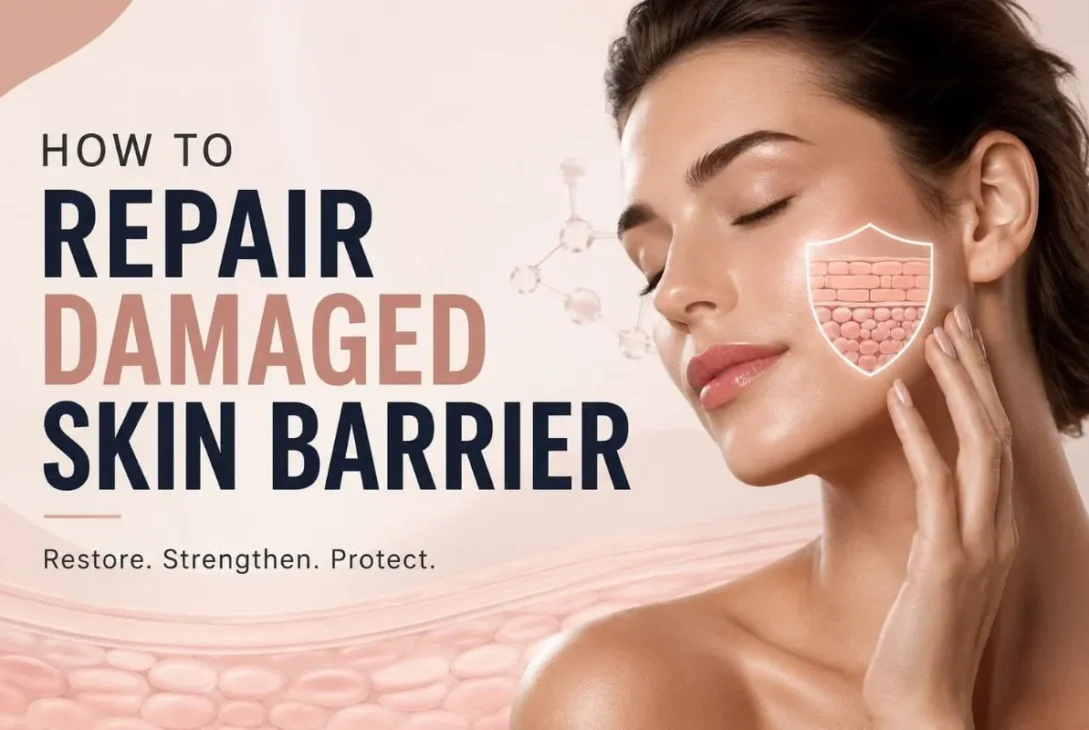
The stratum corneum is the outermost layer of your skin, and it’s the actual physical structure of your barrier. Picture it like a brick wall: the skin cells are the bricks, and a mix of ceramides, fatty acids, and cholesterol acts as the mortar holding everything together. Crack the mortar, and the whole wall weakens. That’s what barrier damage really is — a breakdown in that lipid matrix.
How the barrier protects your skin
A healthy barrier pulls off two jobs at once. It keeps the bad stuff out — irritants, bacteria, pollution — and stops moisture from quietly leaking away. That second part has an actual name: transepidermal water loss, or TEWL. Keep it low, and your skin stays hydrated without you having to think about it. Let it run high, and no amount of moisturizer really catches up. When your barrier is doing its job, calm, comfortable skin isn’t something you work for. It just is.
Signs Your Skin Barrier Is Damaged
Compromised skin barrier symptoms don’t always look the same from person to person. Some people get red and raw. Others dry out. Some break out constantly for no clear reason. The tricky part is that these symptoms overlap with other skin issues—which is why so many people keep treating the wrong thing.
Improving your sleep is one underrated way to calm these symptoms—poor sleep raises inflammation markers that make skin far more reactive. And research on transepidermal water loss confirms that once the barrier is compromised, moisture escapes faster and sensitivity spikes quickly.
Redness, burning, and irritation
If a product you’ve used for months suddenly starts stinging, your barrier is probably the reason. A weakened barrier can’t filter out irritants the way it should—so even gentle formulas get through to nerve endings they shouldn’t reach. Persistent redness that doesn’t fade after a few hours is another tell.
Dry, flaky, tight skin
Tight skin after cleansing isn’t normal. Nor is flakiness that comes back no matter how much moisturizer you apply. This is TEWL in action—water is leaving your skin faster than it can hold onto it, and no topical product fully fixes that until the barrier itself is restored.
Breakouts and sensitivity
Here’s the thing most people miss: barrier damage doesn’t just dry skin out. It also leaves it vulnerable to bacteria and environmental triggers, which can cause breakouts—often the small, clustered kind or inflamed bumps that don’t respond to typical acne treatments. If your skin is reacting to things it never reacted to before, that’s the signal.
What Causes a Damaged Skin Barrier
The honest answer? Usually, it’s something you’re doing that seems totally reasonable. Washing your face twice a day, exfoliating regularly, and using active ingredients are all good habits in moderation. The problem is when they stack up or get pushed too far. Working on better daily habits for better health can absolutely reduce the lifestyle patterns quietly damaging your skin.
Over-exfoliation
Over-exfoliated skin is probably the most common cause of barrier breakdown right now — mostly because the skincare industry has spent years telling people that more exfoliation equals better skin. It doesn’t. Scrubbing too often, using multiple exfoliating acids at once, or applying them daily strips away the lipid layer before it has a chance to regenerate. Your skin ends up raw, sensitized, and stuck in a cycle it can’t break out of.
Harsh cleansers and actives
High-pH cleansers — anything that leaves your face feeling “squeaky clean” — are often the culprit. That feeling isn’t cleanliness. It’s your skin’s natural oils being stripped away. Strong actives like retinoids, AHAs, and BHAs can do the same thing when used too aggressively. Irritated sensitive skin treatment always starts with identifying and removing whatever triggered the irritation.
Weather and environmental stress
Cold, dry air pulls moisture out of skin relentlessly. Wind, UV exposure, and pollution all degrade the lipid barrier over time, slowly wearing it down. In winter, TEWL can increase significantly—and without extra protection built into your routine, the barrier takes a real hit season after season.
Step-by-Step Routine to Repair Your Skin Barrier
This is where most people go wrong — they try to fix a damaged barrier by adding more products. But your skin doesn’t need more right now. It needs less. A simple skincare routine built around barrier repair is far more effective than a complex one. Every extra step is another potential irritant standing between your skin and recovery.
Stop all harsh activities.
This one isn’t optional. Pause retinol, AHAs, BHAs, and scrubs—everything that exfoliates or accelerates cell turnover. Your skin barrier repair routine can’t move forward while you keep disrupting it. Give yourself a minimum of two to four weeks with nothing active before you even think about reintroducing anything.
Switch to gentle, pH-balanced cleanser
A pH-balanced cleanser (ideally between 4.5 and 5.5) cleans your face without stripping it. Look for fragrance-free skincare options with short, simple ingredient lists. Wash with lukewarm water — not hot — and pat dry instead of rubbing. It sounds minor. It adds up.
Use ceramide-rich moisturizer
Ceramides for skin are what actually rebuild the damaged lipid matrix. They’re the mortar you’re missing. Apply a ceramide-rich moisturizer while your skin is still slightly damp — this helps humectants and emollients lock moisture into the skin rather than just sitting on top. Twice a day, every day, without skipping.
Add occlusives to prevent TEWL
Occlusive moisturizers create a physical barrier over your skin and slow water loss dramatically. Plain petrolatum — basic Vaseline — is the most effective and least expensive option. Apply a thin layer over your moisturizer at night. It’s not glamorous, but it genuinely accelerates healing in a way most “barrier repair” creams can’t match on their own.
Keep routine minimal
Morning: cleanser, moisturizer. Night: cleanser, moisturizer, occlusive. That’s the whole routine. No toner, no serum, no essence, no sheet mask. The goal right now is to restore skin moisture barrier function—and the fastest way to do that is to stop introducing variables. You can rebuild your full routine once your skin is stable again.
Ingredients That Help Repair the Skin Barrier
The right ingredients speed up recovery significantly. You don’t need an elaborate regimen—just a few well-chosen ones working together consistently.
What you eat matters here too. Skin inflammation doesn’t only come from the outside. Prioritizing foods for gut health can reduce internal inflammation that shows up directly on your skin.
Ceramides, glycerin, hyaluronic acid, petrolatum
When it comes to how to repair a damaged skin barrier, these four ingredients do the heavy lifting. Ceramides rebuild the lipid layer from within the formula. Glycerin and hyaluronic acid pull water into the skin and keep it there — classic humectants and emollients. Petrolatum seals everything in so the healing process can actually happen. Use them together, and you’ve covered all the bases: repair, hydrate, and seal.
Ingredients to Avoid While Healing
Some ingredients feel productive but are actively working against you during recovery. The temptation to keep using them is real—especially if they were working well before. But your skin is in a different state now, and what helped before may be hurting now.
Retinol, AHAs, BHAs, fragrance
Retinol speeds up cell turnover—which sounds useful, but it’s too much stimulation for a barrier that’s trying to regenerate. AHAs and BHAs exfoliate the very lipid layer you’re trying to rebuild. Fragrance—synthetic or natural—is one of the most common contact sensitizers in skincare and has no business being on compromised skin. Cut them all. They’ll still be there in four weeks.
Repairing a damaged skin barrier takes patience more than anything else. Strip the routine back; feed your skin the ingredients it actually needs—ceramides, glycerin, and occlusives—and get out of the way. Most people start seeing real improvement within two to four weeks. Stay consistent, resist the urge to add things back too quickly, and trust that your skin knows how to heal when you give it the right conditions to do so.