In the event of a burn injury, one of the very first and most important components of emergency care is determining how much of the body has been injured. This is not merely a clinical formality – the proportion of total body surface area (TBSA) that is burnt significantly impacts fluid resuscitation, treatment options and whether a patient needs to be transferred to a specialised burn facility. Medical personnel have been using the Rule of Nines for decades to calculate this swiftly and consistently, even in high-pressure emergency situations.
In this article, we will discuss what the Rule of Nines is, how to use it, the limitations of the Rule of Nines, and how it compares to other methods for assessing burns.
What Is the Rule of Nines?
One of the main clinical methods used to assess the percentage of total body surface area of a person injured by a burn is called the Rule of Nines. It splits the body into parts of around 9% (or a multiple of 9%) of the total skin surface, which makes it easier to do rapid mental calculations during the emergency examination.
That technique was developed in the 1950s by a Scottish surgeon named Dr. Alexander Burns Wallace, which is why it’s frequently called the Wallace Rule of Nines. “Before this method was introduced, clinicians lacked a quick and consistent approach to estimating burn extent, which could slow assessment and lead to variations in triage decisions.
Today the rule of 9s is a first-line tool in emergency rooms, ambulances and burn units around the world since it’s rapid, requires no special equipment and delivers a “close enough” estimate for urgent treatment.
Why Calculating Burn Percentage Matters
And knowing your body burn percentage is not simply an intellectual exercise. This has actual, urgent implications for patient care:
- Fluid resuscitation – Burn victims lose fluid fast through injured skin. The Parkland Formula and others use TBSA % to determine how much IV fluid a patient needs in the first 24 hours.
Triage decisions >10% TBSA burn in infants or elderly >20% TBSA burn in adults (typically indicates need for transfer to a burn center)
Treatment planning – The higher proportion of burn often means more rigorous wound care, closer monitoring and greater risk of consequences, such as infection or shock.
Prognosis – TBSA, along with burn depth and patient age, allows clinicians to estimate the length of recovery and likely outcomes.
If you get this number right, or close to it, it can make the difference between good and bad emergency treatment.
The Rule of Nines Chart: Body Percentages Explained
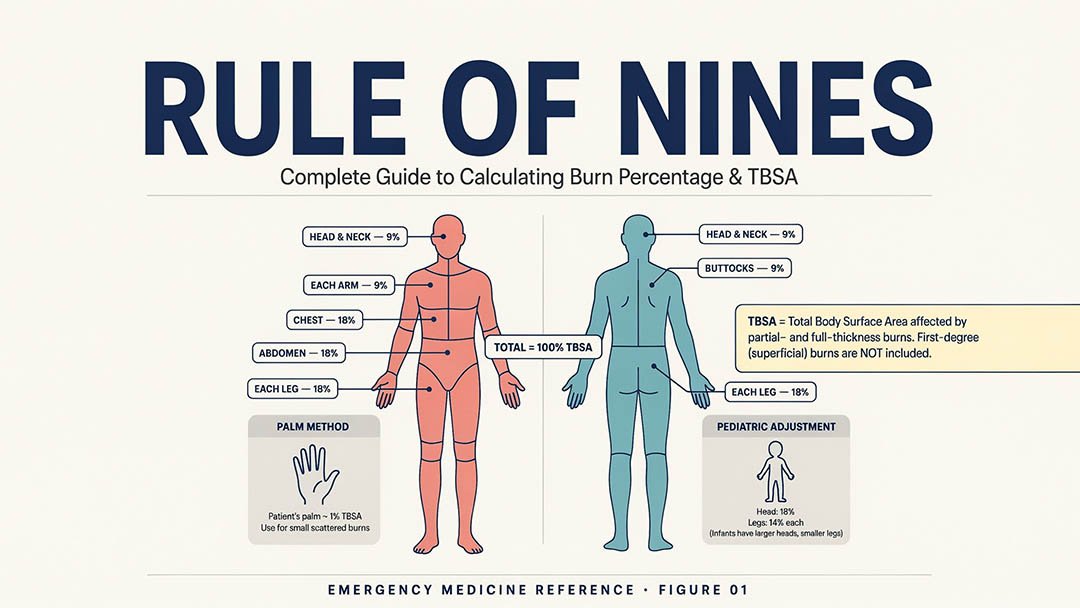
The standard rule of nines chart splits the adult body into eleven areas, each representing 9% of the total, with the groin representing the final 1% to reach 100%.
- Adult Rule of Nines Breakdown
Head and neck – 9% ”
Each arm (front and back combined) 9% per arm (total of 18% for both arms)
Front torso (chest) – 18%
Back (posterior torso) – 18%
Each leg (front and rear) 18% each leg (total for both 36%)
Groin/genital region – 1%
Now add these together 9 + 18 + 18 + 18 + 18 + 18 + 1 equals 100%.
Note that the torso is generally divided into front (18%) and back (18%) and that each leg is considered as 18% overall (9% for the front, 9% for the back). This is why the rule of nines is occasionally stated a little differently depending on the textbook – but the underlying maths always adds up to 100%.
How to Use the Chart in Practice
- Identify all areas of the body with burns.
- Match each burned area to its corresponding percentage on the chart.
- Add the percentages together for a total TBSA estimate.
- Only count second-degree (partial-thickness) and third-degree (full-thickness) burns — first-degree burns, which only affect the outer skin layer, are typically excluded from TBSA calculations.
For example, if a patient has burns covering their entire chest (18%) and one full arm (9%), the total TBSA would be 27%.
Rule of Nines for Burns in Children
The traditional adult chart has one big problem: it doesn’t work well for children. Babies and young children have bigger heads and smaller legs than adults, therefore utilising the adult rule of nines for burns on a child can lead to big miscalculations.
For paediatric patients, the percentages are changed in a modified version:
- Head and neck — 18% (almost double the adult value)
Each leg – 14% per leg (vs 18%)
Arms, chest, and back – about same dimensions as adults
This adjusted paediatric scale takes into consideration the fact that the head of a baby is a much bigger percentage of the total body surface area than an adult’s. This modified version is almost often used by paediatric burn clinicians or more accurate tools such as the Lund-Browder chart.
Rule of Nine vs. Other Burn Assessment Methods
While the rule of nine is popular for its speed, it’s not the only method used in clinical settings. Here’s how it compares:
Lund-Browder Chart
The Lund-Browder chart is considered more accurate, especially for children, because it accounts for age-related changes in body proportions across multiple age brackets (infant, child, adolescent, adult). It divides the body into smaller, more specific regions and is often used once a patient reaches a hospital setting where there’s time for a more detailed assessment.
Best for: Hospital and burn unit settings, pediatric patients, precise treatment planning.
Palmar Method (Rule of Palm)
This method uses the size of the patient’s own palm (including fingers) as a rough estimate — one palm equals approximately 1% of TBSA. It’s especially useful for scattered or patchy burns that don’t fit neatly into rule of nines sections.
Best for: Small, irregular, or scattered burns; quick field estimates.
Rule of Nines
Best for: Fast initial assessment in emergency and pre-hospital settings, adult patients, situations where speed matters more than pinpoint accuracy.
In real-world practice, many clinicians use a combination of these tools — the rule of nines for a fast first pass, followed by the Lund-Browder chart for a more refined calculation once the patient is stabilized.
Limitations of the Rule of Nines
No estimation technique is perfect and it is crucial to know where the rule of nines fails:
- It is less accurate for children. As shown above, it overestimates leg burns and underestimates head burns in children without adjustment.
Does not take obesity into consideration – the distribution of body fat can change surface area ratios, and the usual percentages may be less accurate for overweight or obese patients.
Not perfect for irregular or patchy burns. Palmar technique or Lund-Browder chart may be more reliable for these circumstances.
Does not include burn depth – TBSA percentage is an indication of how much of the body is burnt, not how bad the burns are. Sometimes a massive first degree burn is less harmful than a minor third degree burn.
Given these limitations, the rule of nines is best thought of as a fast triage tool rather than a conclusive diagnostic measurement.
Why This Matters for Everyday Understanding
You don’t have to be a medical professional to benefit from knowing the rule of nines. Parents, carers, first responders and anyone interested in first aid can apply a basic understanding of this concept to better understand burn severity when reading medical information, discussing treatment options with doctors or simply making sense of news and educational material about burn injuries.
That stated, however, the actual examination and treatment of burns should always be left to skilled medical personnel. If you or someone else has a serious burn, getting medical assistance right once will be much more vital than trying to figure out the TBSA yourself.
Frequently Asked Questions
1. What is the Rule of Nines used for?
The Rule of Nines can be used to assess the percentage of total body surface area that has been burnt to immediately guide emergency treatment decisions including fluid resuscitation and whether a patient needs specialised burn care.
2. How accurate is the Rule of Nines?
It’s pretty good for adults in emergency scenarios, although it’s more of an approximation than a precise measurement. More sophisticated tools like the Lund-Browder chart are utilised for more precision ( especially in toddlers ) .
3. What is Difference between Rule of Nines and Rule of 9s ?
No difference. “Rule of Nines” and “Rule of 9s” are two names for the same approach. It’s only a stylistic variation of writing the word.
4. Is the Rule of Nines for children?
Not in its grown-up shape. The body proportions of a child are very different from an adult therefore a modified version is needed to deal with the larger head in relation to the body, and the shorter legs.
5. How much of the body does each arm cover?
The traditional adult Rule of Nines states that each arm is 9% of total body surface area.
6. Why is the head 9% of the body in adults, but 18% of the body in infants?
Infants and young children have larger heads relative to their overall body size than adults, hence the paediatric version of the chart is adjusted for this anatomic difference.
7. Does the Rule of Nines still exist in hospitals today?
Yes. Due to its quickness and simplicity, it remains a staple first-line evaluation tool in emergency departments and pre-hospital care, with more thorough charts such as Lund-Browder used to guide ongoing treatment planning.
Conclusion.
The Rule of Nines has been the bedrock of burn evaluation for more than 70 years, providing a practical balance between speed and reliability. It divides the body into portions of around 9% each, providing medical personnel with a quick method to determine burn percentage and to make vital early treatment decisions. Although it has limits, particularly for minors with irregular burns, understanding this rule of nines chart provides essential insight into how burn severity is judged and why accurate TBSA calculation counts so much in emergency medicine. This information is for educational purposes only for those coping with a real burn injury and not to be a substitute for quick expert medical care.