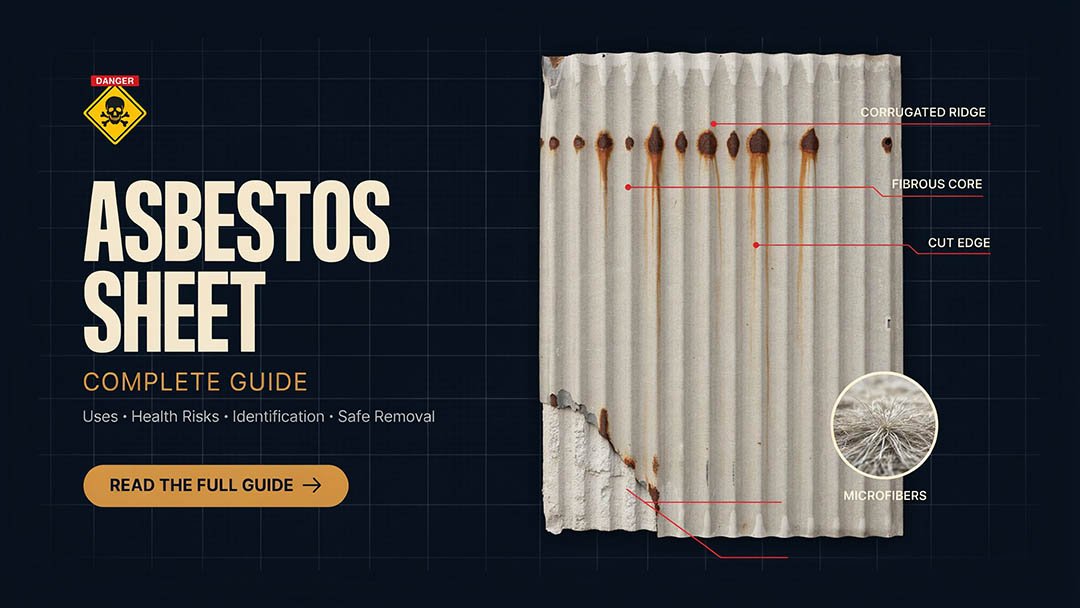
In many nations, the roofs of houses, godowns, farm sheds and factories still have asbestos sheeting. Some are 40 years old and still look good . This is precisely why people ignore them.
In this article we’re going to cover what an asbestos sheet is, where it was used and what the true health hazards are, how to detect it and how to dispose with it safely. It also covers the most common questions purchasers ask: cost, ceiling sheets and finding suppliers.
What Is an Asbestos Sheet?
An asbestos sheet is a building material traditionally manufactured by combining cement with asbestos fibers to create a durable, rigid sheet. It is also known as asbestos cement (AC) sheet and in some markets as a fibre cement or cement roofing sheet.
Quick definition:
- Composition: Portland cement, water and asbestos fibres, normally about 10 to 15% by weight.
Common shapes: Corrugated roof sheets, flat sheets, ceiling boards, wall cladding and water tanks
Main fibre used Chrysotile (white asbestos) in most current asbestos cement products; occasionally amosite or crocidolite in older goods
Why it caught on: It was cheap, fireproof, waterproof and durable.
The fibres gave the cement tensile strength, like steel rods in concrete. That made the sheets light, robust and cheap, thus they expanded so widely over the 20th century.
Where Asbestos Sheets Were Commonly Used
There is a strong likelihood that if a structure was built in the 50’s to 90’s it will have some asbestos product in it. Common usages include:
- House, School, Warehouse and Cattle shed roofing
Partitions and walls
Asbestos in office, garage and ancient flat ceiling sheets
Chimney flues, rain downpipes, gutters
Building facades, industrial
Water tanks.
Not all products are the same. Asbestos cement sheets are regarded as being a lower risk material than sprayed insulation or asbestos insulating board because the fibres are bound in the hardened cement and do not release filaments as easily. Ceiling planks are generally of the second type, hence ceilings require special care.
Asbestos Sheet Health Risks: What the Evidence Says
The World Health Organization and the International Agency for Research on Cancer classified chrysotile, along with all other types of asbestos, as harmful to humans. The World Health Organization (WHO) states that there is no known safe level of exposure to asbestos fibers.
The threat is from airborne filaments. A decent sheet, if left alone, gives out relatively little. The potential health risk becomes greater when the material is:
- Cut, drilled or sanded.
Damaged in a demolition or storm.
Very worn, having a crumbling or mossy surface
Pressure washer or wire brush cleaned
Once inhaled, the tiny threads settle deep in the lungs and may cause:
- Asbestosis Scarring of lung tissue, which causes dyspnoea
Cancer of the lung
Mesothelioma: A rare, serious cancer that develops in the protective lining surrounding the lungs or, less commonly, the abdomen and other organs.Pleural thickness and pleural plaques Changes to the lining of the lung
These disorders take a long time to show up, often 20 to 40 years after exposure to the disease. Historically, workers cutting sheets on a regular basis and family members exposed to dust on work clothes have been at increased risk.
To summarise, not every sheet is a ticking time-bomb yet a broken or disturbed sheet requires care.
How to Identify an Asbestos Sheet
Asbestos cannot be reliably identified simply by its appearance; proper testing is required for confirmation. That is the most important point in this section. Still, some clues help you decide whether to get a test.
Signs a sheet may contain asbestos
- Age: Sheets installed before the 1990s are more likely to contain it, though some countries kept using it much later
- Appearance: Grey, corrugated or flat, with a dull cement texture
- Markings: Stamps or labels on the back showing the manufacturer or “AC” or “asbestos cement”
- Weight: Heavier and more brittle than metal sheets, and it snaps rather than bends
- Weathering: Moss, lichen and a rough, eroded surface after years outdoors
How to be sure
- Check paperwork. Building plans, purchase bills or contractor records may name the product.
- Look for manufacturer marks. Contact the maker with the batch details.
- Use an accredited laboratory. A qualified professional can collect a sample using appropriate safety procedures and have it analyzed in a laboratory using polarized light microscopy.
Do not scrape a sample yourself. Disturbing the sheet to prove it is asbestos defeats the purpose.
Understanding Asbestos Sheet Price
Most people searching for the price of asbestos sheet are looking at choices for roofing or renovating an old shed. Rather than quote numbers that are out of current within months, here is what actually drives the cost:
- Thickness and profile: Corrugated and flat sheets are priced differently with the thicker sheets being more expensive
Length and size of coverage: depending on the market, prices are per sheet, per square foot or per square metre
Quality & Brand: Well-established manufacturers may charge more than comparable unbranded sheets.
Local Taxes & Shipping: Additional taxes and delivery charges may increase the final price, particularly because the sheets are large, heavy, and need to be transported with care.
Region: Prices vary between cities and between cities and rural areas
Looking for ACC sheet pricing, know that many buyers in South Asia relate the brand ACC to cement roofing goods. Prices vary by dealer and area, so ask two or three local dealers for written quotations and compare like for like: same thickness, same length, same tax treatment.
You might also find the phrase aspara sheet being used in local market. It seems to be a generic or local name for cement roofing sheets and I could not attach it to a specific recognised producer. Whatever they name a sheet, get the seller to state the composition of the product in writing before you buy.
Before buying any cement roofing product, ask three direct questions: Does it contain asbestos? Is it legal to sell and install in your country? Does it have a standards certification? Many countries now restrict or prohibit asbestos cement, and installation may be unlawful.
Asbestos-Free Alternatives Worth Considering
When you build or replace a roof you have various choices that eliminate the problem altogether:
- Non-asbestos fibre cement sheets: Look and install like the old ones, using cellulose or synthetic fibres
Galvanised or coated metal sheets Lightweight, quick to install and readily available
Clay or concrete tiles: Heavy but durable and useful for heat
Polycarbonate or PVC sheeting: Good for outbuildings and skylights
Compare cost per year of service, not just the upfront price Cheaper sheet that needs to be changed or has health liability can be more expensive in the end
Asbestos Ceiling Sheets: Extra Care Needed
Asbestos ceiling sheets require special consideration because they are indoors, immediately above where people breathe. Typical situations are:
- Old residences and offices where ceilings are suspended
Utility Rooms, Garage, Ceilings
a textured or painted boards on buildings from 1960s until 1980s
The common suggestion is to leave an intact, painted and undisturbed ceiling alone and handle it. Don’t drill, screw, sand or scrape it to install lighting or fans. If water has damaged or caused the paper to crumble or flake, stop and call a competent specialist. Insulating board varieties can quickly lose fibres thus do not treat like a roof sheet.
Asbestos Sheet Near Me: How to Find Help Safely
People searching for asbestos sheet near me usually seek one of three things:
- Purchase sheets. Be certain the product is legal in your area and look for an asbestos-free substitute if you can.
To get a sheet checked out. You may use an accredited testing laboratory or an environmental consultant.
To have it taken away. Get a licensed or certified asbestos abatement contractor.
When requesting quotes from contractors, make sure they clearly include the following:
- Their licence or certification
Insurance Proof
A written method statement explaining how they will moisten, wrap and dispose of the item
Proof of destination of the garbage
You don’t want a contractor who says “we’ll just break it up and take it away”.
Safe Removal of Asbestos Sheets
Anything bigger than a small solid piece, call a licensed pro. Rules change from nation to country and in many countries removal exceeding a particular amount must be done by certified contractors as per law. The methods below explain how appropriate removal works so you can distinguish good technique and avoid risky shortcuts.
The basic safety principles
- Leave the sheet intact. Do not break or cut it; unscrew or unbolt it.
Keep moist. A light spraying of the surface with water and a little detergent helps cut down on dust.
Don’t use power tools. No Pressure Washers, Drills, Saws, Grinders.
Protect yourself properly. Fitted P3 or FFP3 respirator Disposable boilersuit with hood Gloves and boots – clean or trash
Lock down the area. Keep children, pets and bystanders away and shut windows nearby.
Garnish and label. Store them away from people until collection. Seal them in heavy-duty polythene and mark the sheets as asbestos waste.
Dispose of properly. Take garbage to a facility licensed to receive it. Never burn or bury or dump it.
Wipe thoroughly. Use wet wipes or a HEPA filtered vacuum, not a regular vacuum or dry sweeping.
Encapsulation as an alternative
If the roof is sound, sealing with an appropriate encapsulating coating may be safer and cheaper than removal. It locks in fibres and slows down deterioration. Not suitable for severely damaged sheets. Should be preceded by a professional examination.
- Things to avoid
Do not blow dust off old sheets
Don’t walk on brittle roofing without crawl boards. Falling through the roof is a different danger.
Don’t use sheets again for fencing, animal housing or garden projects.
Do not dispose of shattered parts in household garbage
Frequently Asked Questions
1. Is an asbestos sheet dangerous if it is undamaged?
An intact, unopened sheet will give relatively little fibre. The risk is high when it is fractured, chopped, drilled or poorly worn. The usual approach is to leave it alone and examine it often.
2. How do I identify an asbestos sheet roof?
You can’t tell by eye for sure. Age, grey corrugated look and manufacturer insignia are clues but only scientific testing can confirm it.
3. How long does asbestos sheeting last?
Asbestos cement roofs usually had a life expectancy of 30 to 50 years. The actual lifespan will depend on climate, pollutants and upkeep. Many sheets are now over their specified service life and are becoming fragile.
4. How much is the asbestos sheet?
Regional demand Brand Local taxes Shipping Thickness Size. Get formal quotes, and make sure that the product is legal to install in your area.
5. Can I get rid of the asbestos sheets myself?
In some areas owners can legally handle small amounts on private property but most countries require licensed contractors. The foregoing safety procedures are stringent, and they are allowed. If you are uncertain about the material or how it should be handled, consult a qualified professional.
6. Is asbestos on the roof safer than on the ceiling?
Not necessarily. Cement-based ceiling sheets act like roofing sheets but older insulating boards are softer and shed fibres more readily. • Watch out for ceilings that may have asbestos.
7. What may I use instead of asbestos sheets?
Non asbestos fibre cement, coated metal sheets, tiles or polycarbonate panels according to your budget, climate and type of building.
Conclusion:
Asbestos sheet is a building product made of cement and asbestos fibre that previously covered millions of roofs and ceilings. It was popular for a reason, but today we know the fibres represent a major long-term health concern when discharged into the air.
The lessons learned are basic. Don’t glance at a sheet and say this is safe or not safe. If in doubt, leave the undamaged sheets as they are. Do not cut, drill or clean them. If you need to replace or remove them, hire licensed professionals and use an asbestos-free product for the replacement process. When comparing estimates or pricing for asbestos sheets from suppliers realise that the lowest option is not always the cheapest option when you factor in health and disposal