Introduction
Frankincense is a fragrant spice that is… If you’re familiar with its distinctive aroma from incense, essential oils, candles, or rituals, you might be curious about its extraordinary character. Frankincense has a strong aroma and a long history of cultural and historical worth.
There’s no way to describe the aroma adequately. A variety of frankincense aromas are possible, depending on the kind, preparation, and use: woody, resinous, warm, earthy, faintly citrussy, peppery, or even mildly sweet. The smokiness intensifies as it’s torched. The aroma of frankincense essential oil tends to be more subtle and less overpowering.
“Think of it as a layered fragrance that reveals different aromas over time rather than a scent with just one defining note. First impression is fresh and a bit green then a warm resinous character with a slight earthiness.
If this old aromatic chemical has such a unique aroma, what is it? What to expect when you find it, how to use it, the various sorts, and its scent will all be covered.
Frankincense: How Does It Smell?
The aroma of frankincense is earthy, woodsy, resinous, and warm, with hints of sweetness. However, the exact aroma can differ significantly
Some people detect a clear, almost lemony freshness when sniffing some types. Others pick up pine, dry wood, spice, herbs or a hint of sweetness. When heated the scent of the resin is more nuanced and deeper.
One reason the scent is hard to describe: frankincense develops as you smell it. The first smell can be light and fresh, but after a short while more woody and balsamic overtones can appear.
Common scent descriptions include:
- Woody
- Earthy
- Resinous
- Warm
- Slightly sweet
- Fresh
- Citrusy
- Pine-like
- Spicy
- Balsamic
- Smoky when burned
Imagine yourself going through a dry woodland after a light shower and someone close is burning some scented wood. That mix of earthiness, greenness, warmth and smoke offers you a taste of why frankincense has such a distinctive reputation.
It’s not normally a very sweet scent. Its appeal, in contrast, is typically its between freshness and profundity.
What is the scent of frankincense?
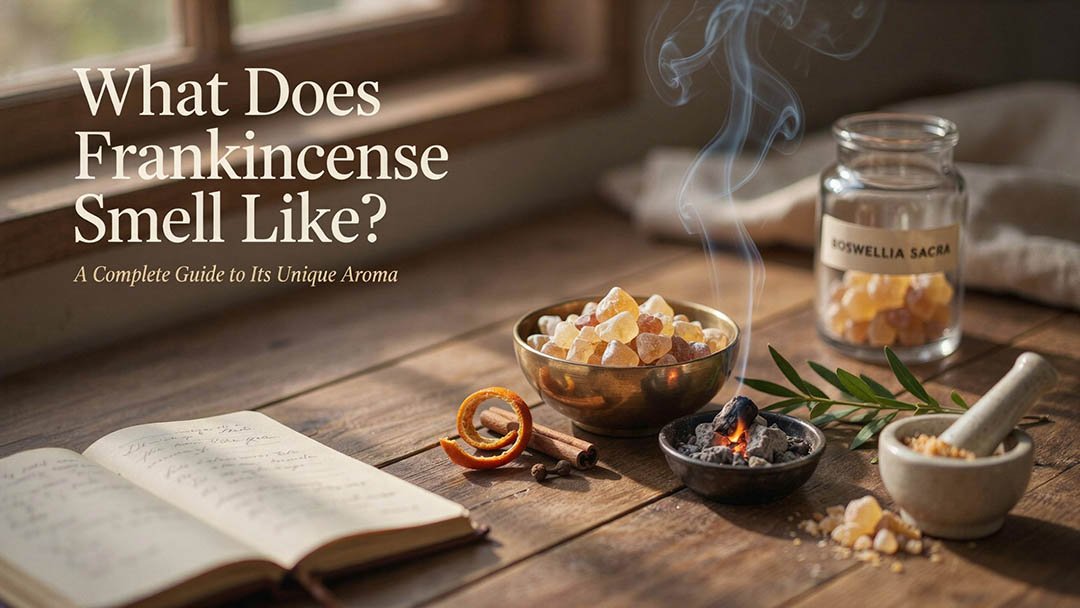
Frankincense is obtained from the fragrant resin of tree species of the genus Boswellia. They are mostly found in the dry parts of Africa and the Arabian Peninsula.
The resin is harvested by making precise incisions in the bark of the tree. A creamy fluid appears and progressively becomes hard in little fragments or rips . These hardened bits are called frankincense resin.
The smell is due to aromatic chemicals naturally present in the resin. Each of the different Boswellia species has varied ratios and amounts of these substances which goes some way to explaining why one variety may smell brighter and another darker, sweeter or woodier.
The tree, climate, soil, harvesting and processing procedure might influence the aroma of the final product.
It is like how grapes from different areas can make wines that taste very different. The base component might be the same general type, but growing conditions and processing can make for a vastly distinct experience.
So to argue that all frankincense smells exactly the same would be false
Main Fragrance Notes of Frankincense
To understand the aroma of frankincense, it helps to break its fragrance down into the individual notes that give it such a distinctive character
Woody Notes Notes
Frankincense has a reputation for having a dry, woodsy aroma. Some people find that it smells like freshly cut wood, dried timber or fragrant tree bark.
One reason frankincense is so versatile is because of its woodsy flavour, which gives aromas depth and is perfect for use in colognes and other scented products.
Rustic Melodies
Also, frankincense could have an earthy aroma. It may evoke images of parched ground, tree roots, or scenic landscapes.
When the resin is heated or burnt, its earthy quality will likely become more apparent.
Balsamic and Resinous Undertones
In its natural state, resin is warm, silky, and has a somewhat sticky aroma. Balsamic is another name for this.
When used in aromatherapy, balsamic vinegar does not always imply that the scent is reminiscent of a particular cuisine. As an alternative, it is often used to describe the silky, warm, rich texture of natural resins.
Fresh & Citrus Notes
Some types have an unexpectedly fresh quality: Hints of lemon peel, citrus, pine needles or green herbs may be noticeable.
Frankincense, with all its heavy historical associations, can take on a lighter air when exposed to this air of freshness.
Hints of spice
Slightly spicy or peppery undertones can be detected in some varieties of frankincense. These notes can provide complexity, although they are typically not as pronounced as the woody or resinous ones.
A Hint of Smoke
Smoke from the burning of frankincense resin is a component of the aroma. The aroma could intensify, darken, and warm.
For this and other reasons, the aroma of burning frankincense may change greatly from that of an unopened resin package.
How Frankincense Smells When Burned
Burning frankincense creates a richer, smokier aroma that differs noticeably from the scent of the unheated resin.
When burnt over charcoal or some other appropriate means of incense-burning, the resin releases fragrant molecules into the air. The outcome can be warm, smokey, woody, sweet, earthy, resinous.
The smoke might give a somewhat burnt quality not necessarily present in the unheated material.
The aroma may unfold in stages. First you can notice smoke and a pungent resinous fragrance. As the material continues to warm, deeper woody and balsamic notes can develop.
Others call the ensuing ambiance “rich and meditative.” This can be quite overpowering for some, especially if a lot of resin is burnt in a small room.
The quantity you use can greatly influence the overall intensity and character of the fragrance. Just one small piece can give out a mild smell. A couple of pieces can soon fill the air with a much more smoky atmosphere.
Ventilation is also important. And even if you like the smell, burning incense indoors can add to airborne particles and smoke, so it makes sense to use it sparingly in a well-ventilated environment.
How to Experience the Fragrance Safely
You don’t need to use a lot of fragrant materials to enjoy them.
When burning frankincense, use a suitable heat-resistant burner and follow the directions on the product. Also continue to keep burning material away from drapes, paper, furniture, children and pets.
When burning incense, good ventilation is vital.
If you are using an essential oil, use it as the manufacturer directs. Don’t assume that if a product is natural it is safe for everyone in all situations. Concentrated oils might irritate the skin and may not be suitable for all.
And you don’t even have to burn anything to enjoy the aroma. A well-made perfume, diffuser product or scented preparation might offer a milder approach to experience the fragrance.
If you are sensitive to strong smells, begin with a modest amount and see how you respond.
The idea is to enjoy the aroma, not to fill the room with it.
Frequently Asked Questions
1. What does frankincense smell like in its natural state?
Natural frankincense usually has a woody, resinous, earthy perfume with hints of citrus, pine, spice or a little sweetness. The particular smell varies based on the species, origin, quality, and age of the resin.
2. Is frankincense sweet smelling?
Frankincense is often faintly sweet but not generally syrupy or dessert-like. That sweetness tends to mix with woody, resinous, earthy and fresh notes.
3. Does frankincense smell like pine?
Some frankincense kinds may have pine-like or fresh green notes, but the aroma is generally more nuanced than that of pine. Notes of resin, wood, balm and citrus may also be evident.
4. Does frankincense smell like incense?
Frankincense is a sort of aromatic resin which may be used as incense. When burnt it emits a smoky, warm, resinous smell. But commercial incense can have numerous different elements, so not all incense products smell like pure frankincense.
5. Is frankincense a strong smell?
It can be. Raw resin has a relatively mild aroma, and burning it will produce a much stronger fragrance. Additionally, essential oil may be really potent, so a little bit can go a long way in terms of aroma.
Summary
So what does frankincense smell like? The most basic explanation would be that it has a warm, woody, resinous, earthy smell that can have a fresh, citrus, pine-like, spicy and slightly sweet smell.
Its character varies according to species, provenance, quality, preparation and mode of application. The experience between raw resin, essential oil and burning frankincense can be quite different.
Perhaps such complexity is the very reason this aromatic element has been so fascinating for thousands of years. Frankincense unveils itself in layers, unfolding slowly rather than smelling like a single, uncomplicated element.
Once you get to know it, it’s easy to identify whether you come across it in incense, perfume, an essential oil, or in conventional settings, due to its unique combination of freshness, warmth, woodiness and resinous depth.