You feel something lumpy on your face. It is red, sensitive and it appeared out of nowhere. Pimple or Something More Serious? That question gets millions of people Googling every month and the answer effects how you should approach it.
Often confused with a pimple or cyst as they might look very similar at first. But they grow differently and last various time and react to different care. This tutorial will tell you what each of these things is, what’s inside a cyst pimple, how to tell a cyst from a pimple, and what to do next.
This article is for general education. It is not a substitute for a diagnosis from a doctor or dermatologist.
What Is a Pimple?
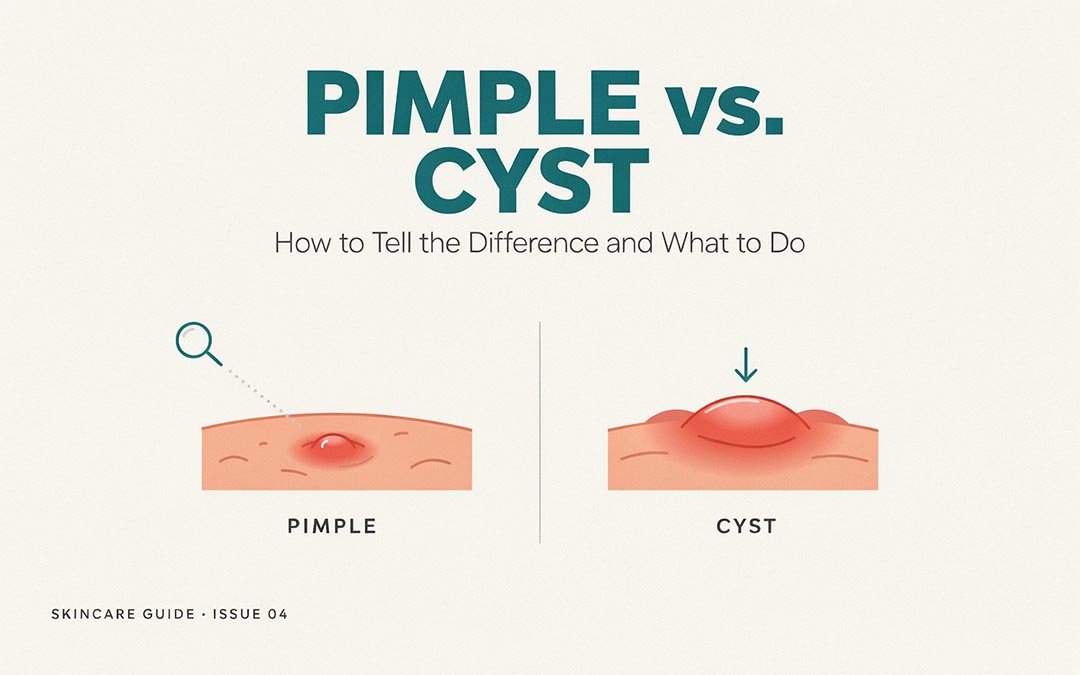
A pimple is a small, inflammatory bump that forms when a pore becomes blocked. Inside the oil (sebum) on the hair follicle, dead skin and sometimes pathogens gather. If the blockage is close to the surface, you will acquire one of the usual types of lesion:
- Whitehead: a clog of white or flesh-colored matter in a pore of the skin.
Blackhead: a pore that contains substance that darkens when exposed to air. - Papule: A tiny, red lump that is painful, without a head.Pustule: a red bump with a white or yellow center of pus that you can see.
Most pimples are surface deep. Usually they settle down in a few days to a week or two, especially with basic care
What Is a Cyst?
The phrase cyst gets tossed about a lot. In medicine a true cyst is a closed sac with a definite membrane lining the inside and containing fluid, semi-solid material or gas. Epidermoid cyst is the commonest true cyst of the skin. It arises when cells of the skin surface get trapped under the skin and continue to produce keratin, the protein that makes up skin, hair and nails.
Here is when it gets complicated. When individuals refer to “cystic acne” or a “cyst pimple,” they are generally talking about a deep, severe form of acne lesion. This form of acne is sometimes dubbed cystic acne by dermatologists or nodules. In fact, these acne lesions do not have a real cyst wall. But that term remained and it’s what people mostly seek for.
So the term ‘pimple cyst’ might refer to two separate things:
- Cystic Acne Deep Inflamed Acne Lesion
A real skin cyst (ie an epidermoid cyst) which is not acne at all.
It makes a difference the one you get. The treatments are different.
What Is Inside a Cyst Pimple?
People often enquire what a cyst pimple contains, and it varies depending on the type.
Within a lesion of cystic acne:
- Overabundance of oil (sebum)
Dead skin cell
Clogged pores are a breeding ground for Cutibacterium acnes, bacteria that exist on the skin
Pus is a collection of white blood cells and debris from the immunological response of the body
Deep beneath the skin the wall of the follicle bursts. This is why these lesions are so sore and inflamed as the body responds with a lot of inflammation.
In a real epidermoid cyst:
- Keratin – a thick, silky, off-white substance
A distinct sac wall And continues on makin’ more of it
Sometimes a terrible smell if the contents leak or become contaminated
That’s why a real cyst can come back after squeezing. Unless a doctor takes it out. The wall stays and replenishes.
Cyst vs Pimple: Key Differences
Here is a quick comparison to help you sort out cyst vs pimple.
| Feature | Typical pimple | Cystic acne lesion | True skin cyst |
|---|---|---|---|
| Depth | Surface or shallow | Deep under the skin | Under the skin |
| Size | Small (a few mm) | Often larger than a pea | Can range from pea to larger |
| Pain | Mild tenderness | Often painful | Usually painless unless inflamed |
| Head | May have a visible head | Usually no head | May have a small central pore |
| Duration | Days to 2 weeks | Weeks to months | Persists until treated |
| Scarring risk | Low | High | Low to moderate |
| Cause | Clogged pore | Deep follicle rupture, inflammation | Trapped skin cells in a sac |
Quick signs it’s a pimple
- Appears quickly and often has a visible head
- Small and mildly tender
- Heals within about one to two weeks
Quick signs it’s cystic acne
- Feels like a hard, painful lump deep under the skin
- Red or purple, with no clear head
- Lingers for weeks and keeps returning in the same area
- Often appears along the jawline, chin, and lower face
Quick signs it’s a true cyst
- A smooth, round, slow-growing lump
- Often found on the face, neck, back, or scalp
- Sometimes has a tiny dark dot at the center
- Usually painless unless it becomes infected
What Causes a Pimple/Cyst?
A mixture of a few things:
- Hormones. . Androgens increase oil output. Breakouts can be caused by changes around adolescence, menstrual cycles, pregnancy and disorders such as PCOS.
Genetics. If your parents had acne, chances are you will too.
Bacteria and Inflammation. The blocked follicle is colonised by C. acnes and the immune response is initiated.
Some stuff. It can also be caused by heavy use of cosmetics or hair products that clog the pores.
Some medicines. Acne can be worse by corticosteroids, lithium and some anticonvulsants.
Stress and sleep. Stress doesn’t directly cause acne, but studies show it can make existing acne worse.
True cysts can be caused by blocked follicles, mild skin damage, and even inherited abnormalities. Sometimes no cause is found.
What to Do About a Pimple
A simple procedure will handle most common pimples.
- Wash gently twice a day with a mild cleanser. Scrubbing breaks down the skin barrier and hence increases the redness.
Use a non-prescription OTC. Benzoyl peroxide (2.5% to 5%) or salicylic acid or adapalene may be helpful. Take it easy so you don’t dry out.
Use a non-comedogenic moisturiser and sunscreen. It has poor healing of dry irritated skin.
Let it go. Picking pushes bacteria deeper and encourages blemishes and scarring.
Try a spot treatment of benzoyl peroxide or a hydrocolloid patch to cure a surface pimple without picking at it.
What to Do About a Pimple Cyst (Cystic Acne)
Deep lesions rarely clear with drugstore products alone. Here is what helps and what doesn’t.
Safe things you can do at home
- Apply a warm compress many times a day for 10 minutes. It can remove the pain and maybe help the lesion to surface on its own.
Keep a soft routine. Skip harsh scrubbing and alcohol-based toners.
Wash your phone and pillowcases often and don’t touch your face.
For short periods, apply an ice pack in a cloth to help minimise swelling and pain.
What not to do
- Don’t squeeze or pop it. There is no opening to drain a deep lesion. Squeeze might push the substance deeper, spread infection and produce scars.
Don’t go spearing it yourself. This is a task for a qualified physician.
Don’t use toothpaste, undiluted essential oils or other tricks. They can cause skin irritation, burns, or allergic responses.
Treatments a dermatologist may recommend
- Topical retinoids (like tretinoin or adapalene) can prevent blocked pores
Topical or oral antibiotics, often coupled with benzoyl peroxide to limit resistance.
For certain women, a hormonal therapy, such as combination oral contraceptives or spironolactone.
Isotretinoin (strong oral medicine for severe acne, scarring acne or resistant acne). Close medical care and rigorous pregnancy precautions are needed.
Corticosteroid injection directly into a painful lesion to rapidly reduce swelling.
Professional incision and draining of selected particularly big or fluctuant lesions.
Early treatment matters. The sooner deep acne is controlled, the lower the risk of permanent scars.
What to Do About a True Skin Cyst
An epidermoid cyst is a benign growth. If it does not disturb you it may not require any treatment. Check it the first time you notice it because other lumps can look identical.
Doctors may:
- If it is small and painless, watch it.
If it is inflamed, inject it with a steroid.
It can be removed with a small treatment that takes out the entire sac, reducing the possibility of it happening again.
Drain or provide antibiotics if infected.
Don’t try to cut or squeeze it at home. Infection and scarring are real risks.
When to See a Doctor
Book an appointment if:
- A bump lasts longer than a few weeks without improving
- Lesions are painful, widespread, or keep coming back
- You notice scarring or dark marks forming
- A lump grows quickly, bleeds, or changes in appearance
- The area becomes very red, hot, swollen, or drains foul-smelling fluid
- You have a fever along with a skin lump
- Acne is affecting your mood or confidence
A dermatologist can confirm what you are dealing with and build a plan that fits your skin.
Can You Prevent a Pimple/Cyst?
Prevention is not a sure thing, but these habits reduce your risk:
- Keep your skincare routine constant and mild
Select non-comedogenic labelled items
Spritz your face after a sweat
Change bedding often and wash makeup brushes
Stop Picking Your Skin
Control Stress and Get Enough Sleep
If you have a family history of severe acne, see a doctor early.
Frequently Asked Questions
Is a cyst the same as a pimple?
Naw. A pimple is a blocked, shallow pore. A cyst is a real closed sac under the skin or a deep inflamed acne lesion (cystic acne). They are different in depth, pain, length and treatment.”
What does a cyst pimple contain?
Cystic acne lesions are packed with oil, dead skin cells, bacteria and pus. A true epidermoid cyst contains a sac wall and keratin, a thick cheese like substance.
How long does cystic acne last?
Left untreated, a cystic acne lesion can linger for weeks or even months. A common pimple usually takes around 1 or 2 weeks to heal.
Can You Pop a Cyst Pimple?
No. It is not safe to drain deep lesions at home. Popping distributes the infection, increases the inflammation and creates scarring. If you want it treated, go to a dermatologist.
How do you get rid of cystic acne fast?
There are no easy answers. The pain can be eased by warm compresses and lots of love. A dermatologist can give you an injection of a steroid and it will typically reduce the swelling in a couple of days.
Do cysts disappear on their own?
Cystic acne lesions normally resolve with time but might result in scarring. True epidermoid cysts normally do not go away unless excised, however some may diminish or drain on their own.
When Are Cystic Pimples a Sign of a Health Problem?
Sometimes. Frequent deep breakouts might be a sign of a hormonal imbalance like PCOS, especially if you have irregular periods or increased hair growth. Help a medical evaluation.
Bottom line
A pimple/cyst can look identical from the outside, but the differences are enormous. A pimple is a transient, superficial clog of a pore. Cystic acne lesions are a deep, intense and often long-lasting and scar-forming inflammation. A true cyst is a sac under the skin filled with keratin and usually needs to be treated professionally.
Don’t squeeze deep lesions, be gentle with your skincare and see a dermatologist if a lump is uncomfortable, persistent or recurrent. Most people may clear up their skin and avoid chronic scars with the right treatment.