A broken bone is never a small event. But a comminuted fracture is a different level of serious. Instead of one clean crack, the bone shatters into three or more pieces. That changes how doctors treat it, how long it takes to heal, and what you should expect along the way.
This guide explains what a comminuted fracture is, why it happens, how to spot it, and how it is treated. You will also find a realistic look at recovery, plus answers to the questions people ask most.
Note: This article is for general education. It is not a substitute for advice from a qualified doctor who has examined you.
What Is a Comminuted Fracture?
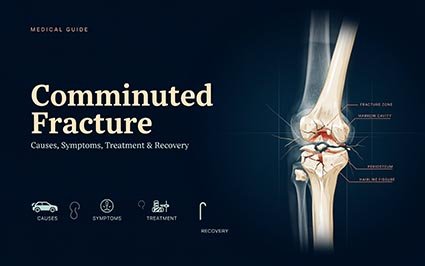
A comminuted fracture is a break in which the bone splinters or crumbles into three or more fragments. The word “comminuted” comes from a Latin root meaning “to break into small pieces.”
Here is the quick version:
- Definition: A bone break that produces three or more separate pieces.
- Usual cause: High-energy force, such as a car crash or a fall from height.
- Common sites: Thigh bone (femur), shin bone (tibia), upper arm (humerus), wrist, ankle, and skull.
- Typical treatment: Often surgery, using plates, screws, rods, or external frames.
- Healing time: Usually several months, sometimes longer.
Because the bone is in many fragments, the area around it is often badly damaged too. Muscles, blood vessels, nerves, and skin can all be injured. That is why doctors treat these breaks with extra care.
What Does Fracture Mean?
If you are wondering what does fracture mean, the answer is simple. A fracture occurs when a bone develops a crack or breaks partially or completely. It can be a hairline crack that barely shows on an X-ray, or a complete break that leaves the bone in several parts.
People often use “break,” “crack,” and “fracture” as if they were different. Medically, they are the same thing. Doctors just prefer the word fracture because it can be described more precisely.
Types of Bone Fractures
Fractures are classified according to the pattern of the break and whether the injury causes an opening in the skin. Knowing the main types of bone fractures helps you see where a comminuted break sits on the spectrum.
Common fracture types
- Simple (closed) fracture: The bone breaks, but the skin stays intact.
- Open (compound) fracture: The bone breaks through the skin, or a deep wound reaches the bone. Infection risk is higher.
- A transverse fracture occurs when the bone breaks along a line that runs horizontally across it.
- An oblique fracture occurs when the bone breaks diagonally, creating an angled fracture line.
- Spiral fracture: The break twists around the bone, often from a rotating force.
- Greenstick fracture: The bone bends and partly cracks. Mostly seen in children.
- Stress fracture: A tiny crack from repeated overuse, common in runners and athletes.
- Compression fracture: The bone collapses, often in the spine.
- A comminuted fracture occurs when a bone shatters into three or more separate fragments.
Displaced vs. nondisplaced
Doctors also describe whether the broken ends have moved out of place.
A displaced fracture happens when the broken pieces of bone move from their original position and become misaligned. In a nondisplaced fracture, the bone cracks but stays in its normal position.
What Is a Nondisplaced Fracture?
People searching what is a nondisplaced fracture usually want a plain answer. It is a break in which the bone is cracked or broken, but the pieces remain properly aligned.
These fractures are often treated without surgery. A cast, splint, or walking boot is usually enough to hold the bone steady while it heals.
A comminuted fracture is typically the opposite situation. Many fragments, often shifted from their normal place, make the injury less stable. This is why surgical intervention is often needed to restore proper bone alignment and stability.
Comminuted vs. other fractures at a glance
| Feature | Nondisplaced fracture | Simple (single-line) fracture | Comminuted fracture |
|---|---|---|---|
| Number of pieces | Usually two, aligned | Two | Three or more |
| Bone alignment | Stays in place | May shift | Often shifted |
| Force involved | Low to moderate | Moderate | Usually high |
| Common treatment | Cast or splint | Cast or surgery | Often surgery |
| Typical healing | Shorter | Moderate | Longer |
Causes of a Comminuted Fracture
A healthy bone is strong. It takes real force to shatter one. Most comminuted fractures come from high-impact events.
Common causes
- Car, motorcycle, or bicycle accidents. The sudden force can crush the bone.
- Falls from a height. Landing hard on the legs, wrists, or heels is a frequent cause.
- Sports injuries. Contact sports and extreme sports can produce severe breaks.
- Direct blows or crush injuries. Industrial accidents and heavy objects are examples.
- Gunshot or blast injuries. These often cause open, multi-fragment fractures.
Risk factors that make bones easier to shatter
Some people break bones with less force than expected. Osteoporosis is the biggest factor, especially in older adults. Other contributors include long-term steroid use, low calcium or vitamin D, smoking, certain cancers, and some inherited bone conditions.
In an older person with weak bones, even a fall from standing height can sometimes cause a comminuted break, particularly in the hip or wrist.
Symptoms of a Comminuted Fracture
The signs are usually obvious, but they can overlap with other injuries. Look for these:
- Sudden, severe pain that gets worse with movement
- Swelling and bruising around the injury
- A visibly bent, twisted, or out-of-shape limb
- Inability to move the area or put weight on it
- Tenderness when touched
- A grinding or crunching sensation
- Numbness or tingling below the injury
- In an open fracture, the broken bone may protrude through the skin or be exposed through an open wound
Swelling can be significant, because these injuries involve a lot of tissue damage.
When to seek emergency care
Go to the emergency room or call your local emergency number if:
- You see bone through the skin
- The limb looks deformed
- The area below the injury turns pale, blue, or cold
- You feel numbness or cannot move your fingers or toes
- The injury followed major trauma, such as a crash
Never attempt to realign or straighten an injured limb on your own, as this could worsen the damage. Keep it still, apply gentle pressure to any bleeding with a clean cloth, and wait for help.
How Doctors Diagnose a Comminuted Fracture
Diagnosis starts with a physical exam. The doctor checks the skin, circulation, nerve function, and range of motion.
Imaging confirms the break:
- X-rays show the break and the number of fragments.
- CT scans give a detailed 3D view, which is very helpful when planning surgery on complex breaks.
- MRI scans may be used to check ligaments, tendons, and other soft tissue.
The care team will also look for injuries elsewhere, since the force behind a comminuted fracture rarely affects only one spot.
Fracture Treatment for Comminuted Breaks
The goal of any fracture treatment is the same: put the bone back in proper position, hold it steady, and let it heal. With a shattered bone, that takes more planning.
Immediate care
First, doctors control pain and bleeding and protect the limb with a splint. If the fracture is open, antibiotics are started quickly to lower the infection risk. Tetanus protection is also checked.
Non-surgical treatment
Surgery is not always required. Some comminuted fractures, particularly those in smaller or less weight-bearing bones, can be treated with a cast or brace if the fragments are stable and well aligned. This is less common, though.
Surgical treatment
Most comminuted fractures need an operation. The surgeon chooses the method based on the bone, the location, and the condition of the skin and soft tissue.
- Open reduction and internal fixation (ORIF). The surgeon repositions the fragments and fixes them with metal plates and screws.
- Intramedullary nailing. A metal rod is placed inside the hollow center of a long bone, such as the femur or tibia.
- External fixation. Pins go into the bone and connect to a frame outside the body. It is often used when the skin is damaged or the patient is too unstable for a longer operation.
- Bone grafting. If fragments are missing or the bone is slow to heal, graft material may be added.
Sometimes treatment happens in stages. An external frame may be used first to stabilize the limb, followed by definitive internal fixation days later once swelling settles.
Pain management
Pain control usually combines prescribed medication, ice, elevation, and rest. Always follow your doctor’s instructions on medicines, especially stronger painkillers.
Recovery Time for a Comminuted Fracture
Recovery varies widely. Age, overall health, the bone involved, and how severe the damage was all matter. As a rough guide, many comminuted fractures take three to six months to heal, and some take longer.
Here’s a step-by-step overview of what the recovery process typically involves:
- First few weeks: Rest, protection, and swelling control. Putting weight on the injured limb may be restricted or prohibited until the bone has healed sufficiently.
- Weeks 6 to 12: The bone starts to knit. Follow-up X-rays check progress. Gentle movement may begin.
- Months 3 to 6: Strength and mobility work increases. Weight-bearing is slowly added if the surgeon approves.
- After 6 months: Many people return to normal activity, though full strength can take longer.
Your surgeon will set the timeline for your case. Rushing it can damage the repair.
The role of physical therapy
Physical therapy plays a vital role in restoring strength, flexibility, and mobility during the recovery process. After weeks in a cast or brace, muscles shrink and joints stiffen. A therapist guides you through safe exercises to restore range of motion, strength, balance, and walking pattern.
Possible Complications
Comminuted fractures carry more risk than simple breaks. Possible problems include:
- Infection, especially after open fractures or surgery
- Delayed union or nonunion, where the bone heals slowly or not at all
- Malunion occurs when a fractured bone heals in an abnormal or misaligned position
- Nerve or blood vessel damage
- Compartment syndrome, a dangerous pressure buildup in the muscles
- Post-traumatic arthritis, if a joint surface was damaged
- Hardware irritation, where plates or screws cause discomfort
Call your doctor quickly if you notice increasing pain, fever, redness, drainage from the wound, or new numbness.
Tips to Support Healing
You cannot speed up bone biology, but you can avoid slowing it down.
- Stop smoking. Nicotine reduces blood flow and is linked to slower healing.
- Eat well. A balanced diet rich in protein, calcium, and vitamin D can help provide the nutrients your body needs for bone repair and recovery.
- Attend every follow-up. Early problems are easier to fix.
- Follow weight-bearing rules. Do not test the leg early.
- Do your rehab. Skipping therapy often leads to stiffness and weakness.
- Manage other health conditions. Diabetes, for instance, can affect healing.
Frequently Asked Questions
What is a comminuted fracture in simple words?
It occurs when a bone fractures into at least three separate fragments. Instead of a single crack, the bone is shattered or crushed.
Is a comminuted fracture serious?
Yes. It usually involves strong force and more tissue damage than a simple break. With proper treatment, though, many people recover well.
Does a comminuted fracture always need surgery?
Not always, but often. Surgery is common when fragments are unstable or out of place. Stable cases in some bones can heal in a cast.
How Much Time Is Needed for a Comminuted Fracture to Heal?
Usually three to six months for the bone to heal, though full recovery of strength and movement can take longer. It depends on the bone, your age, and your health.
Is It Possible for a Comminuted Fracture to Heal Without Surgery?
Bone can heal naturally, but a shattered bone left untreated may heal crooked or not at all. Medical care is needed to align and stabilize it.
How Does a Comminuted Fracture Differ From a Compound Fracture?
These describe different things. “Comminuted” refers to the number of pieces. “Compound,” or open, refers to bone breaking through the skin. A fracture can be both.
Can You Regain Your Normal Walking Ability After a Comminuted Fracture?
Many patients recover substantial mobility and function, although outcomes depend on the fracture’s location and severity, the effectiveness of treatment, and commitment to rehabilitation. Your surgeon can give you a realistic outlook.
Conclusion
A comminuted fracture occurs when a bone shatters into three or more pieces, often as a result of severe trauma or a high-impact accident. It is more complex than a simple or nondisplaced fracture, and it often calls for surgery, careful follow-up, and structured rehabilitation.
The most important steps are to get medical help fast, follow your treatment plan closely, and stay committed to recovery. If you suspect a serious break, do not wait. Seek immediate medical attention by contacting a doctor or visiting the nearest emergency department.
Medical Disclaimer: This content is intended solely for general educational purposes and should not replace guidance, diagnosis, or treatment from a qualified healthcare professional. Always consult a qualified healthcare professional about your own condition