Looking in the mirror, you notice a pink, fleshy growth slowly spreading across the white part of your eye. Maybe it started as a small bump on the eyeball. Now it seems larger, and your eye feels gritty and irritated.
This is often pterygium, better known as surfer’s eye. Pterygium is a relatively common condition that is generally harmless, but it may cause noticeable changes in the eye’s appearance, lead to irritation or discomfort, and sometimes interfere with clear vision.
This guide explains what causes pterygium, how to recognize its symptoms, how it differs from other eye growths, and which treatments may help, including surgical removal when necessary.
What Is Pterygium (Surfer’s Eye)?
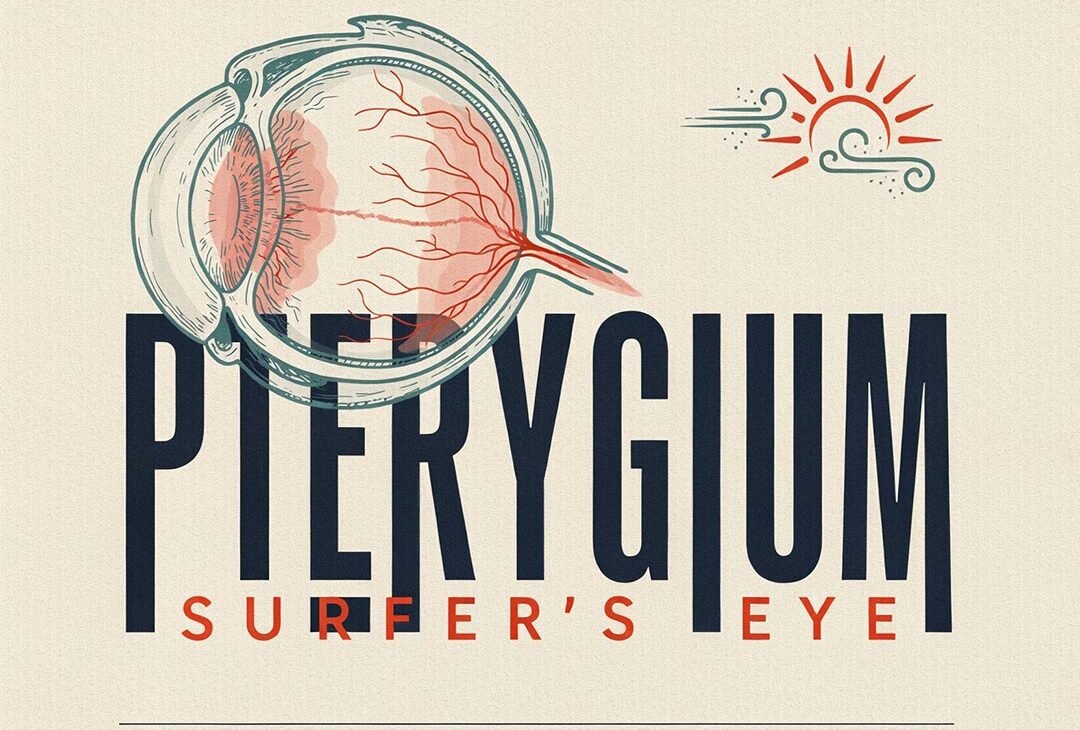
Pterygium (pronounced tuh-RIJ-ee-um) is a noncancerous, triangular growth of tissue that forms on the conjunctiva, the thin, transparent membrane covering the white of the eye. It typically begins near the nose and may gradually spread onto the cornea, the clear front surface of the eye that covers the iris and pupil.
It is called surfer’s eye because people who spend lots of time outdoors in sun, wind, and sand develop it more often. Individuals who work or spend significant time outdoors, such as farmers, fishers, construction workers, and skiers, may face a higher risk of developing pterygium. Despite being known as surfer’s eye, this condition is not limited to surfers and can affect anyone regularly exposed to UV radiation, wind, dust, and other environmental irritants.
Quick facts:
- It is a benign (non-cancerous) growth.
- It can affect one eye or both.
- It tends to grow slowly, sometimes over years.
- It is more common in sunny, dusty, or windy climates.
- Unlike a pterygium, a pinguecula is a smaller, raised patch of tissue on the conjunctiva that stays on the white of the eye and does not extend onto the cornea.
Pterygium Symptoms: What Does It Look Like and Feel Like?
Some people have no symptoms at all beyond a small visible patch. Others have ongoing irritation. Common signs include:
- A raised, pink or reddish, triangle-shaped growth on the white of the eye
- Intermittent eye redness that becomes more noticeable after exposure to sunlight or windy conditions
- A gritty or burning feeling, as if sand were in the eye
- Dryness or excess tearing
- Vision may become blurry if the tissue growth spreads onto the cornea and interferes with the eye’s ability to focus clearly.
- A sense of something being in the eye
- Discomfort wearing contact lenses
Because the growth is often visible, many people search for terms like “bump on eyeball” or “red bump on eyeball” when they first notice it.
When pterygium affects vision
A small pterygium usually does not change your sight. But if it grows across the cornea, it can distort its shape and cause astigmatism. In more severe cases, a pterygium can grow far enough to cover part of the pupil, potentially obstructing vision and reducing visual clarity. An ophthalmologist may recommend surgical removal if the growth threatens eyesight or causes significant visual problems.
Is It a Pterygium or Something Else? Common Eye Bumps Compared
An abnormal spot or bump on the eye may have causes other than pterygium, as several eye conditions can produce similar visible changes. Changes described as a “white bump on the eyeball,” a “yellow spot on the eye,” or a “bubble on the eyeball” may be signs of different eye conditions, each requiring proper evaluation. Here is how they compare.
| Condition | Typical appearance | Common features |
|---|---|---|
| Pterygium | Pink, fleshy, wedge-shaped, with blood vessels | Grows toward the cornea; irritation |
| Pinguecula | Yellowish or white raised patch, usually near the nose | Does not cross onto the cornea; common with age and sun exposure |
| Conjunctival cyst | Clear, fluid-filled, bubble-like bump | Often painless; may look like a bubble on the eyeball |
| Stye or chalazion | Red or tender lump on the eyelid | Affects the lid, not the eye surface |
| Episcleritis or scleritis | Red, sometimes raised area of inflammation | Scleritis can be painful and needs urgent care |
| Conjunctival growths or lesions | Variable color and shape | Need examination to rule out serious causes |
Yellow mark on eye
A yellowish spot on the white of the eye is commonly associated with a pinguecula, a small, raised growth on the conjunctiva. It is common in adults and linked to sun, wind, and aging. A pinguecula is generally harmless, but it may occasionally become swollen, red, or irritated. Although a pinguecula may sometimes be associated with the development of a pterygium, most pingueculae do not necessarily develop into this type of growth.
White bump or bubble on the eyeball
A tiny white spot or raised bump on the eye may be a pinguecula, a conjunctival cyst, or another type of surface growth. A clear bubble-like swelling is often a conjunctival cyst, which is typically harmless. An ophthalmologist can assess the eye and identify the nature of the growth through a detailed examination.
Red bump on eyeball
A red bump can come from inflammation, a blocked gland, an irritated pinguecula, or a pterygium with enlarged blood vessels. If the bump is painful, changes quickly, affects your vision, or follows an injury, see an eye doctor promptly.
Important: Do not diagnose yourself from photos online. Many eye growths look alike, and a few need medical attention.
What Causes Pterygium?
Although the precise cause of pterygium remains unclear, studies suggest that prolonged exposure to environmental factors—particularly ultraviolet (UV) radiation—plays a significant role in its development.
Main risk factors
- UV radiation. Prolonged exposure to sunlight, particularly its ultraviolet (UV) rays, is a major recognized risk factor for pterygium.
- Wind, dust, and sand. These environmental factors can dry out the eyes and irritate the delicate surface tissue.
- Living near the equator. Pterygium occurs more frequently in areas with abundant sunshine and higher levels of UV exposure.
- Outdoor work or hobbies. Water reflects UV light, which is why surfers, sailors, and anglers are affected often.
- Chronic dry eye. Ongoing surface irritation may contribute.
- Age and sex. It is most common in adults between roughly 20 and 50, and it has been reported more often in men, likely due to greater outdoor exposure.
- Family history. Genetics may play a role in some people.
Pterygium can affect people who have never visited the coast, especially those living or working in hot, arid, and dusty environments.
How Is Pterygium Diagnosed?
Diagnosis is usually simple. An ophthalmologist or optometrist can often identify a pterygium during a routine exam using a slit lamp, a microscope with a bright light that magnifies the front of the eye.
During your visit, the doctor may:
- Ask about symptoms, outdoor exposure, and eye history
- Examine the growth and determine the extent to which it has extended onto the cornea.
- Check your vision
- Perform corneal topography to evaluate whether the growth has altered the curvature or shape of the cornea
- Take photographs to track growth over time
If a lesion looks unusual, the doctor may recommend further testing to rule out other conditions.
Pterygium Treatment: Non-Surgical Options
A lot of mild pterygia never need more than regular check-ups and something to calm the irritation. The tissue rarely shrinks on its own, but in many people it holds steady for years.
Home care and conservative treatment
- Lubricating eye drops (artificial tears). These ease dryness and grittiness.
- Anti-inflammatory eye drops. A doctor may prescribe short courses of mild steroid or non-steroidal drops during flare-ups.
- UV-blocking sunglasses. Choose wraparound sunglasses labeled as blocking all UVA and UVB rays. They block sunlight from the sides as well as the front, which can help calm your eyes and may slow the growth.
- Wide-brimmed hats. These cut down overhead sun exposure.
- Avoiding smoke, dust, and wind where possible.
Over-the-counter “redness relief” drops may make the eye look whiter for a while, but they do not treat the growth. Try not to reach for these drops every day. Over time, your eyes can bounce back even redder, so it’s worth a quick word with your eye doctor first.
Pterygium Surgery: When Is It Needed?
Surgery is not necessary for everyone. Doctors generally consider it when:
- The tissue keeps creeping inward and is getting close to the middle of the cornea
- Vision is blurred or distorted
- The eye stays inflamed despite treatment
- Contact lens wear is no longer possible
- The person is bothered by the appearance
- Another eye procedure, such as cataract surgery, requires a stable surface
How pterygium removal works
Think of it as a same-day visit. Your eye is numbed, the surgeon does the work, and you head home to rest. In most cases it takes around 20 to 45 minutes. The surgeon removes the abnormal tissue from the eye surface.
Removal alone has a notable chance of regrowth. For that reason, most surgeons now use one of these techniques:
- Conjunctival autograft. Think of it as a same-day visit. Your eye is numbed, the surgeon does the work, and you head home to rest. This is widely regarded as the standard approach because it lowers recurrence rates.
- Amniotic membrane graft. A thin layer of donated tissue covers the treated area. Surgeons often choose it when the eye lacks enough healthy conjunctiva of its own.
- Tissue glue (fibrin adhesive) or sutures. Surgeons may use biological glue instead of stitches to secure the graft. Glue is often associated with less irritation and faster recovery, though technique varies.
- Adjunct medications. Some surgeons also apply a medication such as mitomycin C to the area during surgery to lower the chance that the growth returns. This choice is made case by case because of potential risks.
Recovery after pterygium surgery
Patients are usually discharged within hours, with the eye covered by a patch or a protective shield. Typical recovery includes:
- Redness, tearing, and mild discomfort for the first days
- Prescription anti-inflammatory and antibiotic drops for several weeks
- Gradual fading of redness over weeks to a few months
- Follow-up visits to check healing and watch for regrowth
Avoid rubbing the eye, swimming, and dusty environments until your surgeon says it is safe.
Possible risks
Like any surgery, pterygium removal carries some risk. These include recurrence, infection, persistent redness, dry eye, scarring, and, rarely, vision-threatening complications. Choosing an experienced eye surgeon and following aftercare instructions lowers these risks.
Can You Prevent Surfer’s Eye?
Complete prevention isn’t possible, but limiting UV, wind, and dust exposure reduces risk and may slow progression in people who already have a lesion.
- Wear sunglasses labeled as blocking 100% UV, ideally wraparound.
- Add a brimmed hat on bright days.
- Heading to the beach, a dusty job site, or a windy trail? Slip on wraparound glasses or goggles to keep grit and gusts off your eyes.
- Keep lubricating eye drops handy if your eyes tend to feel dry or gritty.
- Keep your sunglasses on even when the sky is overcast, because UV rays pass through clouds.
- Schedule regular eye exams, especially if you work or play outdoors.
When to See an Eye Doctor
Book an appointment if you notice:
- A new growth or bump on the eyeball that does not fade
- A growth that is getting bigger
- Blurry or changing vision
- Persistent redness, irritation, or discharge
- Pain or sensitivity to light
- Any eye change after an injury
Seek urgent care for sudden vision loss, severe pain, or a significant eye injury.
Frequently Asked Questions
Is pterygium dangerous?
Pterygium is not cancer and is usually not dangerous. However, corneal involvement can distort the eye’s surface and reduce visual acuity, so periodic monitoring by an eye care professional is advised.
Can pterygium go away on its own?
No. Once formed, a pterygium typically does not disappear without treatment. The catch is that a growing pterygium can creep onto the clear front of your eye and blur your vision. Regular check-ups let your doctor catch any change early.
What is the difference between a pterygium and a pinguecula?
A pinguecula is a small yellow or white bump on the white of the eye that never crosses onto the cornea. A pterygium is a fleshy, blood-vessel-rich growth that does spread over the cornea. In some people, a pinguecula eventually turns into a pterygium.
Is pterygium surgery painful?
The eye is numbed beforehand, so you should not feel pain during the procedure. Some scratchiness, tearing, and light sensitivity are common for a few days afterward and are usually manageable with prescribed drops and medication.
Can pterygium grow back after surgery?
Yes, recurrence is possible. Techniques such as conjunctival autografting have significantly reduced regrowth rates compared with older methods. Following aftercare and wearing UV protection can help.
Can I wear contact lenses with a pterygium?
Some people can, but irritation and poor lens fit are common as the growth enlarges. Talk to your eye doctor about whether contacts are still a good option for you.
Is a bump on the eyeball always a pterygium?
No. A bump, bubble, or yellow or white mark on the eye can be a pinguecula, cyst, inflammation, or other condition. An eye exam is the only reliable way to know.
Conclusion
Pterygium, or surfer’s eye, is a common, noncancerous growth linked mostly to long-term UV, wind, and dust exposure. It often begins as a small pink bump on the white of the eye and may stay mild for years. Lubricating drops and good sun protection are enough for many people.
When the growth threatens vision, causes ongoing irritation, or keeps spreading, surgery with a graft offers an effective solution with low recurrence in experienced hands.
If you notice a white bump, yellow mark, bubble, or red bump on your eyeball, do not guess. Have it checked. Early evaluation gives you more options, and protecting your eyes from the sun is the simplest step to take today.