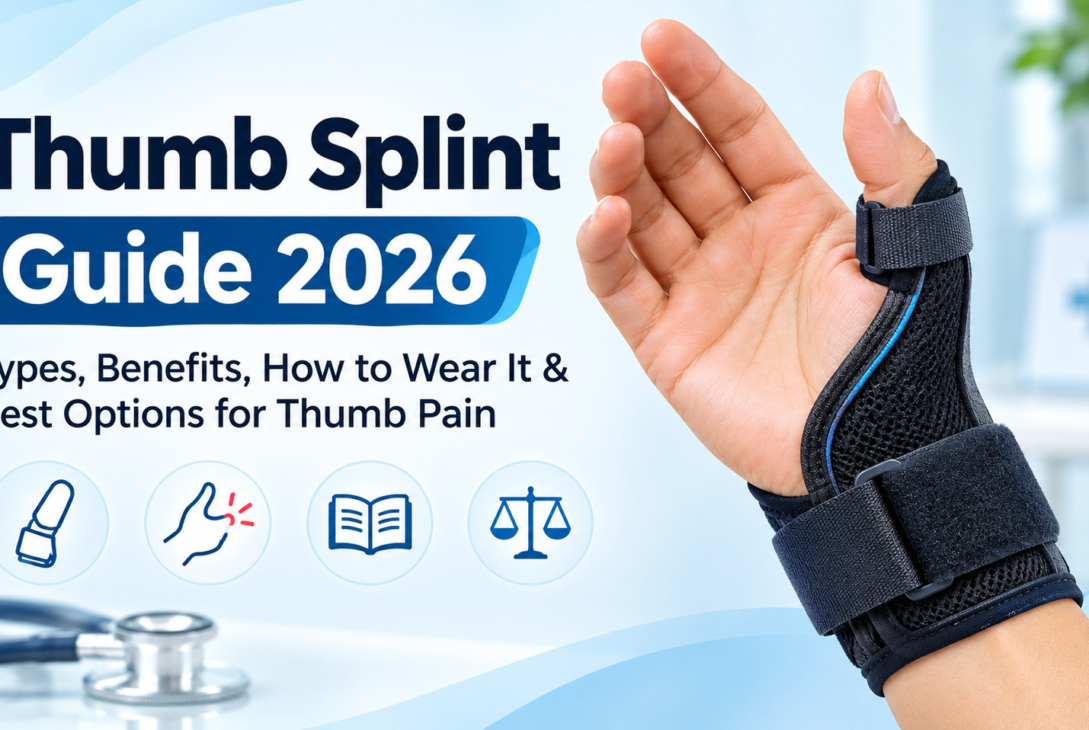
A thumb splint supports painful thumb joints and limits movements that aggravate symptoms. The right design depends on which joint or tendon needs support. A small brace around the thumb base serves a different purpose from a longer splint that also holds the wrist still.
That distinction matters when you shop. Choosing the stiffest brace or the one with the most straps can leave you with support that misses the problem. Start with the cause of your pain, then compare designs that suit it.
This guide explains the main options and fitting checks; a clinician should assess unexplained pain or a new injury before you choose treatment.
Which thumb splint fits your problem?
The word “thumb” covers several joints, and pain around its base can come from different structures. A product label that says “thumb pain relief” tells you little about what the brace actually controls.
Before comparing products, ask your pharmacist or hand therapist whether you need support at the thumb base alone or across both the thumb and wrist. That answer narrows the choice considerably.
Thumb-base arthritis
The carpometacarpal joint, usually shortened to CMC, sits at the base of the thumb. Arthritis here can make gripping or pinching painful. You might notice discomfort when turning a key, for example, rather than only when bending the thumb tip.
A thumb splint for arthritis can support this joint during daily tasks. Berkshire Healthcare’s advice on thumb osteoarthritis explains that limiting aggravating movement with a splint may ease pain. Treatment also includes changes to activity and maintaining movement and strength.
For this problem, a compact CMC brace may be worth discussing. Some designs leave the wrist free, which matters if you need to move it while working. Your therapist may suggest a different design if other joints also need support.
Pain on the thumb side of the wrist
De Quervain’s syndrome affects tendons around the thumb side of the wrist. It can cause pain with thumb movement and lifting. Symptoms can overlap with other conditions, so the location alone does not establish a diagnosis.
The British Society for Surgery of the Hand’s guidance describes a splint that immobilises both the thumb and wrist as one treatment option. A short brace that leaves the wrist moving freely may therefore fail to provide the support a clinician wants for this condition.
Look closely at the product photographs. Does the brace extend across the wrist, or stop around the thumb base? Those designs are not interchangeable simply because both listings use the term “thumb support”.
Pain after an injury
Do not use a shopping guide to decide whether a painful injury is a sprain or fracture. Seek urgent care for severe pain, a changed thumb shape or colour, loss of feeling, or an inability to move the thumb or hold objects. The NHS thumb pain guidance also advises urgent assessment if you heard a snap or grinding sound during the injury.
An injury may need a particular immobilisation plan. Follow the treating team’s instructions about removal and exercise rather than applying general advice for an everyday working brace.
Best thumb splint options: compare the support first
There is no single best thumb splint for every diagnosis. The useful comparison is between the structures each design supports and the movement it leaves available.
| Option | Main purpose | What to check |
|---|---|---|
| Soft fabric thumb support | Support during everyday activities while allowing some flexibility | Whether it includes an insert and supports the required joint |
| Compact CMC brace | Focused support around the thumb’s basal joint | Whether your condition allows the wrist and other thumb joints to remain free |
| Wrist-inclusive thumb spica splint | Support or immobilisation across the thumb and wrist | Whether the design controls both areas as prescribed |
| Custom thermoplastic splint | Individually fitted support for a prescribed position or purpose | Your therapist’s fitting, wear and care instructions |
Soft support for selected daily tasks
A fabric thumb support brace can suit someone who needs support while retaining some grip and flexibility. South Tees Hospitals’ fabric splint leaflet describes ready-made neoprene designs, with or without a thermoplastic insert, for this purpose.
Check the construction before buying. A fabric sleeve and a fabric brace containing a firm insert can look similar in a small product photograph. Ask the supplier what movement the model limits.
A compact option for CMC support
The Push ortho Thumb Brace CMC is one named option to discuss for thumb-base arthritis. Its manufacturer describes a design that stabilises the CMC joint; the product instructions explain that it leaves the wrist and MCP thumb joint free.
That makes it a relevant example of targeted support, rather than a universal recommendation for thumb pain. This guide has not independently tested its comfort or effectiveness against competing braces. Check the correct hand and size with the supplier, and ask whether professional fitting is available.
When custom fitting deserves consideration
A ready-made product is not the only route. Kingston and Richmond NHS guidance discusses soft supports for everyday tasks and firmer or custom thermoplastic splints for resting a particularly painful joint at night.
Ask for a fitting review if an existing brace rubs or never sits comfortably. Buying another size without understanding the problem can leave you with the same pressure point.
How to wear a thumb splint
Follow the instructions for your exact model. Strap order and support-bar position vary, and a custom splint may have a fitting method your therapist has demonstrated.
For a removable support, work through these checks:
- Confirm that you have the correct hand and size. Use the manufacturer’s measurement guide rather than choosing by appearance.
- Open the straps enough to position your hand without forcing it through a tight opening.
- Seat the thumb in the intended section. Follow the model’s diagram for the position of any reinforced strip or insert.
- Fasten the straps until the brace feels secure and comfortable. Extra tightness is not a substitute for the correct fit.
- Check for rubbing or pressure. Stop and seek fitting advice if the splint causes pain, tingling, swelling or sore skin.
Arthritis UK’s splint guidance gives separate fitting instructions for different designs. Its thumb spica advice places the reinforced strip over the thumb joints and cautions against overtightening.
Do not copy a fitting video for a different brace just because the shape looks familiar. Keep your own instructions nearby for the first few uses, especially if someone else helps you put it on.
Avoid reshaping a prescribed splint unless your therapist has told you how. South Tees’ thumb CMC splint advice specifically warns patients not to alter their splint.
Should you wear it all day or sleep in it?
Wear schedules differ enough that a blanket answer would be misleading.
For its fabric working splint, South Tees advises daytime use during relevant activities, with regular removal and no more than two hours at a time. This is guidance for that support and purpose, not a rule for every thumb condition.
By contrast, Dorset County Hospital’s de Quervain’s treatment leaflet describes a trial of six weeks of day and night splinting, with removal for hygiene and specified exercises. The same leaflet explains how to reduce wear afterwards if symptoms improve.
These instructions address different treatment needs. Do not transfer the schedule from one to the other.
Ask your clinician to make your own plan explicit: when to wear the splint, when to remove it, which movements are allowed, and when to review progress. If someone has prescribed continuous protection after an injury or surgery, clarify any uncertainty with that team before changing the schedule.
For arthritis working supports, unnecessary continuous use can contribute to stiffness. Arthritis UK advises against sleeping in a working splint unless your therapist or nurse recommends it. A prescribed night splint has a different role.
What benefits can you reasonably expect?
A suitable brace may make painful activities more manageable by supporting the affected area. The American Academy of Orthopaedic Surgeons’ thumb arthritis guidance includes splinting among nonsurgical options for reducing pain during activity or overnight.
Treat symptom relief as one part of your plan. A brace does not remove the need to review activities that keep provoking pain, and splinting is not a promise that arthritis will disappear.
For thumb-base osteoarthritis, Berkshire Healthcare recommends breaking tasks into smaller portions and considering aids such as jar openers. Ask your therapist about exercises that suit your diagnosis. An exercise programme for arthritis should not automatically become the programme for a fresh injury.
When judging whether a thumb splint for pain is helping, note a specific everyday task. Record whether that task feels easier during your prescribed use and whether the brace creates any new discomfort. Bring those observations to your review instead of relying on a vague impression that it feels “supportive”.
Care checks before the next wear
Read the washing label. South Tees advises hand-washing its fabric splint in warm soapy water after removing any plastic insert, then allowing it to dry without tumble drying.
Custom materials need their own precautions. Heat can distort thermoplastic, so keep these splints away from radiators and hot water. Follow your therapist’s cleaning instructions and ask for advice if the shape changes.
Inspect the skin where the edges and straps sit. Redness, numbness or increasing pain deserves attention rather than tighter straps. Contact the issuing department or a healthcare professional if these problems occur.
Before buying, write down where the pain occurs and which activity triggers it. Take that information to a pharmacist or hand therapist and ask which joints the proposed brace will support. If symptoms keep returning, interfere with normal activities, or have not improved after two weeks of home care, arrange a GP assessment rather than continuing to swap braces.