
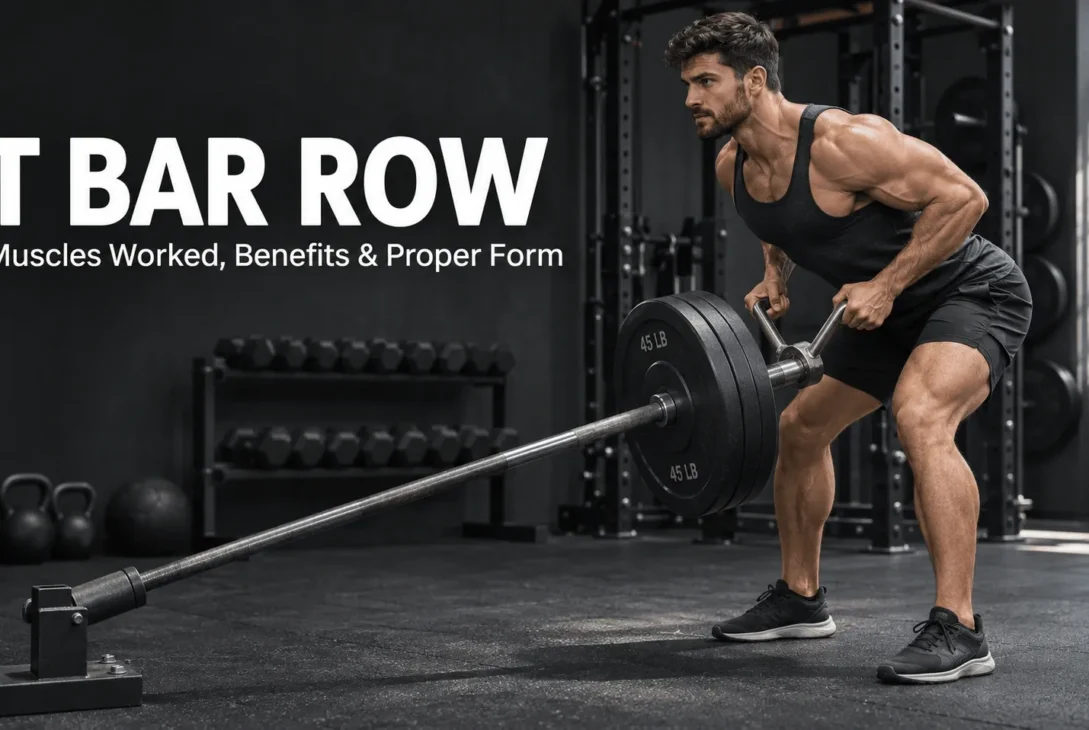
The T bar row is a compound back exercise that trains your lats and upper back while your arms help pull the weight toward your torso. You can perform it on a dedicated machine or with a barbell secured in a landmine attachment, using the equipment your gym provides and a grip that feels comfortable.
Before loading plates, check whether the setup supports your chest. That detail changes how much work your lower back must do to hold you in position. Choosing the right version matters more than copying someone else’s plate stack.
What Is a T Bar Row?
A T bar row involves pulling a weighted lever toward your body. One end pivots from a fixed point, so the handle travels through an arc. Many machines offer several handles; the familiar landmine version usually uses a narrow V-handle beneath the barbell.
The fixed pivot helps guide the movement, although an unsupported version still requires you to maintain a bent-over position. StrengthLog’s exercise guide describes this guided path as a way to reduce balance demands compared with free-standing rows.
T Bar Row Muscles Worked
Several muscles share the work, with their contribution depending on your elbow path and equipment.
| Muscle | Main role during the row |
|---|---|
| Latissimus dorsi | Draws your upper arms back toward your torso |
| Rhomboid muscles and middle trapezius | Pull your shoulder blades toward your spine |
| Rear deltoids | Help move your upper arms backward |
| Biceps and other elbow flexors | Bend your elbows during the pull |
| Forearm muscles | Maintain your grip on the handle |
| Spinal erectors and abdominal muscles | Help stabilize your torso, especially without chest support |
Bringing your shoulder blades together is called scapular retraction. It happens alongside elbow bending; squeezing your shoulder blades without rowing your arms does not complete the movement.
The Gymshark T bar row guide covers the back muscles and supporting muscles involved. Think of the exercise as a coordinated pull rather than an isolation movement for one small area.
Benefits of T Bar Row
Back muscle development is the main reason to include this exercise. It provides a way to progressively challenge your lats and upper back, which can contribute to the fuller appearance lifters describe as back thickness.
A guided handle path can also make it easier to repeat the same movement across a set. On a chest-supported machine, you can concentrate on pulling without holding your torso unsupported throughout every repetition.
Still, no rowing machine guarantees superior muscle growth. The ACSM resistance training update reports that equipment type did not consistently determine results for the average healthy adult. Choose a setup you can use comfortably and train consistently.
How to Do T Bar Row Correctly
These instructions cover the landmine version. Follow the equipment instructions when using a dedicated T bar row machine.
- Secure the barbell in a compatible landmine attachment. Load the free end and secure the plates as the equipment requires.
- Stand astride the bar facing the plates. Position a suitable rowing handle beneath the bar, behind the loaded sleeve.
- Bend your knees slightly and move your hips backward. Keep your spine in a comfortable neutral position and your neck aligned with your torso.
- Grip the handle and lift the load into the starting position. Brace your abdomen and let your arms extend without losing control of your back position.
- Drive your elbows backward, bringing the handle toward your lower ribs or upper abdomen as the setup allows. Keep your torso angle steady.
- Lower the weight under control. Let your arms straighten and your shoulder blades move forward naturally, then begin the next repetition.
Muscle & Fitness demonstrates the basic setup and pull. Your torso angle and finishing point will vary with the handle and your proportions; forcing the plates into your chest is unnecessary.
For a practical form check, film a light set from the side. Watch whether your chest rises sharply with each pull. If it does, reduce the load and repeat the set with a more stable torso.
Different Types of T Bar Rows
Chest-Supported T Bar Row
This version uses a pad to support your torso. Adjust the machine so you can reach the handles and row comfortably while keeping your chest against the pad.
Chest support reduces the need for your lower back to hold the bent-over position. Legion’s technique guide explains the setup and why it can help when lower back fatigue limits standing rows. Avoid lifting your chest off the pad to finish a heavy repetition.
Landmine T Bar Row
A barbell in a landmine attachment lets you perform the T bar row without a machine. You still need a secure anchor and a suitable handle. The fixed end guides the bar, but your trunk must support your bent-over position.
Wide-Grip T Bar Row
A wider handle usually allows your elbows to travel farther from your sides. This changes the movement toward a more flared-elbow row. Start with a comfortable width.
Close-Grip T Bar Row
A narrow neutral grip places your palms facing each other and usually keeps your elbows nearer your torso. Grip width alone does not isolate your lats or switch off your upper back; elbow movement and machine design also matter.
Common T Bar Row Mistakes to Avoid
Swinging your torso upward changes the exercise as the set gets harder. If each repetition requires a bigger heave, stop and lower the weight.
Another mistake is holding your shoulder blades tightly together throughout the entire set. They should move as your arms extend and return. Muscle & Strength’s technique notes specifically advise allowing that movement while controlling the weight.
Also watch for excessive lower back arching and a head that juts forward. Keep your abdominal brace and let your neck follow your torso. Keep the range consistent.
T Bar Row vs Barbell Row
The clearest difference is the equipment. A T bar setup has a fixed pivot, while a barbell row requires you to control a freely moving bar. Both can train your back effectively.
A chest-supported version also removes much of the demand of holding your torso unsupported. An unsupported landmine row retains that demand, so calling every T bar variation easier on the lower back would be misleading.
For comparison, ACE’s barbell row instructions emphasize a hip hinge, slightly bent knees, and a steady back position. Use the version that lets you repeat controlled repetitions with the equipment available.
Best T Bar Row Alternatives
Choose your replacement by the equipment you have and whether you want chest support, particularly when your existing workout already includes exercises that tire your lower back.
| Alternative | Equipment | Useful when |
|---|---|---|
| Chest-supported dumbbell row | Incline bench and dumbbells | You want torso support without a dedicated machine |
| One-arm dumbbell row | Dumbbell and stable support | You prefer training each side separately |
| Seated cable row | Cable station | You want an adjustable horizontal pulling exercise |
| Inverted row | Secure bar or rated suspension trainer | You want a bodyweight option |
| Resistance band row | Band and suitable secure anchor | You train at home with limited equipment |
When comparing it with a seated cable row, consider the setup: the cable version lets you row from a seated position, but you still need to control your torso.
ACE’s back exercise research found useful back muscle recruitment across several rowing movements. That study measured muscle activation, not long-term growth, and did not establish a T bar row winner.
Recommended Sets and Reps
For a beginner workout, a practical starting prescription is 2 sets of 8 to 12 controlled repetitions. Rest about 2 minutes between sets, taking longer if needed to maintain technique. Treat this as a starting plan, not a uniquely proven formula for this exercise.
Choose a load that leaves you able to perform another couple of clean repetitions. Training to complete muscular failure is unnecessary for making progress, according to ACSM’s updated guidance.
For progressive overload, first work toward the top of your chosen repetition range. Once every set looks consistent, add the smallest practical amount of weight and rebuild your repetitions. The earlier ACSM progression position stand supports increasing resistance as you exceed your target repetitions.
Place the exercise in a pull-day workout or a full-body session. Account for your other back exercises before adding more sets.
Safety Tips for Beginners
Practice with a light load before your working sets, and ask a qualified trainer to check an unfamiliar machine’s adjustments. Use a purpose-built landmine anchor rather than assuming a loose barbell wedged against a wall will stay in place.
Stop if you feel sharp or worsening pain. Persistent symptoms or an existing back injury deserve individual advice from a qualified healthcare professional; ACE’s pain guidance explains why pushing through pain can be the wrong response.
Frequently Asked Questions
Is T bar row good for back thickness?
Yes, it trains muscles that contribute to back size, including the lats and upper back. Growth depends on progressive training and recovery, so the exercise name alone does not predict your results.
What are the best T bar row alternatives at home?
Consider a supported dumbbell row or a resistance band row with a secure anchor. An inverted row also works if you have equipment designed to support your body weight.
Should I do T bar rows every day?
Daily hard rowing is unnecessary. Fit rows into your wider training schedule and allow recovery between demanding sessions; ACSM recommends training all major muscle groups at least twice weekly, which does not mean repeating this one exercise every day.
Should I feel T bar rows in my biceps?
Some arm effort is normal because your elbows bend during the pull. Check your load and elbow path if your arms consistently limit the set before you can perform a controlled back movement.
Final Thoughts
At your next workout, choose one version and record its handle setting alongside the load and repetitions. Keep that setup consistent while you learn the movement. Increase the weight when you can repeat the same controlled row across the whole set.