Introduction
It can be unsettling to see a bump on your eyeball. You look in the mirror and suddenly ask, “What is that spot and should I be worried? The good news is that many pimples on the visible surface of the eye are harmless and may be related to inflammation, UV exposure, dryness, or a common surface growth. However, some changes demand a professional eye check, especially if they grow quickly, become painful, or impact your vision.
The eye is a delicate organ, and even a small-looking alteration can have multiple plausible reasons. Think of the surface of your eye as a smooth window: when something grows on that surface, its appearance can vary depending on what is underneath or surrounding it. Understanding the common possibilities can help you know what to do next.
Important: This article contains general health information and cannot diagnose an eye disease. A qualified optometrist or ophthalmologist should evaluate a new, changing, uncomfortable, or atypical growth.
Important: This article contains general health information and cannot diagnose an eye disease. A qualified optometrist or ophthalmologist should evaluate a new, changing, uncomfortable, or atypical growth.
What does a lump on the eye mean?
People often say they have a bump on the eyeball when they see a raised region on the white part of the eye. Medically, this appearance can be caused by a variety of illnesses; therefore, the term itself is not diagnostic.
A bump might be white, yellow, pink, red, clear or flesh-colored. It may be small and hardly detectable or become large enough to change the look of the eye. Some bumps are symptomless; others may produce dryness, redness, inflammation, tearing or a gritty sensation.
A bump might be white, yellow, pink, red, clear or flesh-colored. It may be small and hardly detectable or become large enough to change the look of the eye. Some bumps are symptomless; others may produce dryness, redness, inflammation, tearing or a gritty sensation.
One of the most prevalent reasons is a pinguecula, a raised yellowish spot on the conjunctiva, the thin tissue that covers the white part of the eye. Or it could be a pterygium, a fleshy growth that can extend from the conjunctiva to the cornea.
The argument is that appearance alone is not always enough to determine the cause.
The argument is that appearance alone is not always enough to determine the cause.
Common Causes of a Bump on the Eye
Several conditions can appear as a bump or raised area on the visible surface of the eye.
Pinguecula
A pinguecula is often a small, yellowish or whitish raised spot on the conjunctiva. It commonly appears on the side of the eye closest to the nose and may remain relatively stable for a long time.
Pterygium
A pterygium is a fleshy, wedge-shaped growth that can begin on the conjunctiva and gradually extend onto the cornea. Unlike a pinguecula, it can eventually interfere with vision if it becomes large enough or changes the shape of the cornea.
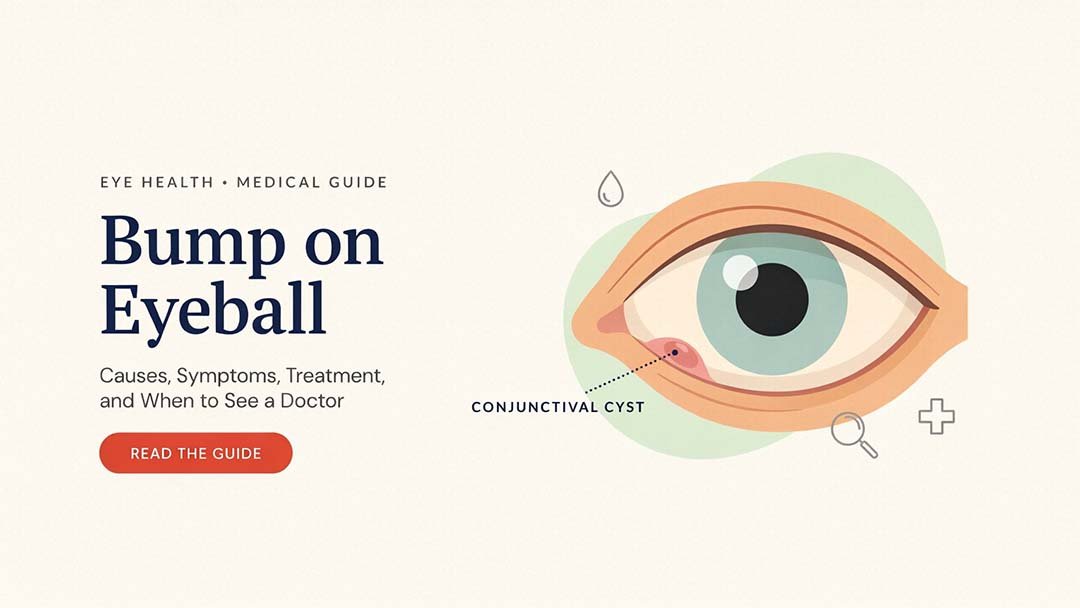
Conjunctival cyst
A small fluid-filled cyst can also appear as a clear or raised area on the surface of the eye. Many conjunctival inclusion cysts cause no symptoms, although larger ones may become uncomfortable or interfere with normal eye function.
Inflammatory growths
Inflammation can sometimes create a raised, irritated area. The exact cause may involve allergies, infection, chronic irritation, or other eye conditions.
Other lesions
Less common growths can include benign tumours and, rarely, abnormal or cancerous lesions. A rapidly changing, unusually pigmented, irregular, or otherwise atypical growth should be assessed by an eye-care professional rather than assumed to be harmless.
Pinguecula: A Common Yellowish Bump
If you see a small yellow lump on the white part of your eye, it may be a pinguecula.
A pinguecula is a growth that occurs in the conjunctiva and normally does not spread across the clear centre area of the eye. This is especially noticeable when the eye is inflamed or irritated.
A pinguecula is a growth that occurs in the conjunctiva and normally does not spread across the clear centre area of the eye. This is especially noticeable when the eye is inflamed or irritated.
What does a pinguecula look like?
It may appear as:
- A small yellow or yellow-white raised spot
- A slightly thickened area on the white of the eye
- A growth near the nose or inner side of the eye
- A spot that becomes more obvious when the eye is irritated
Many pingueculae are asymptomatic or minimally symptomatic. But you can get irritated, especially in dry, windy, dusty or bright conditions.
Sometimes the pinguecula itself gets inflamed. You may experience redness, burning, dryness or a feeling that something is in your eye.
Sometimes the pinguecula itself gets inflamed. You may experience redness, burning, dryness or a feeling that something is in your eye.
Does a pinguecula need treatment?
Not always. If it is minor and causing no issues, an eye specialist may recommend observation and protection from environmental irritants.
Lubricating eye drops can help with surface irritation. If it does not resolve or if there is concern about the cosmetic appearance, an ophthalmologist may discuss treatment alternatives. Surgery is often reserved for certain cases, not all pinguecula.
Lubricating eye drops can help with surface irritation. If it does not resolve or if there is concern about the cosmetic appearance, an ophthalmologist may discuss treatment alternatives. Surgery is often reserved for certain cases, not all pinguecula.
Pterygium: When a Growth Extends Toward the Cornea
Another typical cause of a raised growth on the eye is a pterygium.
It is also referred to as “surfer’s eye” since it is related to significant exposure to the sun, wind and outdoor settings. But you don’t have to be a surfer to come up with one.
A pterygium is a fleshy protrusion that is typically triangular or wedge-shaped. It usually begins on the side of the eye closest to the nose and may gradually grow toward the cornea.
It is also referred to as “surfer’s eye” since it is related to significant exposure to the sun, wind and outdoor settings. But you don’t have to be a surfer to come up with one.
A pterygium is a fleshy protrusion that is typically triangular or wedge-shaped. It usually begins on the side of the eye closest to the nose and may gradually grow toward the cornea.
What symptoms can pterygium cause?
A small pterygium may not cause any noticeable symptoms. As it becomes larger, however, you might experience:
- Eye redness
- Dryness
- A gritty or foreign-body sensation
- Watery eyes
- Irritation
- Blurred vision
- Changes in the shape of the cornea
In severe circumstances, a pterygium can grow toward the centre of vision and impair vision. It can also cause astigmatism by changing the cornea’s natural smooth shape.
Is a pterygium serious?
A typical pterygium is regarded as a benign development. But not all odd eye lesions are pterygium.
If the growth is changing fast, has unusual pigment, is uneven, or has another abnormal feature, your eye specialist may want to take a closer look.
If the growth is changing fast, has unusual pigment, is uneven, or has another abnormal feature, your eye specialist may want to take a closer look.
Other Possible Reasons for an Eye Bump
Some eye bumps aren’t a pinguecula or pterygium.
Cyst, conjunctival
A conjunctival cyst can look like a tiny bubble or clear, elevated area. These cysts may arise naturally or following inflammation, trauma or eye surgery. Most are innocuous and do not need treatment unless they cause problems.
Inflammatory
Inflammatory
Inflammatory
An inflamed eye can have localised oedema. Allergies, dryness, environmental exposure and inflammation can all impact the conjunctiva.
Exogenous substance
Sometimes a small particle, such as dust, might become stuck around the eye and cause discomfort or localised swelling. If anything is stuck in the eye, touching it repeatedly can make it worse.
Surface tumours or aberrant lesions.
Although uncommon, certain conjunctival growths require closer evaluation. Some benign lesions can resemble more serious conditions, while abnormal tissue may occasionally represent a precancerous or cancerous process.
That is why a new or changing growth should be assessed in person rather than diagnosed from a photograph or internet search alone.
Symptoms You Might Notice
Symptoms related to an eye bump can provide important clues, but cannot establish a diagnosis.
You may not have any symptoms at all. This is characteristic of several surface growths.
You may not have any symptoms at all. This is characteristic of several surface growths.
Other possible symptoms include:
- Redness
- Dryness
- Burning
- Itching
- Watering
- Grittiness
- Sensitivity to wind or sunlight
- A foreign-body sensation
- Blurred vision
- Eye fatigue or discomfort
A small pinguecula, for example, may sit quietly on the eye. But if the surrounding tissue becomes inflamed, it may suddenly become much more noticeable.
A pterygium can similarly remain mild for years before causing irritation or visual symptoms.
The pattern matters. A stable, painless spot is different from a growth that becomes painful, changes rapidly, or is accompanied by vision loss.
What Causes These Growths?
Prolonged sun exposure without sufficient eye protection can also expose the eyes to UV radiation. Chronic surface irritation can also be caused by wind, dust, dry weather and other environmental irritants.
That is why these growths are so common in people who spend much of their time outside or live in hot, sunny areas.
That is why these growths are so common in people who spend much of their time outside or live in hot, sunny areas.
Environmental factors may include:
Sunlight: Long-term UV exposure is strongly associated with pterygium and pinguecula.
Wind: Continuous exposure can dry and irritate the eye’s surface.
Dust: Dust particles may contribute to irritation, especially in outdoor or occupational settings.
Dry environments: Low humidity can worsen surface dryness and discomfort.
Eye rubbing: Frequent rubbing may aggravate an already irritated eye.
However, having a bump does not necessarily mean you did something wrong. Many factors can contribute to eye-surface changes, and some lesions occur without an obvious trigger.
How Is a Bump on the Eyeball Diagnosed?
The safest way to identify an unusual eye bump is through an eye examination.
An optometrist or ophthalmologist will usually examine the affected area closely and may also examine the rest of the eye. A slit-lamp examination is commonly used to view the eye’s surface under magnification.
During the examination, the clinician may consider:
- The size of the growth
- Its color
- Its shape
- Its location
- Whether it extends onto the cornea
- Whether blood vessels are present
- Whether it appears inflamed
- Whether vision has changed
- Whether the lesion is growing
If the growth appears unusual, additional testing may sometimes be necessary. In selected cases, tissue removed during surgery may be examined under a microscope to determine exactly what it is.
This is one reason self-diagnosis can be risky: several eye conditions can look similar without magnification.
Treatment Options
Treatment depends entirely on the underlying cause.
Lubricating eye drops
Artificial tears may help reduce dryness and irritation associated with common surface growths. They can make the eye feel more comfortable, particularly in dry or windy conditions.
Reducing environmental irritation
Wearing sunglasses, avoiding excessive dust, and protecting the eyes from wind can help reduce ongoing irritation.
Prescription medication
If a growth becomes inflamed, an eye specialist may prescribe medication to control inflammation. Prescription steroid drops may sometimes be used for selected inflammatory conditions. Still, they should not be used casually or for long periods without medical supervision because they can have significant eye-related side effects.
Surgery
Surgery may be considered when a pterygium causes persistent symptoms, threatens vision, significantly affects the cornea, becomes sufficiently large, or creates a substantial cosmetic concern.
For some pingueculae, removal may also be considered if the lesion remains chronically inflamed, causes significant problems, or is cosmetically unacceptable.
Importantly, surgery is not automatically the best answer for every bump.
Can You Prevent an Eye Bump?
You cannot prevent every possible eye growth, but you can reduce exposure to some known risk factors.
Protect your eyes from UV light.
Wear sunglasses that provide appropriate UV protection when spending time outdoors. A brimmed hat can provide additional protection.
Limit exposure to wind and dust.
If your environment is dusty or windy, appropriate protective eyewear can reduce irritation.
Manage dryness
If your eyes frequently feel dry, lubricating drops may provide relief. An eye-care professional can help determine whether persistent dryness requires further evaluation.
Avoid unnecessary eye rubbing.
Rubbing may worsen irritation and can potentially aggravate the eye surface.
Pay attention to changes.
One of the simplest habits is to notice changes. If a bump suddenly becomes larger, changes colour, starts bleeding, or affects your vision, do not simply wait for it to disappear.
Think of monitoring an eye growth like watching a small crack in a windshield. It may remain harmless and unchanged, but if it starts spreading, you want someone qualified to inspect it before it becomes a bigger problem.
When to See an Eye Doctor?
Not all bumps need emergency care, but you should never ignore these symptoms.
If you:
You don’t know what the bump is, and it’s new.
It is becoming bigger.
It’s always being aggravated or inflamed.
You have blurred vision.
The tissue may slowly migrate centrally into the centre of the cornea.
You have chronic redness or irritation.
The lesion changes colour or seems different.
If you:
You don’t know what the bump is, and it’s new.
It is becoming bigger.
It’s always being aggravated or inflamed.
You have blurred vision.
The tissue may slowly migrate centrally into the centre of the cornea.
You have chronic redness or irritation.
The lesion changes colour or seems different.
Get medical help right away if you have any warning signs.
Seek immediate medical assistance for any eye problem linked with sudden vision changes, acute eye pain, marked swelling, blood or pus, trauma, chemical exposure, severe headache, nausea or vomiting, or sudden halos around lights. These symptoms may signal a more serious eye condition, not just a simple surface growth.
Severe eye pain and vision loss should be considered an emergency.
If a chemical gets in your eye, don’t wait to observe a lump or redness before getting care. First aid immediately, followed by professional assessment.
Severe eye pain and vision loss should be considered an emergency.
If a chemical gets in your eye, don’t wait to observe a lump or redness before getting care. First aid immediately, followed by professional assessment.
Frequently Asked Questions
1. Do I always have a problem if I lump my eyeball?
Nope. Surface bumps are often caused by common, benign disorders such as pinguecula or pterygium. But you can’t reliably tell the cause by how it looks. Any new, changing, or uncomfortable growth should be seen by an eye care expert.
2. Reasons for a yellow bump in the white of the eye?
A yellowish elevated patch may be a pinguecula, a common development of the conjunctiva connected with exposure to UV light, wind and chronic irritation from the environment.
3. Can a pterygium impact my vision?
“Yes. A little pterygium may cause no visual difficulties, while a larger growth may distort the cornea or expand toward the central visual area. This can lead to blurred vision or changes in the eye’s focusing capabilities.
4. How can I treat a lump on my eyeball at home?
No. You should not try to cut, scrape, puncture, squeeze, or otherwise remove a growth from the eye yourself. The eye surface is delicate, and an incorrect attempt could cause injury, infection, scarring, or vision problems.
5. When should I worry about a bump on my eye?
Pay particular attention if the growth is rapidly changing, becomes painful, affects vision, develops unusual pigmentation, or is accompanied by severe redness or other concerning symptoms. Sudden vision loss, severe eye pain, significant injury, chemical exposure, or other acute warning signs require urgent medical attention.
Conclusion
A bump on the eyeball can have many explanations, and common causes such as pinguecula and pterygium are often manageable. Environmental exposure, particularly UV light, wind, and dust, is associated with several common surface growths. Protecting your eyes and managing dryness or irritation can help keep the eye surface comfortable.
Still, don’t assume every bump is harmless. If the growth is new, changing, painful, unusually colored, or affecting your vision, an eye examination is the safest next step. Your eyes are too valuable to leave a suspicious change to guesswork.
Visited 16 times, 1 visit(s) today