If you’ve ever tripped, lost your balance, or slipped on a wet floor, your first instinct was probably to throw your hand out to break the fall. That split-second reaction is completely natural — but it’s also how one of the most common orthopedic injuries happens. Doctors call it a FOOSH injury, and understanding it can help you recognize the warning signs, get the right treatment, and recover faster.
This guide breaks down everything you need to know about FOOSH injuries in plain, practical language — no confusing medical jargon, just the facts you actually need.
What Is FOOSH?
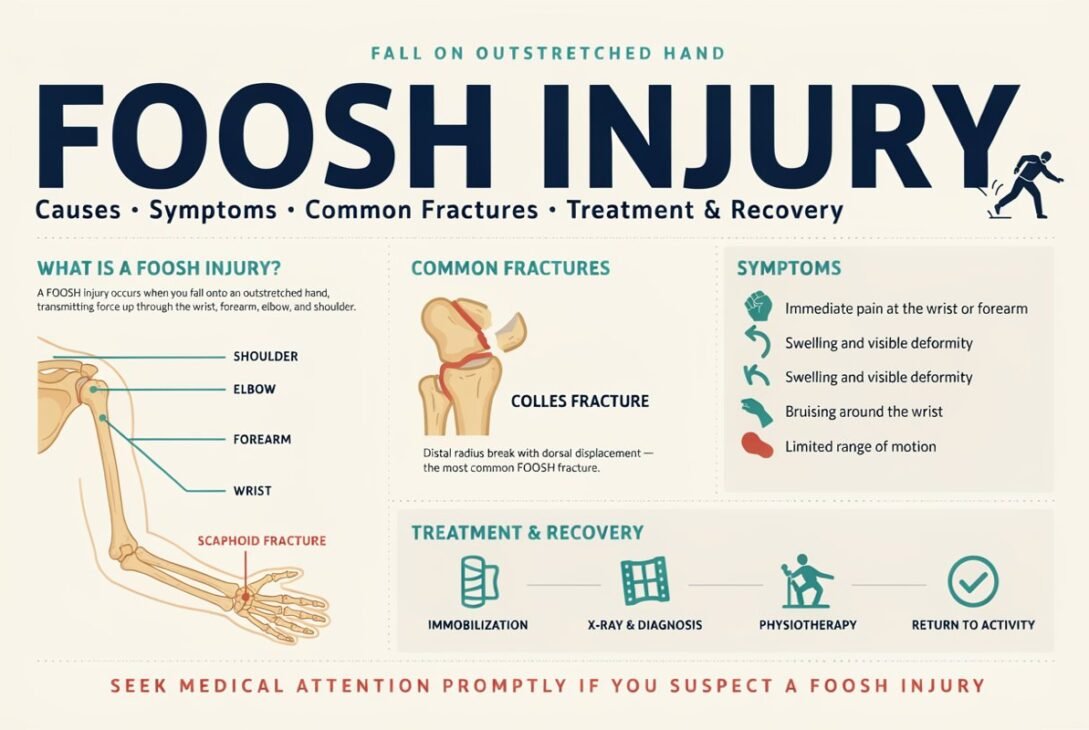
FOOSH stands for Fall On OutStretched Hand. It’s a medical term used to describe any injury that happens when a person falls and instinctively reaches out with their hand to cushion the impact.
When you fall forward or sideways, your brain sends a rapid protective signal to your arms, telling them to extend and absorb the shock. While this reflex often protects your head and torso from serious harm, it transfers a huge amount of force directly through your wrist, forearm, elbow, and sometimes even your shoulder.
In simple terms: a FOOSH injury is any wrist, arm, or elbow injury caused by landing on an outstretched hand during a fall.
This mechanism of injury is so common that emergency rooms see it daily, especially among:
- Children and teenagers (falls during sports or play)
- Older adults (falls due to balance issues or osteoporosis)
- Athletes (skating, cycling, gymnastics, football)
- Anyone who slips on ice, wet floors, or uneven surfaces
How Does a FOOSH Injury Happen?
The mechanics behind a FOOSH injury are fairly straightforward. When you fall and your hand hits the ground first, the force travels upward through the bones and joints of your arm. Depending on the angle of the fall, the amount of force, and the position of your wrist at impact, that energy can cause anything from a mild sprain to a severe fracture.
Common scenarios that lead to FOOSH injuries include:
- Slipping on ice or wet surfaces
- Tripping over an object or uneven pavement
- Falling off a bike, skateboard, or scooter
- Losing balance while playing sports
- Falling down stairs
- Falls related to dizziness, low blood pressure, or age-related instability
The severity of the injury usually depends on three main factors: the speed of the fall, the angle of the wrist on impact, and the bone density of the person falling. This is why older adults with weaker bones often suffer more serious fractures from what seems like a minor stumble.
Common Symptoms of a FOOSH Injury
Not every FOOSH injury looks the same, but there are several telltale symptoms that suggest you need medical attention.
General Symptoms
- Sudden, sharp pain in the wrist, forearm, or elbow
- Swelling that develops quickly after the fall
- Bruising around the injured area
- Difficulty moving or rotating the wrist
- A visible deformity or unusual angle in the arm
- Tenderness when touching the injured spot
- Numbness or tingling in the fingers
When Symptoms Suggest a Fracture
If you notice any of the following, you may be dealing with a FOOSH fracture rather than a simple sprain:
- A “dinner fork” deformity in the wrist (a classic sign of a Colles’ fracture)
- Inability to bear any weight on the hand
- Grinding or popping sensation during movement
- Severe, persistent swelling within minutes of the fall
- Pain that worsens instead of improving after 24 hours
It’s important not to guess. Wrist sprains and fractures can feel remarkably similar in the first hour after a fall, and only imaging can confirm what’s actually going on beneath the skin.
Common Fractures Caused by FOOSH Injuries
Because the wrist and forearm absorb most of the impact, several specific fracture patterns are strongly associated with FOOSH mechanisms. Recognizing these can help you understand what your doctor might be looking for on an X-ray.
1. Colles’ Fracture
This is the most well-known FOOSH fracture. It involves a break in the distal radius (the larger bone in the forearm, near the wrist), where the broken piece angles backward. It’s especially common in older adults with osteoporosis.
2. Scaphoid Fracture
The scaphoid is a small bone on the thumb side of the wrist. Scaphoid fractures are notoriously easy to miss on initial X-rays because the break can be a hairline fracture that doesn’t show up right away. Left untreated, this type of fracture can lead to long-term complications, including poor healing due to limited blood supply to the bone.
3. Distal Radius Fracture
A broader category that includes Colles’ fractures, this involves any break near the wrist end of the radius bone. It’s one of the most frequently diagnosed fractures in emergency departments worldwide.
4. Radial Head Fracture (FOOSH Injury Elbow)
When the fall transfers force further up the arm, it can fracture the radial head at the elbow joint. A FOOSH injury elbow case like this often causes pain and stiffness when trying to bend or rotate the forearm, and it may be mistaken for a simple elbow sprain initially.
5. Supracondylar Fracture
This type is especially common in children and involves a break just above the elbow joint. It requires prompt medical evaluation because of the risk of nerve or blood vessel involvement near the elbow.
6. Clavicle Fracture
In some falls, especially sideways falls, the force can travel all the way up to the collarbone, resulting in a clavicle fracture instead of or in addition to a wrist injury.
How FOOSH Injuries Are Diagnosed
If you visit a doctor or emergency room after a fall on an outstretched hand, expect the following evaluation process:
- Physical examination — The doctor checks for swelling, deformity, tenderness, and range of motion.
- X-ray imaging — This is the standard first step to check for fractures.
- CT scan or MRI — Used if the X-ray is inconclusive or if a soft-tissue injury (like a ligament tear) is suspected.
- Neurovascular check — The doctor will assess circulation and nerve function in the hand and fingers, since some fractures can compress nearby nerves or blood vessels.
Early and accurate diagnosis matters. Fractures like the scaphoid fracture can look normal on an initial X-ray but reveal themselves on a follow-up scan a week or two later, which is why doctors often recommend a repeat X-ray if pain persists despite a “clear” initial result.
Treatment Options for FOOSH Injuries
There’s no one-size-fits-all approach here — the right treatment hinges on exactly which structure is injured and how badly.
Mild Sprains or Strains
- Rest and activity modification
- Ice application for the first 48 hours
- Compression wrap or brace
- Elevation to reduce swelling
- Over-the-counter pain relievers
Non-Displaced Fractures
- Cast or splint immobilization, typically for 4 to 6 weeks
- Regular follow-up X-rays to confirm proper healing
- Gradual reintroduction of movement once cleared by a doctor
Displaced or Complex Fractures
- “A closed reduction procedure, in which the fractured bone is repositioned externally without cutting into the skin
- Surgical fixation using plates, screws, or pins for unstable fractures
- Post-surgical splinting or casting
- Physical therapy once the bone has stabilized
Elbow-Specific Injuries
A FOOSH injury elbow fracture, particularly involving the radial head or supracondylar region, sometimes requires more specialized care due to the complexity of the elbow joint and its proximity to major nerves and blood vessels.
Recovery Timeline and Rehabilitation
How long recovery takes really comes down to just how serious the injury was in the first place.
- Mild sprains: 1 to 3 weeks
- Simple, non-displaced fractures: 4 to 6 weeks in a cast
- Complex or surgical fractures: 8 to 12 weeks, sometimes longer
- Full functional recovery (including strength and flexibility): Up to 6 months in more severe cases
Physical therapy plays a major role in recovery, especially after cast removal or surgery. A typical rehab program includes:
- Gentle range-of-motion exercises
- Progressive strengthening with resistance bands or light weights
- Grip strength training
- Scar tissue management (for surgical cases)
- Functional exercises to restore daily activities like writing, lifting, or typing
Skipping rehabilitation is one of the biggest mistakes people make. Even a well-healed fracture can leave lingering stiffness or weakness if the surrounding muscles and joints aren’t properly reconditioned.
How to Prevent FOOSH Injuries
While you can’t always avoid a fall, you can reduce your risk and limit potential damage:
- Wear proper footwear with good traction, especially in icy or wet conditions
- Use handrails on stairs
- Keep walkways clear of clutter and cords
- Improve balance through regular strength and stability exercises
- Wear wrist guards during high-risk sports like skateboarding or inline skating
- Address vision or balance issues promptly, especially in older adults
- Ensure adequate calcium and vitamin D intake to support bone density
FAQs About FOOSH Injuries
1. What does FOOSH mean in medical terms?
FOOSH stands for Fall On OutStretched Hand. It describes the mechanism of injury rather than a specific diagnosis, referring to any wrist, forearm, or elbow injury caused by landing on an extended hand during a fall.
2. How do I know if my FOOSH injury is a fracture or just a sprain?
Sprains typically cause swelling and pain that gradually improve within a few days. Fractures often involve severe, persistent pain, visible deformity, and inability to bear weight or move the joint normally. An X-ray is the only reliable way to confirm the difference.
3. Can a FOOSH injury heal without a cast?
Some mild sprains and hairline fractures may heal with rest, bracing, and activity modification. However, most confirmed fractures require casting or splinting to ensure proper bone alignment during healing.
4. Why do scaphoid fractures get missed so often?
Scaphoid fractures can be nearly invisible on X-rays taken immediately after the injury. Swelling and subtle bone positioning make early detection difficult, which is why doctors often recommend a follow-up scan if wrist pain persists after a “normal” initial X-ray.
5. Is a FOOSH injury elbow fracture serious?
It can be, particularly in children, because the elbow area contains major nerves and blood vessels. Radial head and supracondylar fractures require careful evaluation to rule out complications and may need specialized treatment.
6. How long does it take to fully recover from a FOOSH wrist fracture?
Most simple fractures heal within 6 to 8 weeks, but full strength and flexibility can take several months, especially with physical therapy factored in.
7. Who is most at risk of FOOSH injuries?
Older adults with osteoporosis, children involved in active play or sports, and athletes in high-impact activities like skating or cycling face the highest risk.
Conclusion
A FOOSH injury — a fall on an outstretched hand — is one of the most common ways people injure their wrist, forearm, or elbow. While the protective reflex of reaching out during a fall is instinctive, it often results in significant force being transmitted through the arm, leading to sprains or fractures like the Colles’ fracture, scaphoid fracture, or radial head fracture.
Recognizing the symptoms early, seeking prompt medical evaluation, and following through with proper treatment and rehabilitation can make a major difference in long-term outcomes. If you or someone you know experiences a fall like this, don’t ignore persistent pain or swelling — getting checked out early is always the safer choice