If your lower back aches after long hours at a desk, and your belly seems to poke forward no matter how much you suck it in, you might be dealing with something more specific than “bad posture.” It could be lower crossed syndrome — a muscular imbalance pattern that quietly builds up from sitting too much and moving too little.
This condition is common, well documented in physical therapy and sports medicine literature, and — good news — very manageable once you understand what’s actually going on in your body.
In this guide, we’ll break down what lower crossed syndrome is, why it happens, how to spot it, and what you can actually do about it, including targeted exercises and stretches you can start today.
What Is Lower Crossed Syndrome?
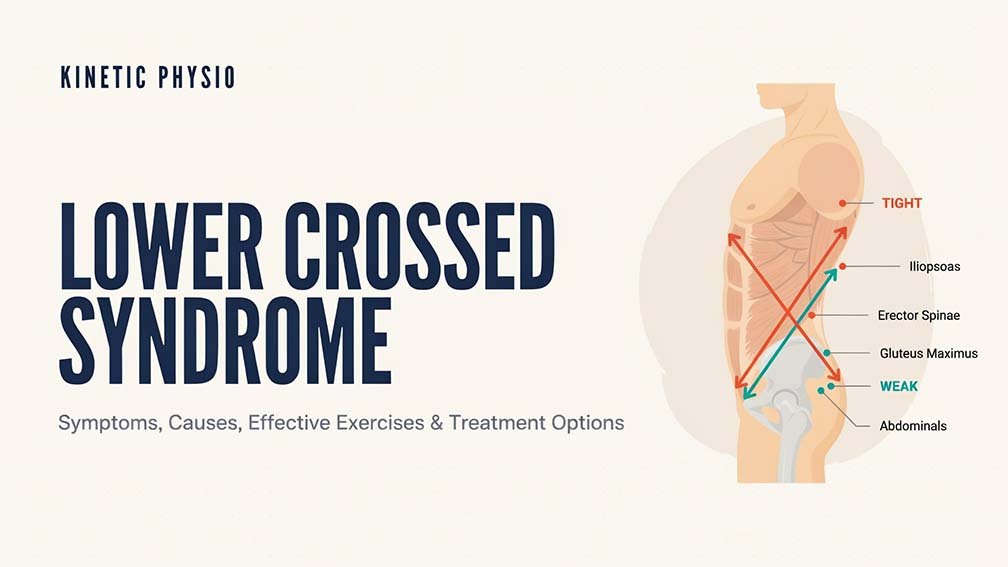
Lower crossed syndrome (LCS) is a postural imbalance pattern where certain muscle groups around the pelvis and lower back become tight and overactive, while their opposing muscle groups become weak and underactive.
The name comes from the “X” or crossed pattern the affected muscles form when you draw lines connecting them:
- Tight muscles: hip flexors (front of hips) and lower back extensors (erector spinae)
- Weak muscles: abdominal muscles (especially the deep core) and glute muscles (especially the gluteus maximus)
When you connect the tight hip flexors to the tight lower back muscles, and the weak abs to the weak glutes, the lines cross diagonally — hence “crossed syndrome.”
This imbalance was first described by Czech physician Vladimir Janda, a pioneer in physical rehabilitation, who noticed that certain muscles have a tendency to tighten under stress (postural muscles) while others tend to weaken and shut down (phasic muscles). Lower crossed syndrome is one of the clearest real-world examples of his theory.
The Telltale Sign: Anterior Pelvic Tilt
The hallmark physical feature of lower crossed syndrome is an anterior pelvic tilt — where the front of the pelvis drops down and the back of the pelvis lifts up. This creates:
- An exaggerated inward curve of the lower back (hyperlordosis)
- A belly that appears to protrude, even in people who aren’t overweight
- Hips that sit slightly forward of the ankles when standing
If you’ve ever looked in the mirror from the side and wondered why your stomach sticks out despite a flat midsection otherwise, this could be your answer.
Upper Cross Syndrome vs. Lower Crossed Syndrome
Lower crossed syndrome doesn’t exist alone. Janda also described a companion condition affecting the upper body: upper cross syndrome.
Understanding both helps clarify the full picture of how modern sedentary habits reshape the body.
What Is Upper Cross Syndrome?
Upper cross syndrome involves tightness in the chest muscles (pectorals) and the muscles at the base of the skull (upper trapezius and levator scapulae), paired with weakness in the deep neck flexors and the muscles between the shoulder blades (rhomboids and lower trapezius).
Upper Cross Syndrome Symptoms
Common upper cross syndrome symptoms include:
- Forward head posture (the head juts ahead of the shoulders)
- Rounded shoulders
- A hump at the base of the neck (sometimes called “tech neck” or “text neck”)
- Tension headaches and neck stiffness
- Reduced shoulder mobility
Upper and Lower Cross Syndrome Together
Here’s the part most articles skip: upper and lower cross syndrome frequently occur together in the same person, especially those who sit for extended periods — office workers, drivers, students, and gamers. Together, they create a distinctive full-body posture: forward head, rounded shoulders, arched lower back, and tilted pelvis.
Think of it as a chain reaction. Long sitting hours compress the hip flexors and round the shoulders forward simultaneously, so it’s rare to find one syndrome without at least mild signs of the other. This is why a comprehensive assessment — and a comprehensive fix — usually addresses posture from head to hips, not just one isolated area.
What Causes Lower Crossed Syndrome?
The root cause of lower crossed syndrome almost always traces back to prolonged positions that shorten the hip flexors and deactivate the glutes and core. Common contributors include:
- Prolonged sitting — at a desk, in a car, or on a couch, which keeps the hips in a flexed position for hours
- Sedentary lifestyle — a general lack of movement weakens the muscles responsible for pelvic stability
- Poor exercise technique — training the lower back and hip flexors repeatedly while neglecting glute and core work
- Pregnancy — the added abdominal weight and hormonal changes can shift pelvic alignment
- Obesity — extra abdominal weight pulls the pelvis into an anterior tilt
- Weak core strength from inactivity or past injury
- Improper footwear or high heels, which alter pelvic alignment over time
None of these causes are exotic. That’s precisely why lower crossed syndrome is so widespread — it’s a byproduct of everyday modern habits, not a rare medical disorder.
Lower Crossed Syndrome Symptoms
Recognizing the signs early can save you years of discomfort. Common symptoms include:
- Persistent lower back discomfort that becomes more noticeable after prolonged sitting or standing
- A visibly protruding lower abdomen despite low body fat
- Tight hip flexors that feel stiff when standing up after sitting
- Weak or “sleepy” glutes that don’t seem to activate during exercises like squats
- Reduced hip extension, making it harder to fully straighten the leg behind you
- Stiffness or reduced range of motion in the lower back
- A tendency to overuse the lower back during exercises meant to target the glutes or hamstrings
- Poor posture that seems resistant to conscious correction
If several of these sound familiar, it’s worth paying closer attention to your posture and movement habits — or getting assessed by a physical therapist or qualified movement specialist.
Why Lower Crossed Syndrome Matters (Beyond Posture)
It’s tempting to treat this as a cosmetic issue — nobody loves the look of a protruding belly or a stiff walk. But the real concern goes deeper.
When your pelvis sits in a chronic anterior tilt, your spine absorbs stress it wasn’t designed to handle. Over time, this can contribute to:
- Increased risk of lower back injury
- Disc compression and nerve irritation
- Hip impingement
- Reduced athletic performance, particularly in running, jumping, and lifting
- Compensatory pain in the knees or ankles as your gait pattern shifts
Addressing lower crossed syndrome isn’t just about looking better standing up straight — it’s about protecting your spine and joints for the long haul.
How Is Lower Crossed Syndrome Diagnosed?
A physical therapist, chiropractor, or sports medicine doctor typically diagnoses lower crossed syndrome through a combination of:
- Postural assessment — observing pelvic tilt, spinal curvature, and standing alignment
- Muscle length testing — checking hip flexor and lower back tightness (such as the Thomas Test)
- Muscle strength testing — assessing glute and core activation
- Movement screening — watching how you squat, hinge, or walk to spot compensation patterns
This isn’t something you typically diagnose from an X-ray; it’s a functional, hands-on assessment based on how your muscles behave and how your body moves.
Lower Crossed Syndrome Exercises: Stretch the Tight, Strengthen the Weak
The treatment approach for lower crossed syndrome follows one core principle: lengthen what’s tight, strengthen what’s weak.
Step 1: Stretch the Tight Muscles
Hip Flexor Stretch (Kneeling Lunge Stretch) Kneel on one knee with the other foot planted in front, forming a lunge position. Slowly shift your hips forward until you notice a comfortable stretch along the front of the hip on the kneeling side. Hold 30 seconds, repeat 2–3 times per side.
Lower Back Stretch (Child’s Pose or Knee-to-Chest) Lie on your back and pull one or both knees toward your chest, holding for 20–30 seconds. This gently releases tension in the erector spinae muscles.
Standing Quad and Hip Flexor Stretch Standing on one leg, pull the opposite ankle toward your glutes while keeping your knees close together. This targets both the quadriceps and hip flexors simultaneously.
Step 2: Strengthen the Weak Muscles
Glute Bridges Lie on your back with knees bent, feet flat on the floor. Squeeze your glutes and lift your hips toward the ceiling, avoiding overextension of the lower back. Pause briefly at the highest point for about two seconds, then slowly return to the starting position. Do 3 sets of 12–15 reps.
Dead Bug Lie on your back with arms extended toward the ceiling and knees bent at 90 degrees. Slowly lower one arm and the opposite leg toward the floor while keeping your lower back pressed flat against the ground. This trains deep core stability without straining the spine.
Bird Dog On hands and knees, extend one arm forward and the opposite leg backward while keeping your torso stable and hips level. This builds coordinated core and glute strength.
Planks A basic front plank, held with proper form (no sagging hips), strengthens the entire core and helps stabilize the pelvis.
Clamshells Lying on your side with knees bent, lift the top knee while keeping feet together. This isolates the glute medius, which supports pelvic stability.
A Note on Consistency
Improvement doesn’t happen overnight. Most people notice a difference in comfort and posture within 4–8 weeks of consistent stretching and strengthening, done 3–5 times per week. Skipping days here and there is fine — what matters is the overall trend of consistent effort over weeks and months.
Treatment Options Beyond Home Exercises
While home exercises are the foundation of managing lower crossed syndrome, additional treatment approaches can accelerate progress:
- Physical therapy — a licensed therapist can design a personalized correction plan and monitor your progress
- Manual therapy or massage — helps release chronically tight muscles like the hip flexors and lower back
- Ergonomic adjustments — a standing desk, lumbar support cushion, or better chair setup reduces the daily strain that causes the syndrome in the first place
- Movement breaks — standing up and walking for a few minutes every 30–45 minutes during long sitting sessions
- Yoga or Pilates — both emphasize core control and hip mobility, making them excellent complementary practices
If pain is severe, persistent, or radiates down the leg, it’s important to consult a healthcare provider rather than relying solely on self-guided exercises, since this could indicate a more serious underlying issue like disc involvement.
How to Prevent Lower Crossed Syndrome
Prevention is far easier than correction. A few sustainable habits go a long way:
- Take a standing or walking break every 30–45 minutes if you sit for work
- Strengthen your glutes and core at least twice a week
- Stretch your hip flexors regularly, especially if you sit most of the day
- Pay attention to posture while standing — avoid letting your pelvis tip forward
- Choose supportive footwear over unstable or high-heeled shoes for daily wear
FAQs About Lower Crossed Syndrome
1. Can lower crossed syndrome be fully corrected?
Yes, in most cases. With consistent stretching, strengthening, and improved daily habits, most people see significant improvement within a few months. Severe or long-standing cases may take longer and benefit from professional guidance.
2. Is lower crossed syndrome the same as anterior pelvic tilt?
Not exactly. Anterior pelvic tilt is the visible postural result of lower crossed syndrome. The syndrome itself refers to the underlying pattern of tight and weak muscles that causes that tilt.
3. Can I have both upper cross syndrome and lower crossed syndrome at the same time?
Yes. This is actually common, especially in people who sit for long periods. The combination is sometimes referred to as having both upper and lower cross syndrome, and it typically requires addressing posture throughout the entire body rather than one region alone.
4. What are the main upper cross syndrome symptoms to watch for?
Rounded shoulders, forward head posture, neck and shoulder tightness, and frequent tension headaches are the most common signs.
5. Does lower crossed syndrome cause back pain?
Yes, it’s one of the most common causes of chronic, non-specific lower back pain, particularly in people who sit for most of the day and don’t engage in regular strength training.
6. How long does it take to fix lower crossed syndrome?
Mild cases often improve within 4–8 weeks of consistent exercise. More established patterns, especially in people who’ve had poor posture for years, may take several months of dedicated work.
7. Do I need a professional to diagnose lower crossed syndrome?
While you can often recognize the pattern yourself using the symptoms listed above, a physical therapist or sports medicine professional can confirm the diagnosis and rule out other causes of back pain, ensuring your treatment plan is safe and effective.
Conclusion
Lower crossed syndrome is a common but often overlooked cause of lower back pain, poor posture, and that stubborn protruding-belly look that has nothing to do with body fat. It develops from an imbalance between tight hip flexors and lower back muscles on one side, and weak abdominals and glutes on the other — usually the result of too much sitting and too little targeted movement.
The encouraging part is that this condition responds well to consistent, targeted care. By stretching what’s tight, strengthening what’s weak, and making small ergonomic changes to your daily routine, you can correct the imbalance, relieve pain, and move with more confidence and control. And since lower crossed syndrome often travels with its upper-body counterpart, paying attention to your posture from head to hips will serve your whole body — not just your lower back.