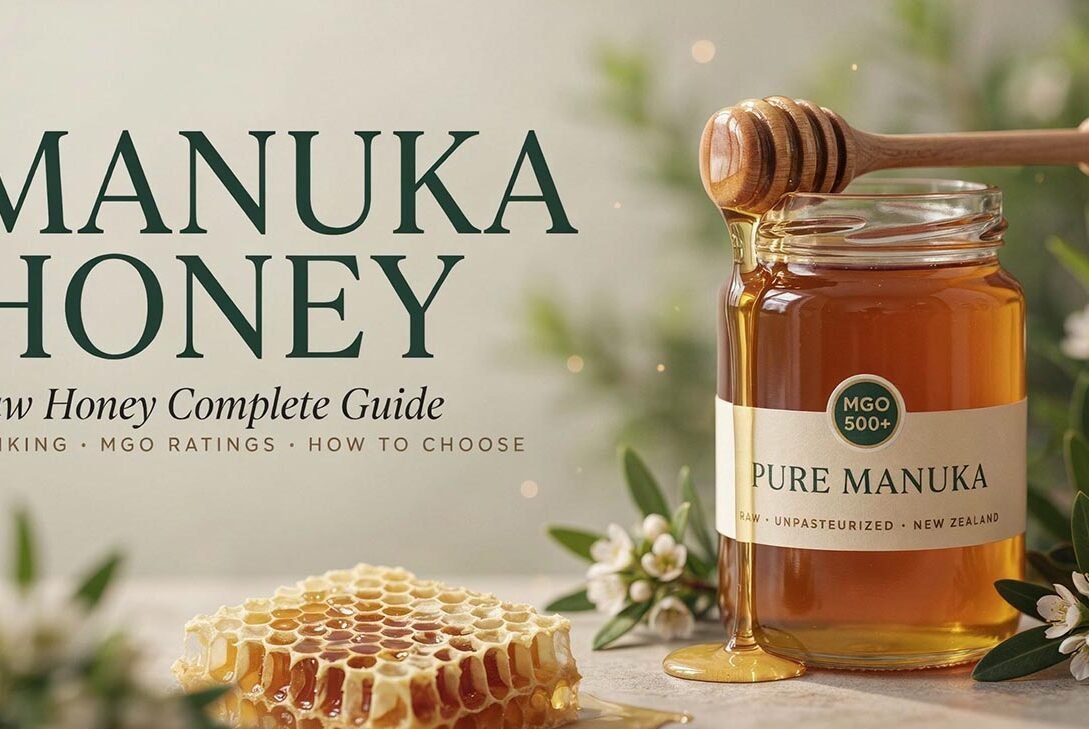
Manuka honey has become one of the most searched natural items online, from a niche health food to the mainstream. Shoppers are curious about why it costs so much more than conventional honey, what those MGO and UMF numbers actually stand for, and how to avoid purchasing a phony or diluted container. This handbook covers all of that, in simple terms, based on the actual production, testing and grading of manuka honey.
What is Manuka Honey, Anyway?
Manuka honey has a naturally occurring chemical called methylglyoxal (MGO) that conventional clover or wildflower honey don’t have in the same proportion, giving manuka honey antibacterial qualities.
The main reason manuka honey commands premium prices. This isn’t just marketing hype—the antibacterial activity is measurable, and investigated by food experts and microbiologists for decades.
Quick definition for search purposes:
Manuka honey is a raw, monofloral honey from New Zealand and Australia, prized for its natural methylglyoxal (MGO) content, which provides antibacterial and wound-healing properties beyond those of standard honey.
Unprocessed Manuka Honey vs. Typical Manuka Honey
Not all the manuka honey on the shelf is “raw.” It’s a difference most purchasers don’t understand is so important.
- It is not pasteurized and is only minimally filtered. It has natural enzymes, pollen and traces of propolis, and useful substances that can be destroyed by heat processing.
Pasteurized or processed manuka honey has been heated to increase its shelf life and to improve its texture, which may decrease enzyme activity and part of the honey’s natural nutritional content.
If you’re buying manuka honey for health advantages, such as easing sore throats, improving digestive health, or for use on the skin, raw, unpasteurized honey is usually the superior choice. Always read the label, “raw” should be clearly written not implied.
Understanding MGO Ratings: The Core of Manuka Honey Quality
MGO stands for methylglyoxal, the compound responsible for manuka honey’s unique antibacterial strength. The MGO rating tells you the concentration of this compound in milligrams per kilogram of honey.
Common MGO Ratings and What They Mean
- MGO 30–100: Everyday table honey with mild manuka characteristics. Good for general use, not therapeutic strength.
- MGO 100–250: Moderate antibacterial activity. Suitable for daily wellness use, immune support, and mild throat soothing.
- MGO 250–550: High-grade honey often used for more targeted wellness routines.
- MGO 550–1000+: Premium, therapeutic-grade honey. This is the strength most associated with clinical-style research and topical wound care products.
Higher MGO doesn’t automatically mean “better for everyone.” A first-time buyer often does better starting around MGO 100–250 rather than jumping straight to the strongest, most expensive jar.
UMF vs. MGO: What’s the Difference?
This is one of the most common points of confusion for shoppers.
- MGO measures a single compound — methylglyoxal — directly.
- UMF (Unique Manuka Factor) is a broader certification system used mainly by New Zealand producers. It verifies MGO levels alongside other markers like leptosperin and DHA, plus purity and quality checks, to confirm the honey is genuinely manuka and not blended or mislabeled.
Rough comparison for reference:
| UMF Rating | Approximate MGO Equivalent |
|---|---|
| UMF 5+ | MGO 83+ |
| UMF 10+ | MGO 263+ |
| UMF 15+ | MGO 514+ |
| UMF 20+ | MGO 829+ |
Neither system is “fake.” They’re simply different grading approaches, and reputable brands often display both numbers on the jar.
How to Select the Right Manuka Honey
The right jar depends on your objective, budget and how often you use it.
1. Seek out Third Party Certification
Look for UMF certification or a validated MGO number stated clearly on the label. This confirms the honey has been lab tested, not self-reported by the brand.
2. Look at the Country of Origin
Real manuka honey is produced in New Zealand or some parts of Australia. If the label is imprecise about where it came from, that’s a red flag.
3. Align Your Purpose with MGO Potency
General everyday health → MGO 100-250
Immune and seasonal support → MGO 250-400
Targeted, higher strength utilization → MGO 400+
4. Look for “Raw” and “Unpasteurized” on the label
This is discussed above and impacts enzyme content and overall quality.
5. Price Per Gram, Price Per Jar
A 250g jar of MGO 400+ will always be more expensive than a 500g jar of MGO 30. Compare strength and weight of like products before you decide one is overpriced.
6. Analyze Color and Texture
True raw Manuka honey is normally thick, creamy to dark amber in color and won’t separate readily. If the honey is watery or too liquid and says “raw manuka” on the label, think twice.
Common Uses of Raw Manuka Honey
People buy manuka honey for a variety of everyday and wellness uses:
- Good for sore or scratchy throat—often added to hot (not boiling) water or tea
Topical skin application – utilized in several skin care treatments for its hydrating and calming properties
Digestive comfort – add a teaspoon to your daily wellness regimen
Natural sweetener – replaces sugar with a more nutrient packed alternative
Wound treatment support – Medical grade manuka honey products are utilized in some therapeutic settings under professional direction
Please be aware that manuka honey is a supplemental wellness product and not a replacement for medical therapy. If you have a health condition, talk to your health care professional before adding it to a treatment plan.
How to Identify Fake or Diluted Manuka Honey
Counterfeiting and dilution have unhappily haunted the manuka honey market. Here’s what to look for:
- No MGO or UMG number on the label – reputable products will nearly always show one or both
Prices that appear too good for the indicated MGO rating
Using vague sourcing language like “made with New Zealand ingredients” instead of “produced in New Zealand.”
No batch number or reference to lab tests – reputable brands will often allow you to verify test findings online
Crystallization irregularities – raw honey crystallizes naturally with time, but strange texture changes soon after purchase can be a red flag
Purchasing from recognized shops or directly from certified New Zealand farmers greatly diminishes the danger of obtaining a diluted product.
Storing Manuka Honey Properly
To preserve its natural properties:
- Store in a cool, dry place away from direct sunlight
- Keep the lid tightly sealed to prevent moisture absorption
- Position it somewhere cool, well away from kitchen heat sources like ovens or stovetops
- Refrigeration isn’t necessary and can sometimes speed up crystallization
Properly stored raw manuka honey has a long shelf life, often several years, without significant loss of quality.
FAQs (often asked questions)
1. Which MGO rating should a newbie begin with?
For most first-time consumers, starting with MGO 100-250 is a good place to get the visible quality improvement without the premium price tag of higher-grade selections.
2. Is it safe for everyone to eat raw Manuka honey?
Raw honey, especially manuka, is not suggested for children under the age of one years, because of the risk of botulism spores. Generally safe for adults and children over one, though care should be taken by anyone with allergies to bee products.
3. Is MGO in honey good? More MGO is better?
Not always. Higher MGO has more antibacterial action but depends on how you plan to utilize it as to what is “better”. Mild daily honey does not need MGO 800+.
4. How do you know whether the manuka honey is real?
Look for UMF certification or a validated MGO number, verify the place of origin, and buy from trusted sellers who have transparent lab testing.
5. Can manuka honey expire?
Raw honey handled properly seldom goes bad. The honey may crystallize with time, but this is a natural process and not a sign of bad honey.
6. What is the difference between UMF and MGO ratings?
MGO is a direct measurement of the methylglyoxal molecule, whereas UMF is a broader certification that includes MGO and other indications of purity and validity.
7. Can manuka honey be used for cooking?
Yes but high heat may limit the natural enzyme activity. Best added to warm, not boiling beverages, or used unheated for wellbeing.
Conclusion
Raw manuka honey is different to conventional honey because it has a naturally occurring MGO level that provides it demonstrable antibacterial characteristics. Once you understand what MGO and UMF ratings mean, you may choose a product that truly meets your needs, whether that is for general wellbeing or a greater strength alternative for more targeted use. So the secret to a smart purchasing is threefold: certified certification, clear labeling of origin, and choosing an MGO strength that suits your real purpose, not just buying the highest number on the shelf. With this knowledge, you may shop with confidence and avoid the diluted or mislabeled products that unfortunately circulate in this popular area.