If you’ve noticed a firm knot on the bottom of your foot that wasn’t there a few months ago, you’re probably searching for answers right now. Maybe it’s tender when you walk barefoot. Maybe it’s just a strange lump you keep pressing on out of curiosity. Either way, you’ve likely landed here because you’re dealing with something called plantar fascial fibromatosis, more commonly known as Ledderhose disease.
This guide breaks down everything you need to know — what it is, why it happens, how doctors diagnose it, and what your realistic treatment options look like. No jargon overload, no scare tactics. Just clear, practical information.
Note: This article is for educational purposes only and doesn’t replace advice from a podiatrist, orthopedic specialist, or your own physician. If you have a new or changing lump on your foot, get it checked out in person.
What Is Plantar Fascial Fibromatosis?
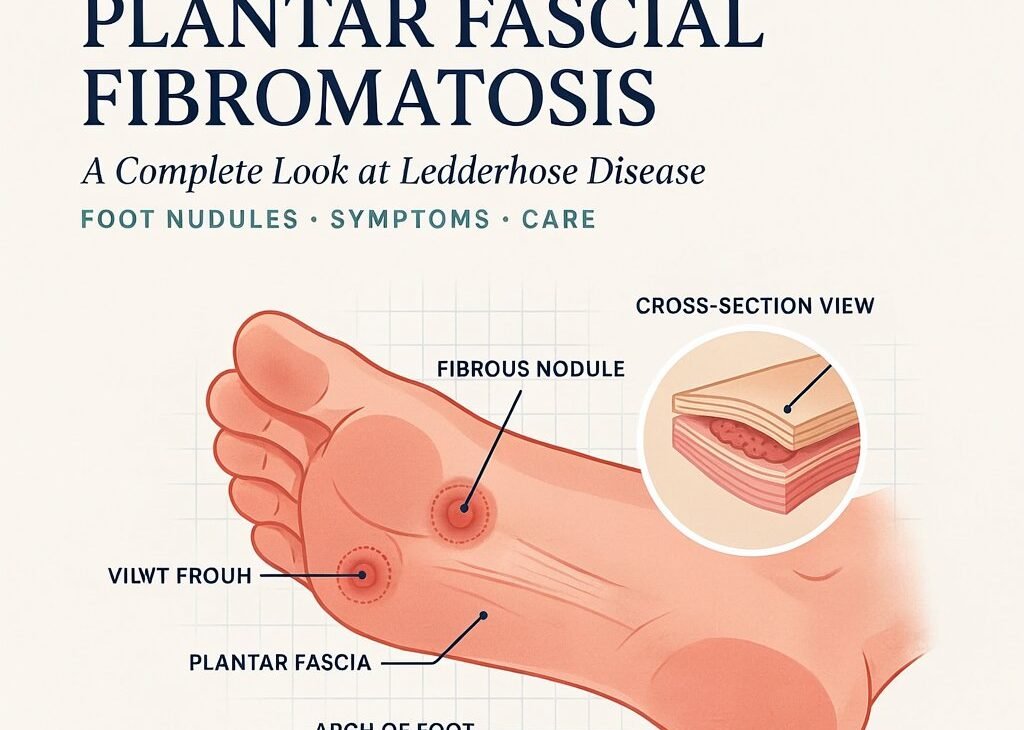
Plantar fascial fibromatosis is a benign (non-cancerous) condition where fibrous nodules — small knots of tissue — grow within the plantar fascia, the thick band of connective tissue that runs extending across the sole of your foot, running from the heel toward the base of the toes. The plantar fascia normally works like a bowstring, supporting your arch and absorbing shock every time your foot hits the ground.
In this condition, the collagen fibers inside the fascia start to overgrow in specific spots, forming one or more firm, rubbery lumps. Doctors also call this Ledderhose disease, named after the German surgeon Georg Ledderhose, who first described it in the early 1900s.
It belongs to a family of conditions known as superficial fibromatoses, which also includes Dupuytren’s contracture (a similar condition affecting the hand). In fact, some people who develop a plantar fibroma also go on to develop Dupuytren’s contracture, since both conditions share a similar underlying tissue process.
Quick Definition (Featured Snippet Friendly)
Plantar fascial fibromatosis is a rare, benign condition where fibrous knots develop in the arch of the foot, causing a firm lump under the skin. It’s also called Ledderhose disease or plantar fibroma, and it typically develops slowly over months or years.
Knots on the Bottom of Feet: What’s Actually Happening?
When people first feel these knots on bottom of feet, the natural reaction is worry. Is it a cyst? A tumor? Something worse? In most cases, it’s simply a fibroma — a benign growth of fibrous tissue.
Here’s what tends to distinguish a plantar fibroma from other foot lumps:
- It sits along the arch, usually on the inner (medial) side of the foot
- It feels firm and fixed to the tissue underneath, not freely movable like a cyst
- It grows slowly, often over several months
- It may or may not hurt, depending on its size and location
- Multiple nodules can appear over time, sometimes on both feet
Unlike a plantar wart, which sits on the skin’s surface and has a rough texture, a fibroma develops beneath the skin, within the fascia itself. Pressing on the skin over a wart usually causes sharper, more localized pain, while a fibroma tends to produce a deeper, achier discomfort.
What Causes a Painful Lump on the Bottom of Foot Under Skin?
Medical researchers haven’t pinned down one single cause for Ledderhose disease, but several factors seem to raise the risk.
Genetic Factors
There appears to be a hereditary component. If a close family member has had Dupuytren’s contracture or plantar fibromatosis, your own risk may be somewhat higher.
Repeated Trauma or Microtears
Repetitive stress on the plantar fascia — from standing for long hours, high-impact sports, or even minor unnoticed injuries — may trigger abnormal tissue repair, leading to nodule formation.
Certain Medical Conditions
Some studies have linked plantar fibromas to:
- Diabetes
- Epilepsy (particularly in people taking certain seizure medications)
- Liver disease
- Alcohol use
- Chronic use of specific medications, including some anticonvulsants
Age and Sex
The condition is more common in middle-aged and older adults, and it tends to affect men slightly more often than women, though it can appear at any age.
It’s worth stressing that having one or more of these risk factors doesn’t guarantee you’ll develop the condition. Many people with plantar fibromas have no identifiable risk factor at all.
Symptoms: How to Recognize a Plantar Fibroma
The classic sign is a hard lump on side of foot or along the arch, but symptoms can vary from person to person.
Common Symptoms
- A firm, well-defined nodule under the skin on the sole of the foot
- Slow, gradual growth over weeks or months
- Mild to moderate tenderness when standing, walking, or wearing shoes
- Thickening of the tissue around the nodule as it grows
- Occasionally, multiple nodules on one or both feet
When Pain Becomes Noticeable
Pain usually shows up once the nodule grows large enough to press against your shoe or shift how weight distributes across your foot while walking. Some smaller fibromas cause no pain at all and are discovered by accident, such as during a pedicure or while checking for a splinter.
Fibroma in Foot vs. Other Foot Lumps: How to Tell the Difference
Because several conditions can cause a bump on the sole of the foot, it helps to understand how a plantar fibroma compares to other common look-alikes.
| Condition | Location | Texture | Typical Cause |
|---|---|---|---|
| Plantar fibroma | Arch, along fascia | Firm, fixed | Fibrous tissue overgrowth |
| Plantar wart | Weight-bearing sole | Rough, callused surface | HPV viral infection |
| Ganglion cyst | Near joints or tendons | Soft to firm, movable | Fluid-filled sac |
| Lipoma | Anywhere under skin | Soft, doughy, mobile | Fatty tissue growth |
| Corn or callus | Pressure points | Hard, thickened skin | Friction and pressure |
If you’re unsure which one you’re dealing with, a podiatrist can usually tell the difference through a physical exam alone, though imaging is sometimes used to confirm.
How Is Plantar Fascial Fibromatosis Diagnosed?
A foot and ankle specialist typically starts with a physical examination, checking the size, location, firmness, and mobility of the lump. In many cases, this is enough for a clinical diagnosis.
If there’s any uncertainty, your doctor may recommend:
- Ultrasound — a quick, non-invasive way to visualize the nodule’s structure
- MRI — provides a more detailed picture, especially useful for larger or multiple nodules, or before surgery
- Biopsy — rarely needed, but performed if the growth has unusual features that don’t fit the typical pattern of a fibroma
Getting an accurate diagnosis matters because it rules out other conditions that may need very different treatment, including soft tissue tumors that require closer monitoring.
Treatment Options for Plantar Fibroma
Treatment depends largely on the size of the nodule, how much pain it causes, and how it affects your daily activities. Many small, painless fibromas don’t need aggressive treatment at all — just monitoring.
1. Conservative (Non-Surgical) Approaches
For mild cases, doctors usually start here:
- Custom orthotics or padded inserts to offload pressure from the nodule
- Supportive, wide-toe-box footwear that reduces friction on the arch
- Physical therapy and stretching to maintain flexibility in the plantar fascia
- Activity modification, such as reducing high-impact exercise temporarily
2. Steroid Injections
Corticosteroid injections can sometimes shrink the nodule and reduce inflammation, though results vary and the effect may be temporary. Multiple injections are occasionally needed.
3. Collagenase Injections
In some cases, doctors use enzyme injections (similar to those used for Dupuytren’s contracture) to break down excess collagen in the nodule. This is a newer approach and not universally available.
4. Radiation Therapy
Low-dose radiation therapy has shown promise in slowing nodule growth and reducing pain in some patients, particularly for early-stage or smaller fibromas. It’s typically considered when conservative treatment hasn’t worked.
5. Surgery
Surgical removal (a procedure called a plantar fasciectomy) is generally reserved for large, painful nodules that interfere significantly with walking and haven’t responded to other treatments. It’s important to know that:
- Recurrence after surgery is fairly common, sometimes reported in a significant percentage of cases
- Wide excision (removing a larger margin of surrounding tissue) tends to lower recurrence rates compared to simply removing the nodule alone
- Recovery typically includes temporarily reducing pressure on the foot, followed by targeted physical therapy to restore strength and mobility
Because of the recurrence risk, surgery is usually a later-stage option rather than a first response.
Living With Ledderhose Disease: Practical Tips
If you’re managing this condition day to day, small adjustments can make a real difference:
- Choose cushioned, supportive shoes over flat or thin-soled options
- Limit prolonged barefoot walking on hard floors to reduce pressure and irritation in the foot
- Use silicone or gel arch pads to reduce direct pressure on the nodule
- Keep track of any changes in size, number, or pain level, and report them to your doctor
- Maintain a healthy weight, since extra load on the feet can worsen discomfort
Most people with plantar fascial fibromatosis continue their normal activities with a few modifications. It’s a chronic condition for many, but it’s rarely dangerous.
Frequently Asked Questions
Is plantar fascial fibromatosis cancerous?
No. It’s a benign condition. The nodules are made of fibrous connective tissue, not cancer cells. However, any new or unusual growth should still be evaluated by a doctor to confirm the diagnosis.
Can a plantar fibroma go away on its own?
It’s uncommon for these nodules to disappear completely without treatment. Some stay the same size for years, while others slowly grow. Regular monitoring helps track any changes.
Does plantar fascial fibromatosis always cause pain?
No. Some people have nodules that never hurt, while others experience noticeable discomfort, especially when standing or wearing tight shoes. Pain often correlates with the nodule’s size and location.
What’s the difference between a plantar fibroma and a plantar wart?
A plantar fibroma develops beneath the skin within the fascia and feels like a fixed, firm lump. A plantar wart grows on the skin’s surface, often has a rough or grainy texture, and is caused by a viral infection (HPV), not tissue overgrowth.
Can I still exercise or walk normally with a plantar fibroma?
Many people can, especially with supportive footwear and orthotic inserts. High-impact activities may need to be adjusted if they aggravate pain, but complete immobility usually isn’t necessary.
Is surgery the best treatment for plantar fascial fibromatosis?
Not necessarily. Surgery is generally considered only after conservative treatments haven’t helped, because the recurrence rate after surgical removal can be relatively high. Non-surgical options are usually tried first.
Are plantar fibromas linked to Dupuytren’s contracture?
Yes, both conditions belong to the same family of superficial fibromatoses and share similar tissue changes. Some individuals develop both conditions, though having one doesn’t mean you’ll definitely develop the other.
Final Thoughts
Plantar fascial fibromatosis, or Ledderhose disease, can feel alarming when you first discover a hard lump on the bottom of your foot. The good news is that it’s a benign, well-understood condition with a range of treatment options — from simple footwear changes to injections, radiation therapy, or, in more severe cases, surgery.
If you’ve noticed a new nodule, don’t try to self-diagnose based on internet searches alone. A podiatrist or orthopedic foot specialist can confirm what you’re dealing with and help you choose a treatment plan that fits your lifestyle, activity level, and how much the nodule is actually bothering you. With the right approach, most people manage this condition well and keep doing the activities they enjoy.