If you’ve ever looked at a red, itchy patch on your skin and wondered whether it’s eczema or psoriasis, you’re not alone. These two skin conditions get mixed up constantly, even by people who’ve dealt with one of them for years. They can look similar at first glance, share some of the same trigger foods and stress patterns, and both make you want to scratch until your skin gives up. But underneath the surface, they’re completely different conditions with different causes, different patterns of behavior, and different treatment paths.
This guide breaks down exactly what separates eczema from psoriasis, how to spot the difference on your own skin, and what treatment options actually work for each one.
What Is Eczema?
Eczema (also known as atopic dermatitis) is a chronic skin ailment that causes the skin to be irritated, dry and very irritating. It is most frequent among youngsters, but a lot of adults live with it as well. Eczema typically occurs in families together with asthma and hay fever, a set of conditions doctors call the “atopic triad.”
The basis of eczema is a damaged skin barrier. Your skin is intended to have a top layer that traps moisture in and irritants out. In those with eczema, that barrier doesn’t operate as efficiently, so moisture escapes quickly and allergens, bacteria and irritants get in more easily. The end effect is dry, cracking skin that reacts to just about everything.
Common Signs of Eczema
- Intense itching, often before any rash appears
- Red to brownish-gray patches, especially on the hands, feet, ankles, wrists, neck, and inside the elbows or knees
- Tiny, elevated bumps may appear on the skin and can release clear fluid if scratched or irritated
- Thickened, cracked, or scaly skin over time
- Raw, sensitive skin from repeated scratching
Eczema flares often follow a pattern. Something triggers it — a harsh soap, wool clothing, sweat, stress, or a change in weather — and the skin reacts within hours or a day or two.
What Is Psoriasis?
Psoriasis is another chronic skin ailment although it operates on an entirely different mechanism. It’s an autoimmune disorder. Your immune system improperly speeds up the synthesis of skin cells, telling them to grow and shed within days instead of the customary weeks. The excess cells pile up on the surface, creating the thick, silvery-white patches of scales that are characteristic of psoriasis.
However, psoriasis is an immune-driven illness and not a barrier malfunction, and it is commonly associated with other systemic diseases such as psoriatic arthritis, cardiovascular disease, and metabolic syndrome. This is one of the primary reasons why doctors take psoriasis seriously beyond just the skin – it can be a signpost for wider inflammation in the body
Common Signs of Psoriasis
- Areas of skin that are raised and thickened into plaques, frequently with a silvery-white scale on top
Sharp, well-defined margins around each patch
Psoriasis occurs often on parts of the body such the scalp, elbows, knees and lower back
Pitting, thickening or nails coming away from the nail bed
Some persons develop joint pain or stiffness (a indication of psoriatic arthritis)
Less itchy than eczema (but still itchy)
Eczema vs. Psoriasis: Understanding the Key Differences
Here’s a comparison to quickly clarify the difference:
- What causes it? Eczema is caused when the skin barrier is damaged and skin is allergic. Psoriasis is caused by an overreaction of the immune system . This causes inflammation and a quicker turnover of cells in the skin .
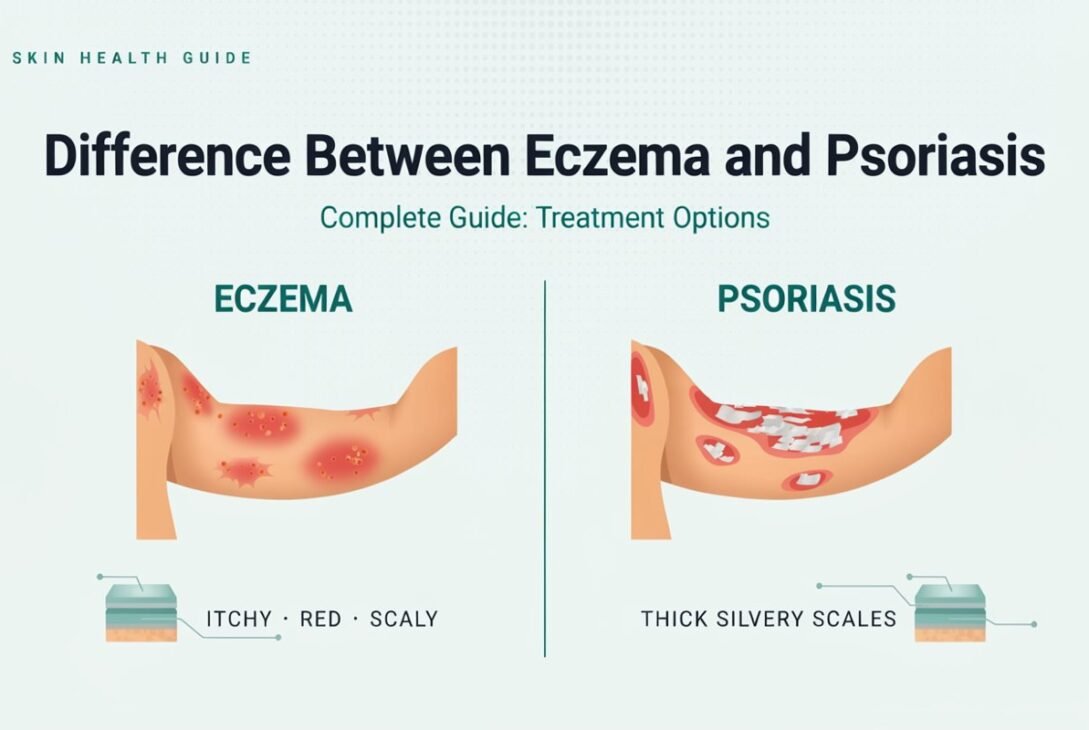
Appearance: Eczema areas seem red and irritated, with a rough or leathery appearance. Plaque psoriasis patches are thicker with well-defined margins and silvery scale.
Itch level: Eczema is usually more strongly itchy and is often the initial symptom of eczema before any rash can be seen. Psoriasis can also itch, but many patients report it feels more like burning or stinging.
Where it occurs: Eczema often occurs in the folds of elbows and knees, on the neck and on the face in youngsters. It is generally symmetrical on both sides of the body and commonly occurs on the scalp, elbows, knees and lower back.
Onset of age: Eczema usually begins in infancy or early childhood. Psoriasis usually begins later, often between 15 and 35 years of age, but can begin at any age.
Family and health links Eczema occurs with allergies, asthma and hay fever. Psoriasis connected to joint issues, heart disease risk, metabolic disorders.
Skin texture: Eczema can cause dry, cracked skin during flare-ups, including some spots that leak or crust over. Psoriasis skin looks thick and scaly, almost as if it’s been layered.
If you are looking at a patch of skin and trying to figure out which one you have, the scale is generally your strongest clue. Redness, dryness and a rash that seems to spread with scratching suggest eczema.
Why the Confusion Happens
Both illnesses produce persistent inflammation . Both can flare with stress, cold weather or irritation to the skin. They can both appear on the hands and scalp. And it’s not always visible to the eye, especially in some people, including those with lighter skin revealing early patches. This is exactly why a dermatologist’s assessment is important, sometimes only a skin sample or a thorough medical history can reliably distinguish them, especially when a milder or atypical presentation is present.
There is also something called sebopsoriasis, which has a combination of both traits, providing another wrinkle for those who are trying to self-diagnose from a mirror or search engine.
Treatment Options for Eczema
The aim of eczema treatment is to restore the skin barrier and reduce inflammation.
Repair and moisturizing
This is the basis of eczema management. Thick, non-perfumed moisturizers applied immediately after showering can help seal moisture into the skin. Lotions usually function less well than ointments and creams, which contain more oil and less water.
- Topical steroids to decrease inflammation during flares
Topical calcineurin inhibitors, such as tacrolimus or pimecrolimus, for sensitive areas such as the face and eyelids
Mild-to-moderate symptoms can be treated with topical PDE4 inhibitors
Lifestyle Modifications
- Showers: not hot, only lukewarm
Unscented soaps and laundry detergents
Knowing and avoiding particular triggers, whether it be certain textiles, foods or stress
Humidifier in dry weather or throughout winter months
Advanced therapies
For moderate to severe eczema that does not respond to topical treatment, doctors may use biologic injections, oral immunosuppressants or phototherapy (controlled exposure to UV light under medical supervision).
Treatment Options for Psoriasis
Psoriasis treatment aims to slow down the overactive immune response and reduce the buildup of skin cells.
Topical Treatments
- Corticosteroids for reducing plaque thickness and inflammation
- Vitamin D analogues, which slow skin cell growth
- Coal tar preparations for scalp and body plaques
- Retinoid creams for milder plaques
Phototherapy
Controlled exposure to ultraviolet light, done under a doctor’s supervision, can significantly reduce plaque severity for many people. This is often used when topical treatments alone aren’t enough.
Systemic and Biologic Treatments
For moderate to severe psoriasis, especially when joints are involved, doctors often turn to:
- Oral systemic medications like methotrexate or cyclosporine
- Biologic drugs that target specific parts of the immune system, such as TNF-alpha inhibitors, IL-17 inhibitors, and IL-23 inhibitors
These have changed the outlook for people with severe psoriasis significantly over the past two decades, offering much clearer skin than older treatments could achieve.
Lifestyle Adjustments
- Maintaining a healthy weight, since obesity is linked to more severe psoriasis
Limit alcohol, which can induce flares
Managing stress with regular exercise or relaxation techniques
Smoking cessation, which is strongly associated with the severity of psoriasis
When to See a Doctor
A mystery rash that you self-treat for weeks without improvement is a common mistake. If you see a dermatologist
- The rash might spread swiftly or may cover a large area of the body
Over the counter creams not working after a few weeks
You may notice skin changes that accompany with joint pain or stiffness.
The skin is crusty, leaking, or displays indications of infection.
You’re not sure if you’re dealing with eczema, psoriasis, or something else entirely, like ringworm or contact dermatitis
With either one, a dermatologist can usually determine the problem with a physical exam, but a biopsy may be performed if it is not clear.
Can You Have Both Eczema and Psoriasis?
Yes. It’s uncommon but not impossible. Having one chronic skin condition doesn’t protect you from developing the other, and some people do experience overlapping symptoms of both throughout their lives. This is another reason professional diagnosis matters more than guessing based on pictures found online.
FAQs
1. What separates eczema from psoriasis and what are the essential features that distinguish them?
Eczema is triggered by a faulty skin barrier and is connected to allergic disorders, but psoriasis is an autoimmune disease that speeds up skin cell development. Eczema tends to be more itchy and more inflamed appearing, while psoriasis generates thicker, scaly plaques with definite borders.
2. Can Eczema become Psoriasis?
No. They are two different conditions caused by different things. You can not become or turn into the other. A person can have both by themselves.
3. Eczema or psoriasis which is worse?
Nor is one generally “worse.” The severity varies on the case. Eczema can be more severely uncomfortable and more disruptive to sleep, whereas psoriasis presents a higher risk of related illnesses, such as psoriatic arthritis and cardiovascular problems.
4. Is psoriasis infectious?
No. Neither is dermatitis. Both are non-communicable. You cannot get either ailment by touching the skin of a person who has it.
5. What causes eczema and psoriasis to flare up?
Common triggers of eczema include harsh soaps, allergies, sweat, stress and changes in the weather. Psoriasis triggers include stress, skin damage, infections, alcohol and smoking, and some drugs.
6. Does food affect eczema or psoriasis?
Diet can play a supporting role for some people, but is not a treatment for either ailment. Some persons with eczema note their flares are related to certain food sensitivities and some people with psoriasis report improvement with anti-inflammatory eating patterns. Results vary from person to person. Talk to a doctor before making major diet changes.
7. Will eczema and psoriasis ever go away?
Both are often chronic, which means that they tend to come and go rather than be gone forever. But with the correct treatment plan and trigger control, many people can have long periods of clean or almost clear skin.
Conclusion
From across the room, eczema and psoriasis might look alike, yet they emanate from two completely different parts of the body. Eczema is related to a weak skin barrier and allergic reactivity and appears as itchy, red, inflamed patches. Psoriasis is caused by an excessive immune response that speeds up the proliferation of skin cells. This leads to well-defined, thicker plaques that are coated with scales. Understanding the difference is more than simply getting the right diagnosis for a rash – it impacts treatment, from moisturizers and trigger-avoidance for eczema to immune-targeting medicines for psoriasis.
If you have a persistent, baffling skin problem, don’t leave it up to chance. A dermatologist can help diagnose what’s really going on and get you on a treatment plan designed for your real problem—not simply the symptoms you can see in the mirror.