
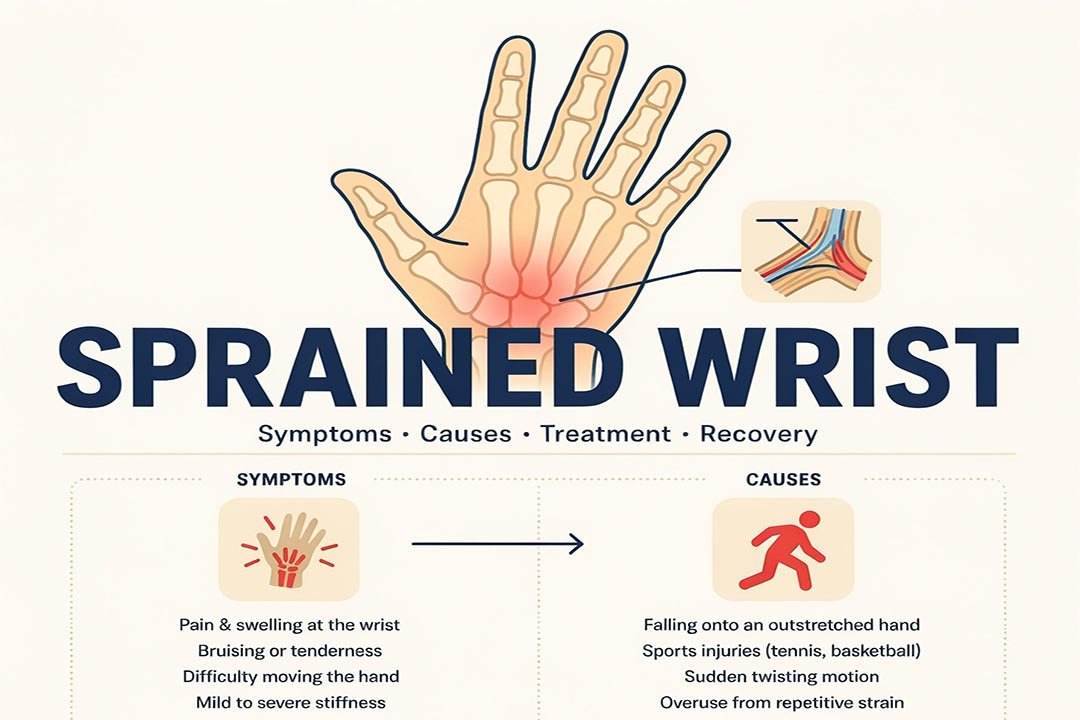
A sprained wrist can take a second. You may trip, wrench your hand awkwardly, or catch yourself in a rapid move and find your wrist is uncomfortable and hard to use. Some injuries are minor while others can include serious ligament damage or even a shattered bone.
Knowing what signs to look for will help you figure out how to treat your wrist and when expert medical assistance may be needed. So, how can you know if you’re dealing with a basic injury or something more serious? Let’s look at it a little closely.
What Is a Sprained Wrist?
A wrist sprain is an injury of one or more of the ligaments that help to hold the wrist together. Ligaments are strong bands of tissue which link bones and help to hold a joint in place.
A slight sprain may just stretch a ligament but a more significant injury can cause a partial or total tear. Ligaments are like strong supporting ropes. If you pull a rope too hard it might get overstretched and destroyed.
Wrist sprains can happen to anyone at any age. They are most common following falls, sports injuries, work injuries or unexpected blows.
What Causes a Wrist Sprain?
Wrist Sprain A wrist sprain is usually caused when the hand is placed in an unnatural position. One of the common causes is falling on an outstretched hand.
Other possible causes are:
- Sports Contact sports, gymnastics, skating and other activities that can lead to falls exert stress on the wrist.
Sudden twisting: A sudden violent wrist turn might overstretch a ligament.
Work-related injuries: Wrist problems can come from repetitive or rapid movements.
Accidents: A blow or impact can damage the tissues that support the teeth.
Daily falls: Just a simple fall at home might cause the wrist to bend quickly backward.
Sometimes the injury appears mild at first but becomes progressively uncomfortable over the next hours as swelling occurs.
Common Symptoms to Look For
The symptoms of a wrist sprain depend on how severe the injury to the ligament is.
Pain: You may feel pain right after the accident, especially when you move your wrist, hand or fingers.
Puffy appearance of the wrist may be due to swelling fluid and inflammation around the wounded region.
Bruising. Some sprains cause a change in colour around the wrist or adjoining hand.
Tenderness: The area may be painful when touched or pressured.
Limited motion: It may be difficult to rotate, bend, or straighten the wrist.
Weakness: You may have a tougher time holding onto objects or doing simple, ordinary things.
A more serious injury may produce plenty of discomfort, oedema or instability . These symptoms should not just be ignored.
Wrist Sprain vs. Broken Wrist
“Is it a sprain or a fracture?” is a question frequently asked following a wrist injury. Unfortunately, the symptoms coincide.
Both injuries can cause discomfort, swelling, bruising and trouble moving the wrist. Sometimes a fracture will result in an evident deformity, but not always.
If you cannot use your wrist regularly, there is a lot of discomfort, swelling, numbness or the contour of the wrist changes, you should get a medical assessment.
An X-ray or another imaging test may be used to identify if a bone has been shattered. It’s preferable to have an injury evaluated rather than thinking it’s only a sprain and continuing to use the wrist.
How a Sprained Wrist Is Diagnosed
Usually the healthcare professional will question how you hurt yourself, where you feel the pain and what symptoms you have had.
Examine the wrist and hand for:
- Oedema
Gentleness
Motion range
Hand strength
Joint Stablity
Symptoms of nerve or circulatory disorders
Imaging may be recommended if a fracture or other injury is suspected. X-rays can show numerous broken bones, and other imaging technologies can be used to examine soft-tissue injuries in more detail.
The aim is not only to find a sprain, but to make sure no additional injury has been neglected.
What to Do Immediately After an Injury
The first few hours following an injury count. Protect the wrist and prevent activities that exacerbate pain.
Rest can help relieve the extra stress on the wounded tissues. And wrist supported may be more comfortable for movement.
You may find that putting a cold compress, wrapped in a cloth, on the area for short periods helps with discomfort and swelling. Don’t apply ice directly to your skin, as it can harm your skin.
Elevating the hand, if possible, may also assist minimise swelling.
Don’t go back to sports, heavy lifting or activities that put a lot of pressure on the wrist quickly. Attempting to “tough it out” may make it more difficult to treat the injury.
Home Treatment and Pain Relief
Many moderate wrist sprains may improve with proper home treatment.
Rest: Allow the wrist to rest, especially in the early phases.
Cold therapy. Wrapping the cold pack over the knee might help ease pain and inflammation.
Support: Wearing a wrist brace or other support may be effective in some instances, but should not be worn unnecessarily or excessively without appropriate counsel.
Elevation: If swelling occurs, elevating the hand could be helpful.
Pain medication: Some take over-the-counter pain medications. But not all medicines are suitable for all people. Follow the product recommendations and seek a healthcare expert or chemist if you are unsure about what is right for you.
As the symptoms go better, gradual return to regular movement can assist to prevent stiffness.
When Should You See a Doctor?
Not all wrist injuries require immediate medical attention, but some warning indications should be checked immediately.
See a doctor if you experience:
- Severe or Increasing Pain
Marked oedema
Severe Bruising
Numbness or tingling
Weakness in the hands
Difficulty moving fingers or wrist
A distinctly unique wrist form
Cold, pale or blue fingertips
Pain that does not get better with basic care
If the injury was caused by a major fall or impact, you should also get medical advice.
Why take the risk? Sometimes a wrist injury that seems like a sprain is really a fracture or more serious harm to the ligaments.
Medical Treatment Options
Treatment varies on the degree of injury.
A moderate sprain can be treated with rest, support, progressive movement and pain control. More serious injuries may need a longer duration of immobilisation.
To restrict movement while the wounded tissues heal, a healthcare expert might suggest a brace or splint.
Certain cases can be treated with physical therapy. Your therapist can teach you exercises to increase flexibility, strength, coordination and wrist function.
Severe ligament damage need professional examination. In some circumstances, surgery may be advised if the ligament is entirely ripped or if there is an additional injury to the structure.
The correct treatment relies on the actual injury, not just how painful it is.
Exercises and Recovery
Gentle movement may be a crucial element of healing when the initial discomfort and swelling begins to subside.
Your health care provider may suggest a few basic workouts such as:
Range of motion: Easy wrist movements may aid to lessen stiffness.
Stretching Gradual, controlled stretching can help restore flexibility.
Strenghtening: When the wrist is ready, it is good to do light resistance workouts to regain strength.
Grip exercises These can be useful in restoring hand function, when suitable.
There’s no rush to this point. If a workout produces sharp or escalating pain, stop and seek professional advice.
There should be a gradual resumption of activities. Before you go back to strenuous sports or heavy lifting, you should be able to use your wrist for typical movements.
How Long Does a Wrist Sprain Take to Heal?
The time it takes you to heal depends on the severity of the sprain, the ligament implicated and how well your wrist is safeguarded during recuperation.
A small injury may resolve in days or weeks, whereas a moderate or severe sprain can take much longer to heal.
Pain usually resolves before full wrist strength is returned. It is tempting to get back to usual activities too soon.
Think of recovery as creating a bridge, not a ladder. The surface could seem good but the underlying structure could not be able to take tremendous traffic.” The more you do, the more time the wounded tissues have to get stronger.
If symptoms are not progressing as predicted, a healthcare professional can review the injury.
How to Prevent Future Wrist Injuries
You can’t prevent every mishap, but there are several habits that can help lower your risk.
Wear suitable protection gear such as wrist guards to prevent injuries when participating in activities where falls are common.
Warm up before exercising. Warming up your muscles and joints might help you move more comfortably.
Strengthen wrists gradually: Stronger wrists and forearms may help support your body better during physical activities.
Better balance and technique: Good movement habits can lessen the probability of awkward falls or twists.
Don’t rush back after injury: Going back to hard work before you’ve fully recovered can increase the chance of further injury.
Pay attention to your wrist rather than forcing it through nagging pain
Frequently Asked Questions
1. How do you tell if you have sprained your wrist?
Common symptoms are pain , swelling , discomfort , bruising , decreased range of motion , and weakness after an injury . Fractures can elicit similar symptoms, therefore persistent or severe symptoms should be checked by a health care expert.
2. Will a sprained wrist heal on its own?
Many mild sprains can be improved with proper rest, protection, and gradual return to regular mobility. More serious injuries may require professional treatment and recovery relies on the level of ligament damage.
3. Do you use ice on a sprained wrist?
In the early stage of an accident, a cold compress wrapped in a cloth may help reduce discomfort and swelling. Do not place ice directly on skin.
4.How long does a sprained wrist rest?
The amount of rest varies on the severity of the ailment. Avoid activities that aggravate the symptoms, and then gradually return to normal movement when the symptoms subside. If there is no recovery, seek medical advice.
5. Is it safe to work out with a sprained wrist?
In the early days of healing, it’s often smart to avoid activities that stress the damaged wrist. As recuperation proceeds, gentle workouts may be introduced, preferably on the advice of a health professional.
Final Thoughts
An injured wrist might be anything from a little annoying to a major ligament tear. In many circumstances rest, protection, good symptom management and gradual return to activities might help recovery. But if you experience extreme pain, significant swelling, numbness, deformity or ongoing symptoms, you should seek expert assessment.
If you’re not sure how serious your injury is, it’s safer to seek medical counsel than to speculate