Medical information note: this article is for general education and does not replace advice from your surgeon. The time needed to recover can differ depending on the individual’s health, the severity of the fracture, and how well the bone heals
A displaced fracture may not heal correctly without medical treatment to realign the broken bone. Sometimes a cast is enough. Often it is not. That is where ORIF surgery comes in.
If a surgeon has told you that you need this operation, you probably have a lot of questions. How long will it take? Will you walk normally again? What happens to the metal left inside your body? This guide answers those questions in plain language, with a focus on what patients actually experience.
What Is ORIF Surgery?
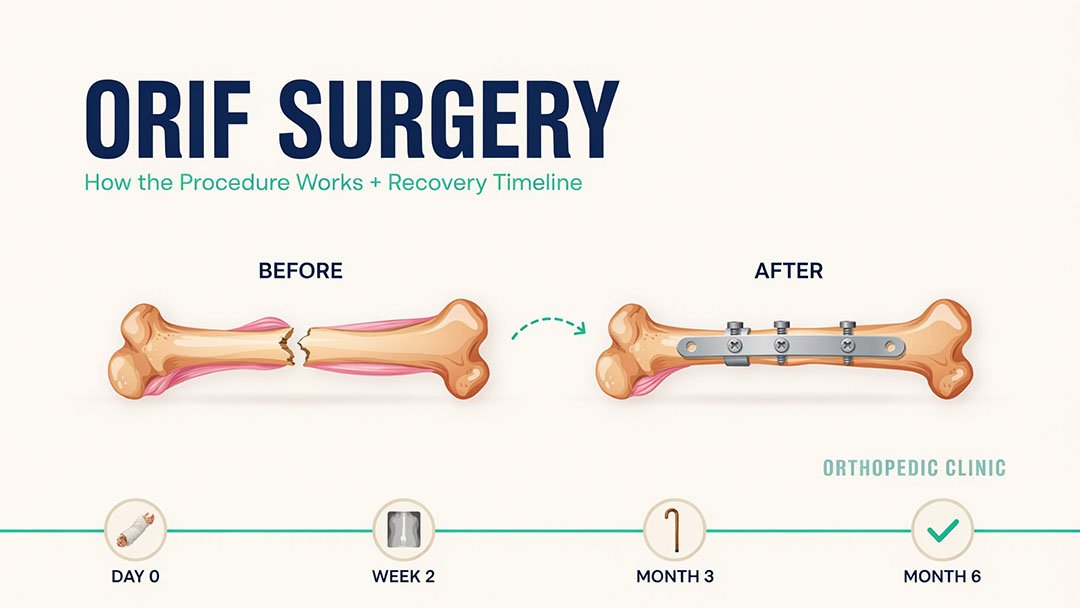
ORIF, or open reduction and internal fixation, is a surgical technique used to realign fractured bone fragments and hold them securely in place with plates, screws, or rods to promote proper healing it stable while it heals properly
The name describes the two steps:
- Open reduction: The surgeon makes an incision to see the fracture directly and moves the bone fragments back into their natural position.
- Internal fixation: The surgeon stabilizes the fractured bone fragments using medical hardware, such as plates, screws, rods, pins, or wires, positioned on or within the bone to maintain proper alignment during healing.
The hardware does not heal the bone. Your body does that. The hardware acts like a scaffold, keeping the pieces still and aligned while new bone forms around them.
Open Reduction vs. Closed Reduction
Doctors use the term reduction to mean putting a broken bone back where it belongs. The main distinction between the two procedures is the technique used to repair the fracture.
- Closed reduction realigns the bone by manipulation from outside the body, with no incision. It is often followed by a cast.
- Open reduction requires surgery because the bone cannot be set reliably from the outside.
Some operations sit in between. A surgeon may use closed reduction and then insert a rod or screws through small cuts. That is closed reduction with internal fixation, which is not the same as ORIF.
When Is Open Reduction Internal Fixation Needed?
Not every fracture needs surgery. Your surgeon will usually recommend ORIF when:
- The bone ends are displaced, meaning they have moved apart or out of line
- The break is unstable, so the bone fragments may shift from their proper position despite being immobilized in a cast.
- The break extends into a joint surface, where even a small step in the bone can lead to arthritis later
- The bone is broken in several places (a comminuted fracture)
- The bone has broken through the skin (an open fracture), often after cleaning the wound first
- A fracture failed to heal with non-surgical treatment
Common sites include the wrist, forearm, ankle, hip, elbow, collarbone, and the long bones of the leg.
How the ORIF Procedure Works, Step by Step
Every operation differs, but the general sequence looks like this.
- Anesthesia. You receive general anesthesia, or a regional or spinal block, sometimes with sedation. Your anesthesiologist will review the available options with you and recommend the most appropriate type of anesthesia based on your needs.
- Incision. The surgeon opens the skin and carefully moves muscle and tissue aside to reach the bone.
- Reduction. Fragments are cleaned of debris and lined up. Surgeons often check the position with live X-ray imaging.
- Fixation. Plates and screws, or a rod down the centre of the bone, hold everything in position.
- Closure. The wound is closed with stitches or staples and covered with a dressing. A splint or brace may be added.
Most ORIF operations take between one and three hours, though complex fractures take longer. Many ankle and wrist cases are done as day surgery. Hip fractures usually require a hospital stay.
ORIF Ankle Surgery
ORIF ankle surgery is one of the most common uses of the technique. The ankle is a hinge joint formed by three bones: the tibia, fibula, and talus, which work together to support movement and stability. A bad twist or fall can break one or more of them and damage the ligaments that hold the joint steady.
Surgical treatment may be necessary if the ankle joint becomes unstable or the fractured bones move out of their normal alignment. A small gap in an ankle joint can change how load passes through it, so surgeons aim for close to perfect alignment.
Fibula Fracture Surgery
Fibula fracture surgery is common because the outer ankle bone, the lateral malleolus, is the end of the fibula. Whether you need an operation depends largely on where the break is and whether the ankle is stable.
- A stable fibula break with no displacement is often treated with a boot or cast.
- A displaced break, or one with torn ligaments that let the ankle shift, often needs surgery.
- The usual fix is a small metal plate on the outer side of the fibula with screws. If the inner ankle or the syndesmosis (the ligament joint between the tibia and fibula) is also injured, extra screws or a suture device may be added.
A break of the fibula higher up the shin, away from the ankle, is handled differently and is often managed without surgery unless the ankle is affected.
Ankle ORIF Recovery
In a typical case, you will keep weight off the foot for around six weeks, using crutches or a knee scooter. Your surgeon decides this, because it depends on the fracture and the fixation. The stitches are generally removed around two weeks after surgery, depending on how well the incision has healed. Physical therapy then focuses on motion, strength, and balance. Many people return to desk work within several weeks and to normal activity within three to four months. Swelling may continue for six months or more as the ankle gradually heals after surgery.
ORIF Hip Surgery
The term ORIF hip is used for fractures around the upper end of the thigh bone (the femur). The right treatment depends on where the break occurs.
- Femoral neck fractures (just below the ball of the joint): In younger patients with good bone, surgeons try hard to save the natural joint and fix it with screws or a plate. In older adults, a partial or total hip replacement is often chosen instead, because the blood supply to the ball can be damaged and fixation may fail.
- Intertrochanteric fractures (below the neck): These are commonly fixed with a sliding hip screw or an intramedullary nail. Surgeons often reduce them closed with image guidance, so strictly speaking not all are ORIF.
- Femoral shaft fractures: These are usually treated with a rod.
Speed matters. Surgeons generally aim to operate on hip fractures within about 24 to 48 hours of admission, because delays are linked with more complications in older adults.
Hip ORIF Recovery
Hip fracture recovery is slower and more demanding than ankle recovery. Many patients can begin standing or walking with the support of a walker or crutches within the first 24–48 hours, depending on their recovery progress and the surgeon’s weight-bearing instructions. How much weight you can put on the leg depends on the type of fixation and the fracture. Rehabilitation may last several weeks or months, and achieving a full recovery can take anywhere from six months to a year, depending on the severity of the fracture and individual healing progress.. Patients often work with physical therapists, occupational therapists, and sometimes a rehab unit before going home.
Recovery Time After ORIF Surgery
There is no single timeline, but these ranges give a realistic idea.
| Fracture | Typical protected period | Return to most daily activity |
|---|---|---|
| Wrist or forearm | 6–8 weeks | 3–4 months |
| Ankle or fibula | About 6 weeks non-weight-bearing | 3–4 months |
| Hip (fixation) | Varies, often weeks | 3–6 months, sometimes longer |
Bone usually takes 6 to 12 weeks to knit, but strength and flexibility take longer to return. Several things speed up or slow down recovery:
- Age and overall health. Younger, healthier patients usually heal faster.
- Smoking. Nicotine reduces blood flow to bone and is strongly linked to slower healing and non-union.
- Diabetes and poor nutrition. Both can delay healing.
- Fracture severity. Open or multi-fragment breaks heal more slowly.
- Following instructions. Putting weight on too soon is a common reason for hardware failure.
Risks and Complications of ORIF Surgery
ORIF is a well-established operation with high success rates, but no surgery is risk-free. Possible complications include:
- An infection can occur at the surgical incision site or develop around the implanted plates, screws, or other fixation devices.
- Blood clots, such as deep vein thrombosis (DVT), can develop after surgery, so your healthcare team may prescribe blood-thinning medication or recommend early movement to help reduce the risk.
- Nerve or blood vessel injury
- Delayed healing or non-union, where the bone does not knit
- Malunion, where the bone heals in a poor position
- Hardware irritation. Plates close to the skin, especially at the ankle, can feel prominent or sore in cold weather
- Loosening or breakage of hardware
- Post-traumatic arthritis, particularly after joint fractures
- Stiffness and lingering pain
- Anesthesia-related reactions
Warning Signs: Call Your Surgeon
Contact your surgeon or healthcare team without delay if you experience any of the following warning signs.
- A fever or chills
- Worsening redness, increased warmth, or unusual fluid discharge from the surgical incision
- Pain that gets worse instead of better
- Calf pain, swelling, or tenderness
- Loss of sensation, a pins-and-needles feeling, or a hand or foot that becomes unusually cold or pale
Sudden chest pain or difficulty breathing requires immediate emergency medical attention. Call emergency services immediately.
Aftercare: How to Heal Well
Proper at-home care and following your recovery instructions are just as important as the surgery itself for supporting healing and preventing complications.
Wound and Pain Care
- Keep the surgical dressing clean and dry, and avoid removing or changing it unless your surgeon advises you to do so.
- Take pain medication as directed. Many surgeons now use a mix of non-opioid medicines to reduce reliance on opioids.
- Elevate the limb above heart level as much as possible in the first week or two to control swelling.
- Ice can help, but protect the skin and keep the dressing dry.
Movement and Weight-Bearing
- Follow your weight-bearing instructions exactly.
- Do the exercises your therapist gives you, even when they feel tedious.
- Walk or move the rest of your body within your limits to keep circulation up.
Healing Habits
- Stop smoking, including vaping nicotine, if you can. Ask your doctor for support.
- Eat enough protein, calcium, and vitamin D. Talk to your doctor before taking supplements.
- Keep follow-up appointments. X-rays confirm that the bone is healing in position.
Will the Hardware Be Removed?
Most plates, screws, and rods are made from titanium or stainless steel and are designed to stay in permanently. Removal is not routine. It is considered if the hardware causes pain, irritation, or infection, or occasionally in young patients. The decision is yours and your surgeon’s, and removal is a second operation with its own risks.
How to Prepare for ORIF Surgery
If your operation is planned rather than urgent, a few steps help:
- Tell your surgeon about all medicines, especially blood thinners.
- Arrange help at home, since you may not be able to drive or carry things.
- Set up a recovery space on one floor if stairs will be hard.
- Practice using crutches or a walker before surgery if possible.
- Follow fasting instructions exactly.
Frequently Asked Questions About ORIF Surgery
Is ORIF surgery major surgery?
It is considered a significant orthopedic procedure because it involves opening the skin, working on bone, and placing implants. Recovery takes weeks to months. Many ankle and wrist cases are outpatient, while hip fractures need a hospital stay.
How painful is recovery after ORIF?
Pain is usually highest in the first few days and then eases steadily. It is typically controlled with medication, elevation, and ice. Your surgeon will explain the expected healing process and recovery timeline based on the type and severity of your fracture.
How long does it take to walk after ORIF ankle surgery?
Many patients are advised to avoid putting weight on the affected leg for around six weeks before gradually transitioning to a walking boot and regular footwear with guidance from physical therapy. Walking comfortably without aids often happens around two to three months, but it varies.
Do all fibula fractures need surgery?
No. Stable fibula fractures with a steady ankle are often treated with a boot or cast. Surgery is usually recommended when the bone is displaced or the ankle joint is unstable.
What is the difference between ORIF and a hip replacement?
ORIF repairs and keeps your natural bone. A hip replacement removes the damaged part of the joint and replaces it with an implant. Surgeons choose based on the fracture type, the patient’s age, bone quality, and activity level.
Can I fly or go through airport security with hardware?
Flying is generally allowed once your surgeon clears you, but ask about timing because of clot risk. Modern implants rarely set off metal detectors, though it can happen. A card from your surgeon can help.
How long does the hardware stay in?
Often for life. It is only removed if it causes problems.
Conclusion
ORIF (open reduction and internal fixation) is a surgical procedure that restores a displaced bone to its proper alignment and stabilizes it with plates, screws, or rods to support proper healing. It is widely used for ankle fractures, fibula fracture surgery, wrist breaks, and some hip fractures. Most people recover well, though healing takes patience: weeks of protection followed by months of rehabilitation.
The best results come from three things: a skilled surgical team, careful aftercare, and following weight-bearing and therapy instructions closely. If you are facing this operation, write down your questions and bring them to your surgeon. Clear answers will make the road to recovery less stressful