Most people go their whole lives without noticing their breath. Then one day, it’s the only thing they can think about. If you or someone you love has been told they might have a lung condition, you’ve probably come across two confusing medical terms: obstructive and restrictive lung disease. They sound similar, but they affect the lungs in completely different ways.
This guide breaks down everything you need to know in plain language, so you can understand what’s happening in the lungs, how doctors tell these conditions apart, and what treatment paths look like for each.
What Is Obstructive Lung Disease?
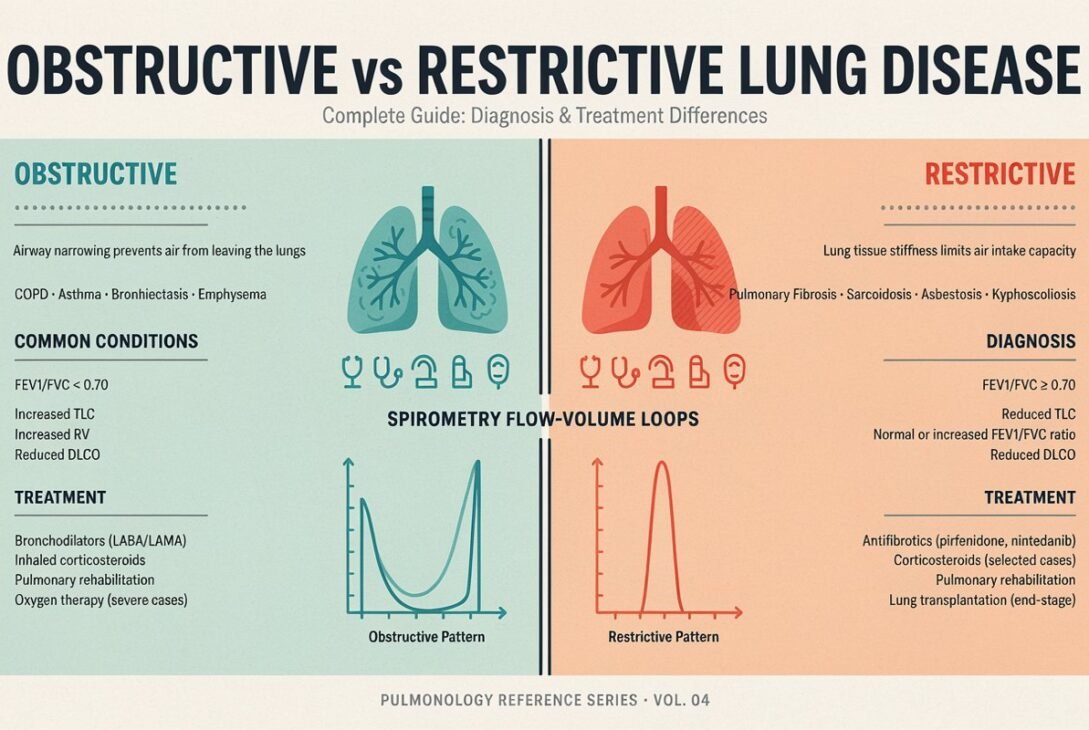
Obstructive lung disease occurs when the airways become narrowed or blocked, making it hard to push air out of the lungs. Think of it like trying to exhale through a straw that’s partially pinched. Air gets trapped inside, and the lungs struggle to empty completely.
The main culprits behind airway narrowing include inflammation, mucus buildup, and damage to the airway walls.
Common Types of Obstructive Lung Disease
- COPD – a progressive condition that typically shows up as either chronic bronchitis, emphysema, or a combination of both
- Asthma – airway inflammation triggered by allergens, exercise, or irritants
- Bronchiectasis – permanent widening of airways due to repeated infections
- Cystic Fibrosis – a genetic condition causing thick mucus buildup
People with obstructive lung disease often describe a feeling of “not being able to get air out,” rather than not being able to breathe in.
What Is Restrictive Lung Disease?
Restrictive lung disease is almost the opposite problem. Here, the lungs can’t expand fully, which limits the amount of air a person can breathe in. Instead of an airway blockage, the issue lies in the lung tissue itself, the chest wall, or the muscles that control breathing.
Imagine trying to fully inflate a balloon that’s wrapped in a tight rubber band—that’s essentially what happens inside the chest.
Common Types of Restrictive Lung Disease
- Pulmonary Fibrosis – scarring of lung tissue that stiffens it
- Sarcoidosis – inflammatory disease affecting lung elasticity
- Obesity Hypoventilation Syndrome – excess weight limiting lung expansion
- Neuromuscular Disorders (like ALS or muscular dystrophy) – weakened breathing muscles
- Severe Scoliosis – spinal curvature restricting chest expansion
People with restrictive lung disease often say they feel like they “can’t take a deep breath,” even when their airways feel clear.
Obstructive vs Restrictive Lung Disease: Key Differences
Sometimes a table says more than paragraphs of explanation ever could. Here’s one that lays out the differences at a glance.
| Feature | Obstructive Lung Disease | Restrictive Lung Disease |
|---|---|---|
| Main problem | Difficulty exhaling air | Difficulty inhaling fully |
| Airway condition | Narrowed or blocked | Usually normal |
| Lung volume | Increased (air trapping) | Decreased |
| Common causes | COPD, asthma, bronchiectasis | Pulmonary fibrosis, obesity, scoliosis |
| Breathing sound | Wheezing common | Often quiet, shallow breaths |
| Onset | Often gradual, linked to smoking or allergies | Can be gradual (fibrosis) or sudden (injury) |
Understanding this table alone answers the core question most people search for: what really separates these two categories of lung disease.
How Doctors Diagnose Obstructive vs Restrictive Lung Disease
Diagnosis usually starts with a physical exam and a detailed history of symptoms, but the real answers come from lung function testing.
1. Spirometry (Pulmonary Function Test)
Spirometry is the gold standard test used to distinguish between these two disease categories. It’s a simple process: breathe in deeply, then blow out into the mouthpiece as hard as you can. The device does the rest, capturing detailed airflow data.
Two numbers matter most:
- FEV1 (Forced Expiratory Volume in 1 second) – the amount of air forcefully exhaled within the first second of the test.
- FVC (Forced Vital Capacity) – total air you can exhale after a deep breath
In obstructive disease: FEV1 is reduced more than FVC, so the FEV1/FVC ratio is low (typically below 70%).
In restrictive disease: Both FEV1 and FVC are reduced proportionally, so the ratio often stays normal or even appears slightly high.
2. Lung Volume Testing
This test measures total lung capacity. In restrictive disease, total lung capacity is lower than normal. In obstructive disease, it can actually be higher than normal due to trapped air.
3. Diffusion Capacity Test (DLCO)
This checks how well oxygen passes from the lungs into the bloodstream. It’s reduced in emphysema and pulmonary fibrosis, but often normal in asthma.
4. Imaging Tests
- Chest X-ray – shows hyperinflated lungs in obstructive disease or scarring in restrictive disease
- CT Scan – provides detailed images, especially useful for detecting fibrosis or bronchiectasis
5. Additional Tests
Depending on symptoms, doctors may order blood tests, allergy testing, sleep studies, or a 6-minute walk test to assess oxygen levels during activity.
Symptoms: How to Tell Them Apart at Home
While only medical testing gives a definitive answer, certain clues can hint at which category someone might fall into.
Obstructive lung disease symptoms often include:
- Wheezing, especially during exhalation
- Chronic cough with mucus production
- Shortness of breath that worsens with activity
- A feeling of chest tightness
- Frequent respiratory infections
Restrictive lung disease symptoms often include:
- Rapid, shallow breathing
- Persistent dry cough
- Fatigue with minimal exertion
- Difficulty taking a full deep breath
- Unexplained weight loss (common in fibrosis)
If symptoms overlap or worsen quickly, it’s important to see a pulmonologist rather than self-diagnose.
Treatment Differences: Obstructive vs Restrictive Lung Disease
Because the underlying mechanisms are so different, treatment approaches diverge significantly.
Treating Obstructive Lung Disease
- Bronchodilators – relax airway muscles to open airways
- Inhaled corticosteroids – reduce inflammation
- Combination inhalers – used for moderate to severe COPD or asthma
- Pulmonary rehabilitation – a supervised program that builds physical endurance while teaching techniques to breathe more efficiently
- Oxygen therapy – for advanced cases with low blood oxygen
- Smoking cessation – critical for slowing COPD progression
- Vaccinations – flu and pneumonia vaccines reduce infection risk
Asthma, in particular, responds well to trigger avoidance and long-term control medications, allowing many patients to live symptom-free with proper management.
Treating Restrictive Lung Disease
Treatment depends heavily on the underlying cause:
- Anti-fibrotic medications – slow scarring in pulmonary fibrosis
- Immunosuppressants – used for inflammatory causes like sarcoidosis
- Weight management – essential in obesity-related restriction
- Physical therapy – helps with neuromuscular or skeletal causes
- Supplemental oxygen – improves quality of life in advanced stages
- Lung transplant – considered in severe, progressive fibrosis cases
Unlike obstructive disease, restrictive lung disease often has fewer medications that directly reverse the underlying damage, so treatment focuses on slowing progression and improving comfort.
Can a Person Have Both Obstructive and Restrictive Lung Disease?
Yes. This is known as a mixed ventilatory pattern, and it’s more common than many people realize—especially in long-term smokers who develop both COPD and fibrosis, or in patients with combined pulmonary fibrosis and emphysema (CPFE).
In mixed cases, spirometry results can be tricky to interpret, which is why lung volume testing and CT imaging become especially important for an accurate diagnosis.
Living With Obstructive or Restrictive Lung Disease
A diagnosis isn’t the end of a normal life—it’s the beginning of a management plan. Many patients successfully control symptoms through:
- Regular follow-ups with a pulmonologist
- Sticking to prescribed medication schedules
- Avoiding smoking and airborne irritants
- Staying physically active within safe limits
- Eating a balanced diet to support lung and muscle function
- Monitoring oxygen levels if advised by a doctor
Early diagnosis dramatically improves long-term outcomes for both disease categories, which is why persistent breathing issues should never be ignored.
Frequently Asked Questions
1. What is the main difference between obstructive and restrictive lung disease?
Obstructive lung disease makes it hard to exhale air due to narrowed airways, while restrictive lung disease limits how much air the lungs can take in due to stiffness or reduced lung expansion.
2. Which is worse, obstructive or restrictive lung disease?
Severity depends on the specific condition and stage, not the category itself. Both can range from mild to life-threatening, so individual diagnosis matters more than the general classification.
3. Can spirometry alone diagnose restrictive lung disease?
Not definitively. Spirometry can suggest a restrictive pattern, but a formal diagnosis usually requires lung volume testing to confirm reduced total lung capacity.
4. Is asthma obstructive or restrictive?
Asthma is classified as an obstructive lung disease because it involves airway narrowing and difficulty exhaling.
5. Is pulmonary fibrosis obstructive or restrictive?
Pulmonary fibrosis is a restrictive lung disease. Scar tissue stiffens the lungs, reducing their ability to expand fully.
6. Can obstructive lung disease turn into restrictive lung disease?
They don’t convert into each other, but a person can develop both conditions simultaneously, resulting in a mixed pattern that requires specialized evaluation.
7. Are obstructive and restrictive lung diseases curable?
Most are chronic and managed rather than cured. However, early treatment can significantly slow progression and improve quality of life.
Conclusion
Obstructive and restrictive lung diseases affect breathing in fundamentally different ways—one blocks airflow out of the lungs, while the other limits how much air the lungs can hold. Recognizing the differences in causes, symptoms, and treatment approaches empowers patients to seek the right care early. If you’re experiencing ongoing shortness of breath, wheezing, or unexplained fatigue, don’t wait—a simple spirometry test could be the first step toward clarity and better breathing