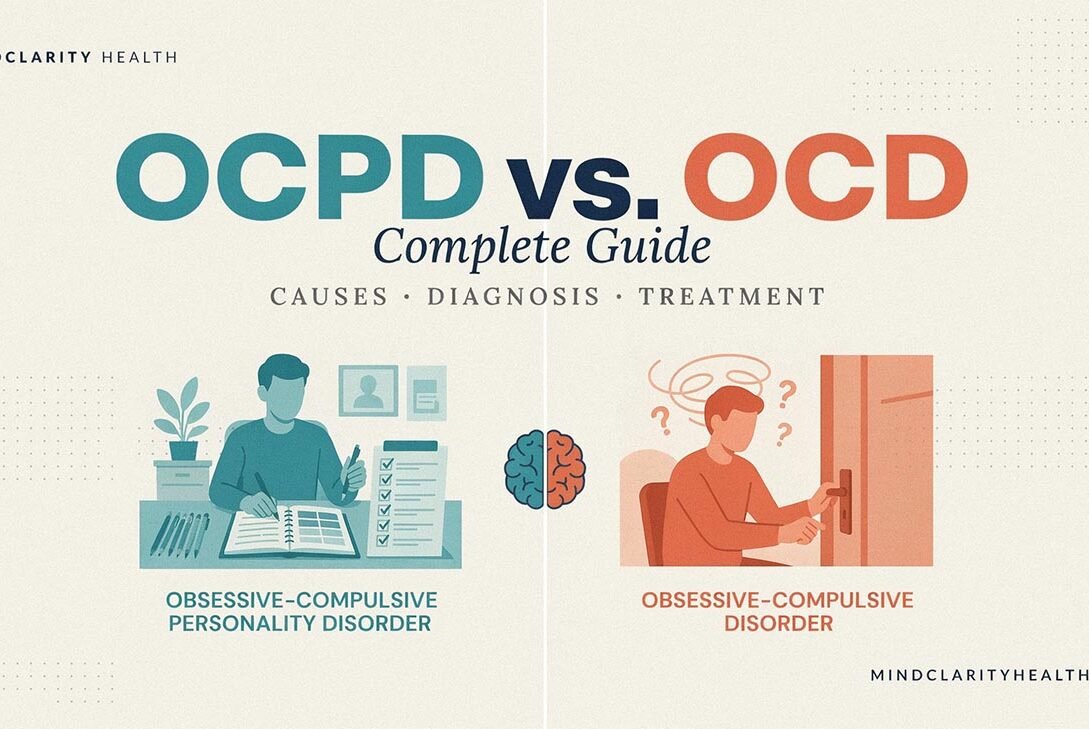
If you’ve ever typed “OCPD vs OCD” into a search bar, you’re probably trying to figure out which one describes you, a loved one, or a client. These two conditions share a similar name and a few surface-level traits, but they are fundamentally different in how they feel from the inside and how they’re treated. Mixing them up isn’t just a labeling error — it can lead to months or years of the wrong kind of therapy.
This guide breaks down both conditions in plain language, based on how they’re currently defined in the DSM-5-TR, so you can understand what separates them and what to do next.
What Is OCD?
Obsessive-Compulsive Disorder (OCD) is an anxiety-related condition built around two core components:
- Obsessions — unwanted thoughts, mental images, or urges that intrude on the mind and trigger real distress
- Compulsions — repeated actions or mental rituals carried out in an attempt to ease that discomfort
Someone with OCD might know their fear is irrational — that touching a doorknob won’t actually spread a fatal illness — but they still feel compelled to wash their hands until the anxiety fades. The compulsion isn’t enjoyable. It’s a release valve for unbearable discomfort.
OCD is classified as an anxiety-spectrum disorder. It’s ego-dystonic, meaning the thoughts feel foreign, unwanted, and inconsistent with who the person actually is. That distinction matters a lot, and we’ll come back to it.
What Is OCPD?
Obsessive-Compulsive Personality Disorder (OCPD) is a completely different category of condition — it’s a personality disorder, not an anxiety disorder. People with OCPD are preoccupied with:
- Orderliness and control
- Perfectionism that interferes with finishing tasks
- Rigid adherence to rules, schedules, and moral codes
- Excessive devotion to work at the expense of relationships or leisure
- Difficulty delegating tasks unless others do them exactly their way
Unlike OCD, OCPD is ego-syntonic. The person usually believes their way of doing things is correct — even superior. A person with OCPD rarely thinks, “This is a problem I need to fix.” They think everyone else is too careless, too messy, or too undisciplined.
OCPD vs OCD: The Core Differences
Here’s the distinction in its simplest form:
| Feature | OCD | OCPD |
|---|---|---|
| Category | Anxiety disorder | Personality disorder |
| Insight | Usually present (knows behavior is excessive) | Often absent (believes behavior is correct) |
| Nature of symptoms | Intrusive, unwanted thoughts + rituals | Personality traits woven into identity |
| Focus | Specific fears (contamination, harm, symmetry) | General perfectionism, control, rules |
| Emotional tone | Anxiety, dread, relief after compulsion | Rigidity, moral certainty, frustration with others |
| Onset | Can appear suddenly, often triggered by stress | Develops gradually, visible since early adulthood |
A useful shorthand clinicians sometimes use: OCD sufferers feel controlled by their symptoms. OCPD sufferers feel their traits control everyone else — or should.
Same Name, Different Roots
It’s easy to assume OCPD is just a “milder” or “personality version” of OCD because of the shared name. Research doesn’t fully support that idea. While some studies find modest overlap and shared genetic vulnerability, OCPD is now understood as its own distinct disorder with different underlying mechanisms, not a subtype of OCD.
Symptom Comparison in Everyday Life
Diagnostic criteria are useful, but they don’t always capture what these conditions actually feel like when you’re living through them. So here’s the day-to-day version
A person with OCD might check the stove five times before leaving the house, not because they enjoy order, but because an intrusive thought — “what if I left it on and the house burns down” — won’t leave them alone until they check. The checking brings temporary relief, not satisfaction.
A person with OCPD might spend three hours reorganizing a spreadsheet that was already functional, because the formatting wasn’t “right.” They’re not anxious about a specific catastrophe. They simply cannot tolerate something being done imperfectly, and they often feel genuinely frustrated with coworkers who don’t share that standard.
Can Someone Have Both?
Yes. Studies on comorbidity suggest a meaningful minority of people diagnosed with OCD also meet criteria for OCPD, and vice versa. When both are present, treatment usually needs to address them separately, since they respond to different therapeutic approaches.
What Causes OCD and OCPD?
Neither condition has one single cause. Both appear to arise from a mix of factors:
Possible contributors to OCD:
- Genetic predisposition (higher risk with a first-degree relative who has OCD)
- Differences in brain circuitry involving the orbitofrontal cortex and basal ganglia
- Serotonin regulation irregularities
- Stressful or traumatic life events as triggers
Possible contributors to OCPD:
- Genetic and temperamental factors, including a naturally cautious or rigid disposition
- Upbringing that emphasized strict discipline, high achievement, or conditional approval
- Learned associations between control and safety, or perfection and worth
Neither condition is caused by poor parenting alone, personal weakness, or a character flaw. Both involve a combination of biology and environment, and both are recognized, diagnosable mental health conditions — not personality quirks people can simply “snap out of.”
How Are OCPD and OCD Diagnosed?
Diagnosis for both conditions should come from a licensed mental health professional — a psychiatrist, psychologist, or clinical social worker trained in differential diagnosis. Self-diagnosis based on online quizzes is a reasonable starting point for awareness, but not a substitute for clinical evaluation.
OCD Diagnostic Criteria (Simplified)
A clinician typically looks for:
- Presence of obsessions, compulsions, or both
- These take up significant time (more than an hour a day) or cause real distress
- Symptoms aren’t better explained by another condition or substance use
OCPD Diagnostic Criteria (Simplified)
A clinician looks for a pattern, present since early adulthood, involving at least four of these:
- Preoccupation with details, rules, and order that obscures the main point of an activity
- Perfectionism that interferes with completing tasks
- Excessive devotion to work, excluding leisure and relationships
- Overconscientiousness about ethics or values
- Inability to discard worn-out or worthless objects
- Reluctance to delegate tasks
- Miserliness toward self and others
- Rigidity and stubbornness
Because OCPD symptoms feel “normal” to the person experiencing them, they’re often diagnosed only after a spouse, employer, or family member urges an evaluation — or after a related issue like depression or relationship conflict brings them into therapy.
Treatment Options: How They Differ
This is where the OCD vs OCPD distinction matters most, because the wrong treatment plan wastes time and can even reinforce unhelpful patterns.
Treating OCD
- Exposure and Response Prevention (ERP) — considered the gold-standard therapy. It involves gradually facing feared situations without performing the compulsion, retraining the brain that anxiety fades on its own.
- Cognitive Behavioral Therapy (CBT) — helps identify and restructure distorted thought patterns.
- Medication — SSRIs (selective serotonin reuptake inhibitors) are commonly prescribed and often at higher doses than for depression.
Treating OCPD
- Psychodynamic or insight-oriented therapy — helps the person understand the roots of their rigidity and how it affects relationships.
- Cognitive Behavioral Therapy (CBT) — adapted to challenge black-and-white thinking about control and perfection rather than fear-based rituals.
- Schema therapy — often used when OCPD traits are linked to early beliefs about worth being tied to achievement.
- Medication — not a first-line treatment for OCPD itself, though SSRIs may help if co-occurring anxiety or depression is present.
A key difference: ERP, the most effective OCD treatment, isn’t designed for OCPD because OCPD isn’t driven by intrusive fear-based obsessions. Using the wrong framework can leave a person with OCPD feeling misunderstood in therapy.
Living With OCD or OCPD: Practical Takeaways
- If you recognize intrusive, unwanted thoughts followed by rituals that bring only temporary relief, that pattern points toward OCD.
- If you recognize a lifelong need for control, order, and high standards that others often call “too much,” that pattern points toward OCPD.
- Either way, a proper evaluation is the fastest path to the right treatment.
- Family members and partners benefit from learning about the condition too — both disorders affect relationships significantly.
- Progress is measured differently: OCD treatment often shows results in weeks to months; OCPD, being a personality pattern, typically requires longer-term therapeutic work.
Frequently Asked Questions
Is OCPD a form of OCD?
No. Despite the similar name, OCPD is a personality disorder and OCD is an anxiety disorder. They involve different brain patterns, different levels of self-awareness, and different treatments.
Can you have both OCD and OCPD at the same time?
Yes, this comorbidity is documented in clinical research. When both exist, a therapist typically treats each condition with its appropriate method rather than assuming one approach covers both.
Which is more common, OCD or OCPD?
OCPD is actually more prevalent in the general population than OCD, though it’s diagnosed less often because people with OCPD frequently don’t see their traits as problematic.
Does OCPD get worse with age?
Traits can become more entrenched over time if left unaddressed, though therapy can meaningfully soften rigidity and improve relationships and quality of life at any age.
Is perfectionism the same as OCPD?
Not necessarily. Everyday perfectionism doesn’t disrupt daily functioning. OCPD is diagnosed when the perfectionism and rigidity significantly interfere with work, relationships, or task completion.
Can children have OCPD or OCD?
OCD can appear in childhood. OCPD, by definition, requires a pattern established by early adulthood, so it isn’t typically diagnosed in children, though early traits may be observed.
What’s the first step if I think I have one of these conditions?
Book an appointment with a licensed mental health professional for a full evaluation. Bring specific examples of your thoughts or behaviors — this speeds up accurate diagnosis.
Conclusion
OCD and OCPD share a name, and occasionally overlap, but they are distinct conditions with different roots, different emotional experiences, and different treatment paths. OCD is driven by unwanted, anxiety-fueled thoughts and the compulsions used to quiet them. OCPD is a deeply ingrained personality pattern built around control, order, and perfectionism — one the person usually sees as correct rather than distressing. Understanding this difference isn’t just academic. It’s the foundation for getting the right kind of help, whether that’s exposure-based therapy for OCD or longer-term insight-oriented work for OCPD. If any of this resonates with your own experience, a licensed mental health professional can help you get a clear, accurate diagnosis and a treatment plan that actually fits.