
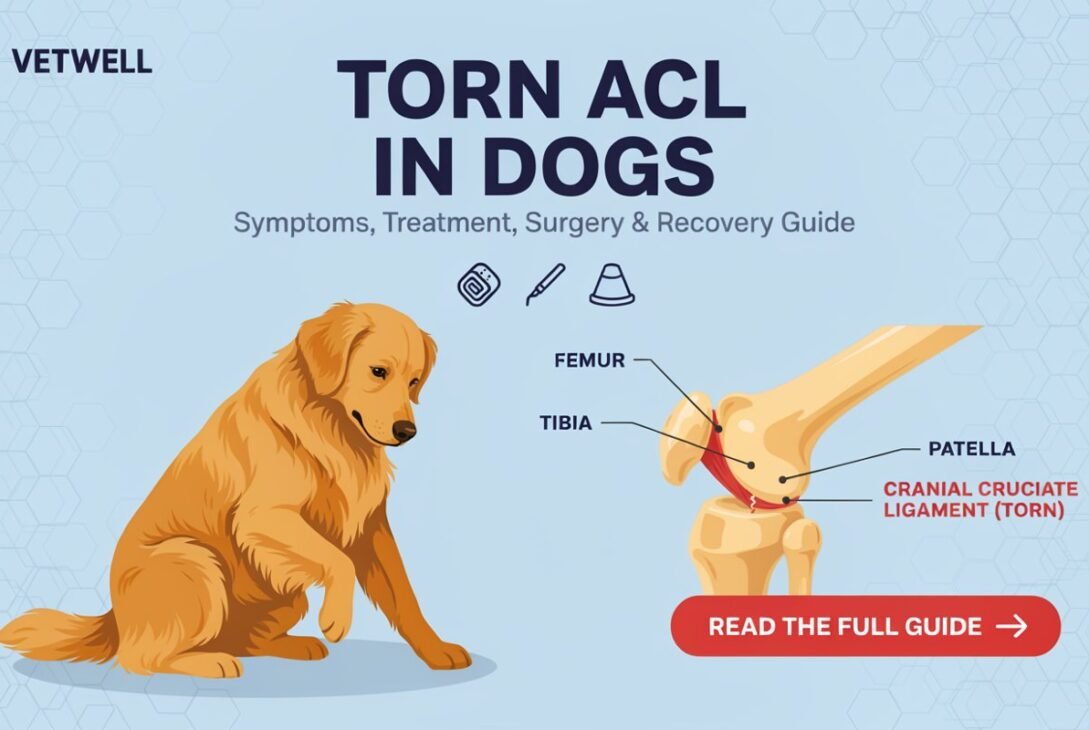
Your dog may suddenly start limping, holding up a back limb, or having trouble jumping up on the couch because of a ruptured ACL. This injury is one of the most common orthopedic problems seen by vets in dogs, and can affect any breed, age or size. Knowing what’s truly going on and what you can do about it can make a tremendous difference in your dog’s long-term comfort and ability to move.
This tutorial will explain the ins and outs of a ruptured ACL in dogs, from symptoms and causes to the treatment route, surgery possibilities, and what recovery really means
What Is a Torn ACL in Dogs?
The word “ACL” derives from human anatomy, however dogs have a structure that is virtually identical and is termed the cranial cruciate ligament (CCL). The injury behaves the same way it does in humans, therefore most people still term it a dog ACL.
This ligament is located inside the knee (stifle) joint, linking the thigh bone (femur) to the shin bone (tibia). It stabilizes the knee while you move – sprinting, jumping, turning, even standing still on uneven ground. The instability of the knee is caused by a partial or total tear of this ligament. That’s what the vets call a torn ACL in a dog.
In humans, ACL rips normally result from a single sports accident. In dogs, ACL rupture is often a slower, degenerative process. Over time the ligament gets weaker until it finally snaps, often at something as simple as leaping off a bed.
Why Do Dogs Tear Their ACL?
There is no single cause. Usually vets cite a combination of factors:
- Breed tendency – Labrador Retrievers, Rottweilers, Newfoundland and Boxers are more likely to sustain this injury.
Obesity – The knee joint is constantly under tension from excess weight. - Age-related deterioration — Older dogs often have ligaments weakened over the years.
Conformation difficulties – Some dogs are just designed with knee angles that place additional stress on the ligament.
Sudden trauma – An acute rip can occur from a forceful twist while sprinting, a rough landing, or a slip.
Remember that many dogs that tear one ACL will tear the other ACL within a year or two, because the same underlying weakness tends to affect both knees.
Symptoms of a Torn ACL in Dogs
Recognizing the indications early can help you start therapy before the joint gets worse. Typical symptoms are:
- Sudden lameness of a hind leg
Difficulty getting up from a laying position
Hesitant to jump run or go up/down stairs
There is a distinct tendency to sit with the affected leg extended rather than in the normal flexed position
Swelling of the knee
A “clicking” sound as you walk (which could mean a meniscus tear in addition to the ligament injury)
Without treatment of the injury, the affected leg will gradually lose muscle tissue
Some dogs will display a sudden dramatic limp (complete tear typical) while others are more subtle and intermittent that gets worse with activity (partial tear common).
How Vets Diagnose an ACL Tear in Dogs
If you suspect a ligament injury, the next step is to get a veterinarian exam. Often, a good diagnosis involves more than one of these methods:
Physical Examination
The vet will check for a “drawer sign” which is when the shin bone moves abnormally forward compared to the thigh bone. Usually this movement confirms a damaged ligament.
Tibia compression test
This tests the joint’s reaction to pressure, allowing vets to measure joint laxity.
X-ray
X-rays cannot directly show ligaments, but they are useful in ruling out fractures, arthritis, or bone cancers, and they can indicate joint effusion (fluid buildup), which may be suggestive of ligament damage.
High-tech imaging technology
In confusing or complex situations, especially if a meniscus tear is suspected combined with ACL injury, MRI or arthroscopy can be performed to acquire a better view.
Torn ACL in Dogs: Treatment Options
In the event of treatment, dog owners are often faced with a choice — surgery or try to manage the ailment without an operation. The best option will depend on your dog’s size, age, activity level, overall health and severity of the rip.
Conservative management
Can a dog with an ACL tear heal without surgery? Yes, in some circumstances — particularly with tiny dogs under 20-25 pounds, senior dogs with health issues that make surgery problematic, or dogs with early-detected partial tears.
Non-surgical treatment generally includes:
- Strict rest and activity limitation for 6-8 weeks or more
Weight control to relieve stress on the joints
Targeted rehab activities to improve the muscles that support the joint
Anti-inflammatory medicine for pain and swelling
Nutritional support supplements such as glucosamine and fish oil, which many vets suggest for joint health
Some owners employ custom knee braces to externally support the joint.[23]
That said, non-surgical management doesn’t fix the underlying instability. Many dogs treated this way develop arthritis faster and may have ongoing discomfort. It can work reasonably well for small, lightweight dogs, but larger, more active dogs generally have better long-term outcomes with surgery.
Treatment of Surgery
Dog ACL surgery is the way to go for most medium to large canines. Surgery directly stabilizes the joint, reduces the course of arthritis, and restores more normal function. “Surgeons have some good options, each of which provides a different technique for restoring stability to the knee:
Tibia Plateau Leveling Osteotomy (TPLO)
Right now it is the most popular and best known method for bigger dogs. The surgeon cuts and turns the top of the tibia to alter the angle of the joint so the torn ligament is no longer needed. TPLO usually gives good long term results, especially in active or bigger dogs.
Tibial Tuberosity Advancement
This operation shifts a section of the tibia to adjust the forces acting on the knee . It stabilizes the joint , but uses a different mechanical principle than TPLO .
Extracapsular Repair (Lateral Suture Method)
The usual approach is to apply a strong stitch outside the joint to replace the torn ligament. Often used for tiny dogs, it is usually less expensive than TPLO or TTA but might not be as durable in larger or more active breeds.
Your physician or a board certified veterinary surgeon will assist you select which treatment is appropriate for your dog’s size, activity level and budget.
Dog ACL Surgery Cost and What to Expect
Surgery costs vary widely depending on location, technique, and whether a specialist performs the procedure. Generally, TPLO and TTA cost more than extracapsular repair due to the specialized equipment and expertise required. Many owners find pet insurance or veterinary payment plans helpful in managing these costs.
Before committing to surgery, ask your vet about:
- The specific technique they recommend and why
- Their experience with that procedure
- Expected recovery timeline
- Aftercare requirements
- Potential complications
Recovery After Dog ACL Surgery
Recovery is a process, not an event. Most dogs need 8 to 16 weeks to heal fully, though timelines vary by procedure and individual dog.
Typical Recovery Phases
Week 1-2: Rest, Rest, Rest
Crate rest is necessary. Bathroom breaks only, short, on leash. This is the time when most problems occur if owners allow their dog to move around too freely.
Week 3-6: Guided Activity.
Short leashed walks to increase gradually. This is frequently when physical therapy activities start, under the guidance of your physician or a canine rehabilitation specialist.
Weeks 7-12: Gradually increasing strength
Add longer walks, gentle stairs and balance exercises gradually. Swimming (hydrotherapy) is commonly recommended as it builds muscle without joint impact.
Weeks 12+: Return to normal activities
Most dogs can slowly return to running and play, but it can take up to 4-6 months to fully recover and mend bones (particularly after TPLO).
One of the major variables in a successful outcome is attentively following your vet’s rehabilitation plan. The #1 reason for setbacks or re-injury is rushing the procedure.
Preventing Dog Ligament Injury
While you can’t always prevent an ACL tear, especially in predisposed breeds, you can reduce the risk:
- Keep your dog at a healthy weight
- Build up exercise gradually rather than sudden bursts of activity
- Avoid repetitive high-impact activities on hard surfaces
- Support joint health with appropriate supplements, especially in senior or large-breed dogs
- Schedule regular vet checkups to catch early signs of joint weakness
Frequently Asked Questions
1. How can I tell if my dog has a torn ACL?
The most typical indicators are sudden lameness in the back legs, difficulties in rising, reluctance to jump and holding the leg up when sitting. It needs to be confirmed with a vet exam with a draw down test.
2. Can a dog’s ACL mend on its own?
Ligament tissue has low blood supply, so a completely torn ligament will not mend back to normal by itself. Some dogs, especially tiny ones, can fare quite well without surgery in the presence of scar tissue growth and muscle support but the joint is usually not as secure as before.
3. Is it worth getting dog ACL surgery?
In medium to large size, athletic dogs, surgical care often gives better long-term mobility, slower progression of arthritis and quicker return to normal activity than non-surgical management.
4. How long will a dog hobble with a ruptured ACL?
Without therapy, limping might continue permanently or get worse over time. Most dogs do much better within 8-12 weeks with surgery and the right treatment.
5. What’s The Outcome If A Dog’s Torn ACL Is Left Untreated?
When left untreated, ACL injuries can cause chronic instability, early onset arthritis, muscle atrophy and a greater chance of rupturing the meniscus or the ligament of the other knee.
6. Can small dogs live with a ruptured ACL without surgery?
Small, lightweight dogs can do well with conservative treatment, particularly with rigorous rest and weight restriction, although results vary with each individual case and the severity of the tear.
7. What is the normal price of dog ACL surgery?
Cost varies widely by area, procedure and clinic, with TPLO and TTA being more expensive than extracapsular repair. The easiest way to plan for it is to get a price directly from your vet.
Conclusion Summary
A ruptured ACL in dogs is a serious ailment but relatively controllable. Your dog’s size, age and activity level will determine whether surgery is necessary or whether they can recover with conservative care. Most dogs go on to enjoy full, active lives following a ligament injury with the correct care.