If you’ve ever sat in a dermatologist’s office while the lights went out and a purple glow swept across your skin, you’ve already met a Wood’s lamp. It looks almost theatrical — a small handheld device casting an eerie violet light — but behind that glow is a decades-old diagnostic tool that dermatologists still trust today.
This guide breaks down what a Wood’s lamp actually is, how it works, what it can (and can’t) detect, and why it remains relevant for diagnosing scalp and skin conditions, including fungal infections. Whether you’re a patient trying to understand a recent exam or someone researching skin diagnostics out of curiosity, this article will walk you through everything in plain, practical language.
What Is a Wood’s Lamp?
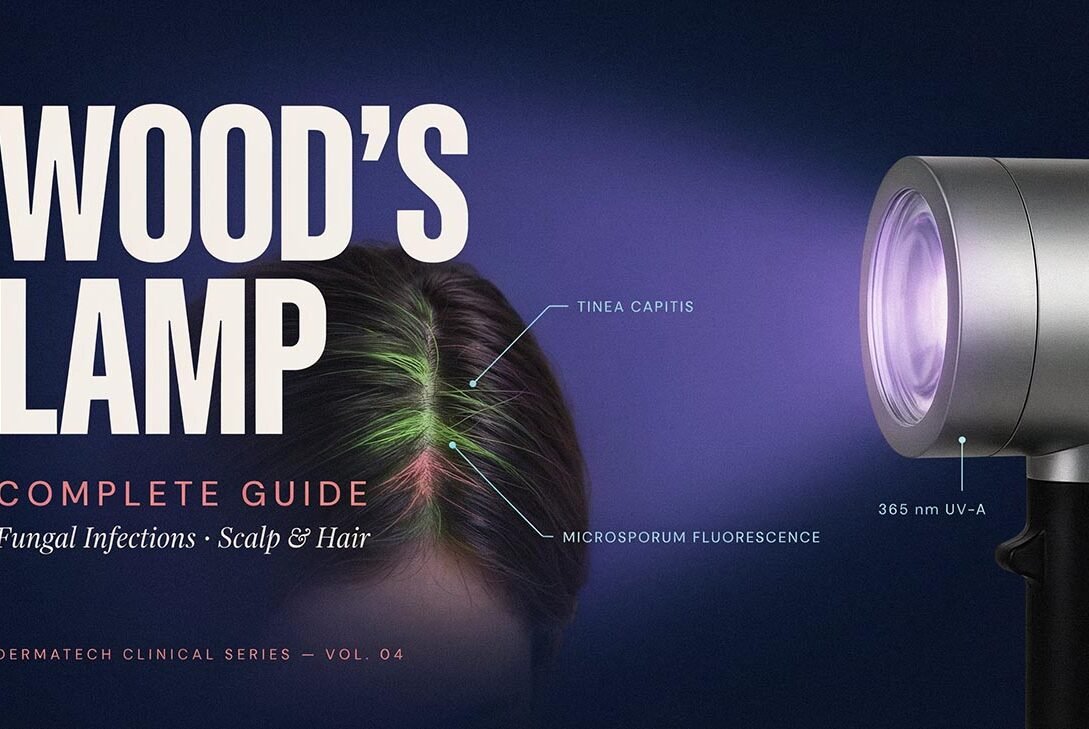
A Wood’s lamp is a diagnostic device that emits ultraviolet (UV) light, typically in the UVA range around 365 nanometers, filtered through a special glass containing nickel oxide. This filtering blocks most visible light, allowing only the long-wave UV rays to pass through, which is what creates that distinctive dark purple or violet glow.
The device was invented by physicist Robert Williams Wood in the early 1900s, and although his original intention wasn’t medical diagnosis, dermatologists quickly realized its value. When UV light hits certain skin conditions, bacteria, or fungal elements, it causes them to fluoresce — meaning they glow in specific colors that help identify what’s going on beneath the surface.
In short: a Wood’s lamp is a low-cost, non-invasive UV screening tool used mainly in dermatology to detect fungal infections, pigment disorders, and certain bacterial skin conditions.
How Does a Wood’s Lamp Work?
The science behind it is simpler than it looks. Certain organic compounds and microorganisms contain molecules that absorb UV light and re-emit it as visible light — a process called fluorescence. Different substances fluoresce in different colors, and that’s the key to how this tool helps with diagnosis.
Lighting matters more than you’d think here. The exam room is usually darkened first, since regular light tends to overpower the lamp’s subtle fluorescence. The examiner holds the lamp close to the skin or scalp, usually four to five inches away, and looks for color changes that indicate specific conditions.
Common Wood’s Lamp Fluorescence Colors and What They Mean
- Blue-green glow – often associated with Microsporum fungal infections (a type of ringworm)
- Coral-red or pink-orange – frequently linked to Corynebacterium minutissimum, the bacteria responsible for erythrasma
- Bright blue-white – can indicate vitiligo, where pigment-producing cells are absent
- Yellow-green – sometimes seen in seborrheic areas or with certain Pityrosporum yeast infections
- No fluorescence – doesn’t rule out infection; some fungal species simply don’t glow
This chart isn’t exhaustive, and colors can vary slightly depending on the device’s calibration and the surrounding lighting, but it gives a general idea of what dermatologists are trained to look for.
Wood’s Lamp and Fungal Infections
One of the most common uses of a Wood’s lamp is screening for fungal infections, particularly those affecting the scalp and skin. Fungal infections like tinea capitis (scalp ringworm) and tinea corporis (body ringworm) are caused by dermatophytes — a group of fungi that thrive on keratin, the protein found in skin, hair, and nails.
Not all fungal species fluoresce under UV light, which is an important detail many people misunderstand. Microsporum canis and Microsporum audouinii, for example, typically produce a greenish glow. However, Trichophyton species — another common cause of ringworm — usually don’t fluoresce at all. This means a negative Wood’s lamp result doesn’t automatically mean there’s no fungal infection present. That’s when a follow-up test — like scraping a small skin sample for KOH microscopy or sending it off for a fungal culture — comes into play to get a clear answer.
This is a crucial point for anyone researching Wood’s lamp exams: it’s a helpful screening tool, not a definitive diagnostic test on its own.
Wood’s Lamp for Scalp Conditions
Scalp health is one of the primary reasons people search for information about Wood’s lamp exams. Conditions like tinea capitis are especially common in children and can spread quickly in schools or households. Since some strains fluoresce under UV light, a Wood’s lamp exam is often the first, fastest way for a dermatologist to get a preliminary read before recommending treatment.
Why Scalp Fungal Infections Matter
Left untreated, fungal scalp infections can lead to:
- Patchy hair loss
- Scalp inflammation or tenderness
- Secondary bacterial infections from scratching
- Spread to other family members or close contacts
Early detection matters because prompt antifungal treatment — usually oral rather than topical, since scalp infections penetrate hair follicles — tends to produce faster, more complete recovery.
What a Scalp Exam Typically Looks Like
During a scalp-focused Wood’s lamp exam, the dermatologist dims the lights, moves the lamp slowly across affected areas, and checks for the blue-green fluorescence associated with certain dermatophytes. They’ll often pair this with a physical exam, checking for broken hair shafts, scaling, or redness, since visual cues combined with UV findings give a fuller picture than either method alone.
Other Skin Conditions Diagnosed With a Wood’s Lamp
While fungal infections and scalp issues are common search topics, Wood’s lamps are used for a surprisingly wide range of dermatological evaluations.
Pigment Disorders
Vitiligo, a condition where skin loses pigment in patches, becomes much more visible under UV light. This helps dermatologists map the exact borders of affected areas, which is especially useful for tracking treatment progress over time.
Bacterial Infections
Erythrasma, caused by Corynebacterium minutissimum, produces a distinct coral-red fluorescence. This helps differentiate it from fungal infections that look similar to the naked eye but require completely different treatment.
Porphyria
Certain porphyrin-related conditions cause urine or skin lesions to fluoresce a pinkish-red color, assisting in rare disease diagnosis.
Assessing Skin Damage
You’ll also find Wood’s lamps popping up in skincare studios, not just dermatology offices, where estheticians use them to check for sun damage, excess oil, or uneven pigmentation
Wood’s Lamp vs. Other Diagnostic Tools
People often ask how a Wood’s lamp compares to other fungal or skin diagnostic methods. Here’s a simple breakdown:
| Method | Speed | Accuracy | Invasiveness |
|---|---|---|---|
| Wood’s Lamp | Instant | Moderate (species-dependent) | None |
| KOH Microscopy | Minutes | High | Minimal (skin scraping) |
| Fungal Culture | Days to weeks | Very high | Minimal |
| Dermoscopy | Instant | Moderate to high | None |
The takeaway: a Wood’s lamp is best used as a first-line screening step, not a replacement for lab-based confirmation when precision matters.
Is a Wood’s Lamp Exam Safe?
Yes. Wood’s lamp exams are non-invasive, painless, and don’t involve ionizing radiation. The UVA light used is similar in wavelength to what’s found in sunlight, though at much lower intensity and for a very brief exposure time. Dermatologists consider it safe for children, pregnant patients, and repeated use during treatment monitoring.
That said, prolonged or repeated direct eye exposure to UV light isn’t recommended, which is why practitioners typically avoid shining the lamp directly into the eyes.
Preparing for a Wood’s Lamp Examination
If you or your child have an upcoming Wood’s lamp exam, a few simple steps can improve accuracy:
- Avoid applying makeup, lotions, or ointments to the area beforehand, since these can mask or mimic fluorescence
- Skip the harsh antifungal or antibacterial washes right before your visit — they can mess with what the lamp picks up
- Try to wear something that lets the doctor easily reach the area in question, so you’re not fumbling with layers during the exam
- Let your dermatologist know about any topical treatments you’ve used recently, since they can skew the exam results
Frequently Asked Questions
1. Does a Wood’s lamp hurt?
No. It’s completely painless. The device simply shines UV light onto the skin or scalp from a short distance, and there’s no physical contact required.
2. Can a Wood’s lamp detect all fungal infections?
No. Some fungal species, like many Trichophyton strains, don’t fluoresce under UV light. Just because nothing glows doesn’t mean you’re in the clear — that’s why doctors often recommend a follow-up test to be sure.
3. How long does a Wood’s lamp exam take?
Typically just a few minutes. The exam itself is quick, though the dermatologist may spend additional time on a broader physical examination.
4. Is Wood’s lamp testing accurate?
It’s a reliable screening tool but not 100% definitive. Its accuracy depends on the specific organism involved, so it’s often combined with microscopy or culture testing for confirmation.
5. Is it possible to use a Wood’s lamp at home?
Handheld UV flashlights marketed as “Wood’s lamps” are available for home use, but they typically aren’t as powerful or precise as clinical-grade devices. For any suspected infection, a professional evaluation is strongly recommended.
6. Does Wood’s lamp fluorescence mean the infection is contagious?
Fluorescence itself doesn’t indicate contagiousness. Contagious risk depends on the type of organism, not whether it glows under UV light.
7. Why do dermatologists use a Wood’s lamp for vitiligo?
Because vitiligo patches often become more distinct under UV light, making it easier to map the exact boundaries of depigmented skin, especially in people with lighter skin tones where patches may be less visible in normal light.
Final Thoughts
A Wood’s lamp might look like a simple gadget, but it plays a genuinely useful role in modern dermatology. From spotting certain fungal infections and scalp conditions to helping map pigment disorders like vitiligo, this UV-based tool gives doctors a fast, non-invasive first look at what’s happening with your skin or hair.
Still, it’s not a stand-alone diagnostic solution. Because not every fungus fluoresces, and because lighting conditions or recent skincare products can affect results, a Wood’s lamp exam is best understood as one piece of a larger diagnostic puzzle. If you’re dealing with unexplained scalp issues, unusual pigmentation, or persistent skin changes, pairing a Wood’s lamp screening with professional lab testing gives you the clearest, most accurate path toward proper treatment