You’re limping around, your ankle is swollen, and you’re staring at it wondering: is this just a sprain, or did I actually break something? It’s one of the most common questions people ask after twisting an ankle on a curb, during a pickup basketball game, or missing a step on the stairs.
Truthfully, you usually can’t figure it out just from the way it looks. Sprains and fractures can feel eerily similar in the first few hours. Swelling, tenderness, and a limp usually show up with either type of injury. But how you treat them—and how quickly you need medical care—can be very different. This guide breaks down the real differences, warning signs, treatment options, and recovery timelines so you know exactly what to do next.
What Is an Ankle Sprain?
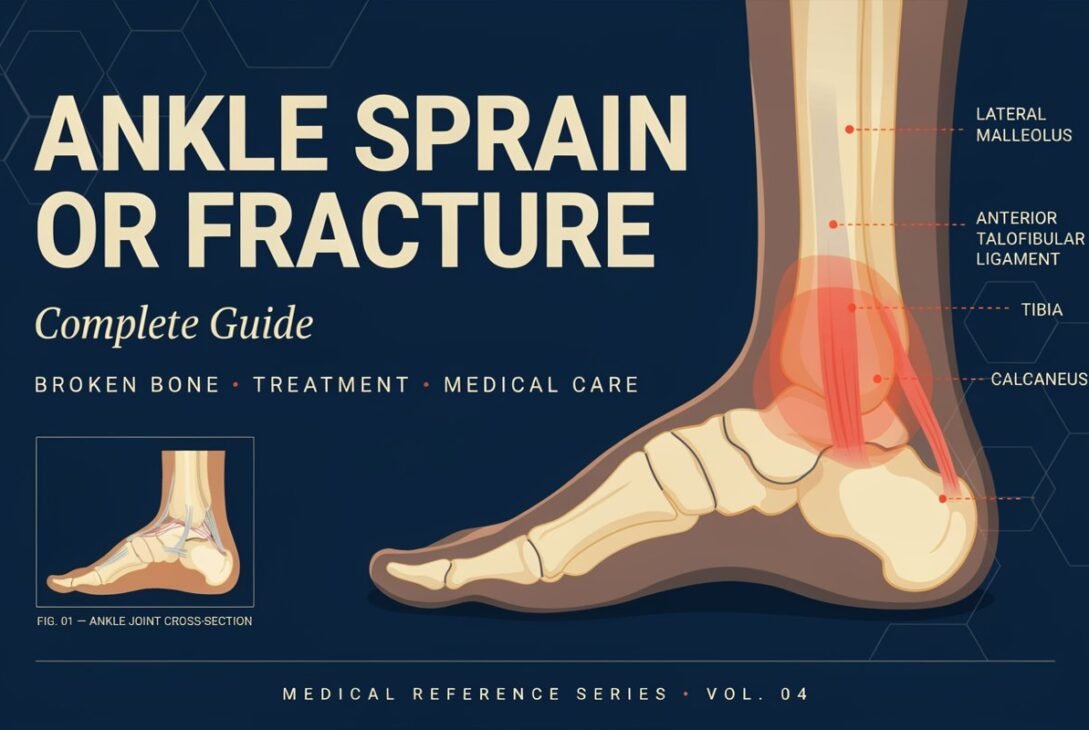
An ankle sprain happens when the ligaments that hold your ankle bones together get stretched or torn. Ligaments are tough, fibrous bands of tissue, and they’re not designed to bend very far sideways. When your foot rolls inward or outward too fast, those ligaments take the hit instead of the bone.
Most sprains happen on the outside of the ankle, involving the anterior talofibular ligament. This is why you’ll often hear people say they “rolled” their ankle rather than “broke” it.
Common causes of ankle sprains:
- Walking or running on uneven ground
- Landing awkwardly after a jump
- Wearing shoes with poor ankle support
- Sudden changes in direction during sports
- Simply misstepping off a curb
What Is an Ankle Fracture?
An ankle fracture is a break in one or more of the bones that make up the ankle joint—the tibia, fibula, or talus. Unlike a sprain, which involves soft tissue, a fracture is damage to the actual bone structure.
Fractures range from small hairline cracks to complete breaks where the bone shifts out of place. Some fractures are stable and heal with a cast, while others require surgery involving plates and screws to hold the bone together properly.
How to Tell an Ankle Sprain Apart from a Fracture
Everyone wants a shortcut here. While only an X-ray can give you a real answer, your body often drops some early hints worth paying attention to.
Signs That Suggest a Sprain
- Pain is present but somewhat tolerable
- You can put at least some weight on the foot, even if it hurts
- Swelling develops gradually over a few hours
- Bruising appears but isn’t severe
- The ankle feels “loose” or unstable when you move it
Signs That Suggest a Fracture
- Pain is sharp, intense, and localized directly over the bone
- You cannot bear any weight at all
- Swelling and bruising appear almost immediately
- The ankle looks visibly deformed or crooked
- You heard or felt a distinct snap or pop at the moment of injury
- Numbness or tingling in the foot
If you’re dealing with several signs from the fracture list, it’s time to stop guessing and get imaging done.
The Ottawa Ankle Rules: A Trusted Clinical Guide
Emergency doctors often use a screening tool called the Ottawa Ankle Rules to decide whether an X-ray is necessary. It’s a simple, well-validated system that helps avoid unnecessary imaging while still catching real fractures.
Generally, an X-ray is recommended if:
- You cannot take four steps immediately after the injury and in the emergency room
- There’s bone tenderness along the back edge or tip of either ankle bone (the malleolus)
- There’s tenderness at the base of the fifth metatarsal or the navicular bone in the midfoot
This isn’t a substitute for a professional exam, but it explains why some people get sent home with an ice pack while others get X-rayed right away.
When to See a Doctor Immediately
Don’t try to tough this one out at home if you notice any of the following:
- Visible deformity of the ankle or foot
- Complete inability to bear weight
- Numbness, tingling, or a cold, pale foot
- The skin over the injury is broken (open fracture)
- Pain that keeps getting worse rather than improving
- Swelling so severe the skin looks shiny or tight
These are red flags that point toward a fracture or a severe sprain that needs professional evaluation, not home remedies.
Diagnosis: How Doctors Confirm a Sprain or Fracture
A physical exam is always the starting point. Your doctor will check for:
- Points of tenderness
- Range of motion
- Swelling and bruising patterns
- Ability to bear weight
If the exam points toward a broken bone rather than a sprain, an X-ray is typically the go-to next step to confirm it. In more complicated cases—like suspected ligament tears that don’t show up on X-ray, or fractures involving the joint surface—doctors may order an MRI or CT scan for a more detailed picture.
Treatment Options for an Ankle Sprain
Most sprains, even moderately severe ones, heal well with conservative treatment. The classic approach doctors still recommend is the RICE method, sometimes updated to POLICE.
RICE Method Explained
- Rest – Avoid putting weight on the injured ankle for the first 24 to 48 hours.
- Ice – Apply an ice pack for 15–20 minutes every couple of hours to control swelling.
- Compression – Use an elastic bandage to limit swelling, but not so tight it cuts off circulation.
- Elevation – Rest your foot on pillows so it sits above heart level, which helps drain excess fluid and ease swelling
Additional Sprain Treatment Steps
- Over-the-counter pain relievers like ibuprofen to manage pain and inflammation
- An ankle brace or splint for support during the first week or two
- Gradual return to weight-bearing as pain allows
- Physical therapy exercises to restore strength and balance once acute pain subsides
If it’s a mild sprain, you’re usually looking at somewhere between one and three weeks before you’re back to normal. Severe sprains involving complete ligament tears can take 6 to 12 weeks, and in some cases, longer for full athletic return.
Treatment Options for an Ankle Fracture
Fracture treatment depends heavily on the type and severity of the break.
Non-Surgical Treatment
For stable fractures that haven’t shifted out of position, doctors typically use:
- A cast or removable walking boot
- Crutches to keep weight off the leg
- Follow-up X-rays to confirm proper healing
- A gradual transition back to weight-bearing over several weeks
Surgical Treatment
If the fracture is displaced, unstable, or involves multiple bones, surgery may be necessary. This usually involves:
- Open reduction and internal fixation (ORIF), where plates and screws hold the bone in place
- A period of non-weight-bearing recovery, often 6 to 8 weeks
- Physical therapy once the bone has sufficiently healed
Fracture recovery generally takes longer than a sprain—anywhere from 6 weeks for simple breaks to several months for complex or surgical cases.
Comparing Recovery Timelines
| Injury Type | Typical Healing Time |
|---|---|
| Mild sprain | 1–3 weeks |
| Moderate sprain | 3–6 weeks |
| Severe sprain | 6–12 weeks |
| Non-surgical fracture | 6–8 weeks |
| Surgical fracture | 3–6 months |
These are general ranges. Age, overall health, and how closely you follow your treatment plan all affect actual recovery speed.
Can You Walk on a Sprained or Fractured Ankle?
This question comes up constantly, and the answer isn’t as simple as yes or no.
With a mild sprain, limited walking is often possible and even encouraged once initial swelling settles down. With a moderate to severe sprain, walking may be painful and should be limited until the ligament starts healing.
With a fracture, walking on it can cause the bone to shift further out of alignment, potentially turning a simple break into a surgical case. If you can’t bear weight at all after an ankle injury, treat it as a possible fracture until proven otherwise.
Preventing Future Ankle Injuries
Once you’ve sprained or fractured an ankle, you’re statistically more likely to injure it again. A few practical habits can lower that risk:
- Build up the muscles around your ankle through balance and stability training
- Wear supportive, properly fitted footwear for your activity
- Take a few minutes to warm up your muscles and joints before diving into sports or strenuous activity
- Use an ankle brace during high-risk activities if you have a history of injury
- Pay attention to uneven surfaces, especially outdoors
Frequently Asked Questions
1. How can I tell if my ankle is sprained or broken without an X-ray?
You can’t know for certain without imaging, but inability to bear any weight, visible deformity, and intense localized pain over the bone are strong signs of a fracture rather than a sprain.
2. Is a sprained ankle worse than a broken one?
Not necessarily. A severe ligament tear can actually take longer to heal and cause more long-term instability than a simple, non-displaced fracture.
3. Should I go to the ER or urgent care for an ankle injury?
If there’s visible deformity, numbness, or you can’t bear any weight, go to the ER. For pain and swelling without those red flags, urgent care is usually sufficient.
4. Can you still move your foot with a fracture?
Sometimes, yes. Limited movement doesn’t rule out a fracture, especially with hairline or stress fractures, which is why imaging matters.
5. How long should I stay off my ankle after a sprain?
Most people rest for 24 to 48 hours, then begin gentle weight-bearing as tolerated, guided by pain levels.
6. Does swelling mean it’s broken?
Not necessarily. Both sprains and fractures cause swelling. The speed and severity of swelling can offer clues, but it’s not a reliable standalone indicator.
7. When can I return to sports after an ankle injury?
This depends entirely on severity and treatment. Mild sprains may allow return in a few weeks; fractures, especially surgical ones, often require 3 months or more, guided by your doctor’s clearance.
Conclusion
Telling a sprained ankle apart from a fractured one isn’t always straightforward, and that’s okay—it’s exactly why medical evaluation exists. Pay attention to your body’s signals: sharp localized pain, inability to bear weight, and visible deformity all point toward a possible fracture and warrant prompt medical care. Milder symptoms that improve with rest, ice, and elevation often indicate a sprain you can manage conservatively. When in doubt, getting an X-ray is a small step that can save you weeks of unnecessary pain or complications down the road. Your ankle carries your whole body weight every day—give it the accurate diagnosis and proper care it deserves