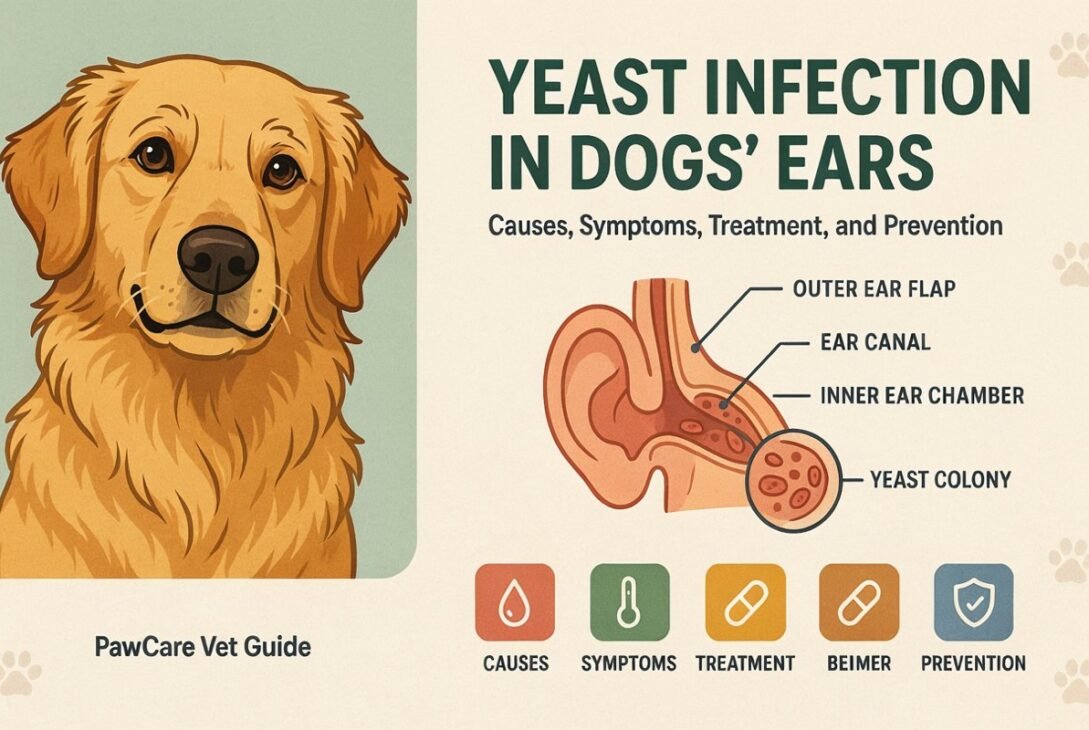
If your dog is continually scratching an ear, shaking their head, or there is a strange odour coming from the ear canal, you might be asking yourself what is happening. One frequent possibility is an ear infection from yeast.
Usually, tiny amounts of yeast can live on a dog’s skin and in their ears in harmony. Yes, problems can occur if the ear environment changes and the yeast gets out of hand. The yeast most commonly related to this form of ear inflammation in dogs is Malassezia.
Fortunately, most uncomplicated cases respond well to appropriate veterinary care. The trick is finding out what caused the yeast to overgrow in the first place. Otherwise, the problem may recur.
What Is a Yeast Infection in a Dog’s Ear?
Otitis externa is a commonly used phrase to refer to an ear infection caused by yeast, usually in the outer ear canal. A yeast infection occurs when yeast overgrows, causing discomfort, discharge, redness, irritation, and itching.
The ear canal is like a little, warm room. Under normal settings, its inherent balance prevents germs from proliferating. Yeasts thrive when conditions change because of wax buildup, allergies, inflammation, or wetness.
Dogs’ ears normally contain trace levels of yeast and other microorganisms. Having them around doesn’t automatically mean you have an illness. Sometimes a veterinarian may need to look at a sample under a microscope to see whether there is too much yeast and whether bacteria are present.
This distinction matters because solving the wrong problem doesn’t address the underlying issue.
Common Signs You May Notice
Some dogs show obvious discomfort, while others develop subtle changes that are easy to overlook.
Common signs include:
- Scratching the ears a lot
Repeated head movements
Rubbing the ear on the furniture or floor
Redness in the ear
Swelling of the ear canal
Discharge, brown, yellow or waxy
A bad or powerful smell
Oily-looking detritus
Touch sensitivity
A new way of carrying the head
Flicking ears while you clean
Thickening of the skin around the ear canal
Hair loss or discomfort from scratching
Yeast can create a black discharge, but its presence alone doesn’t prove it is the cause. Bacteria, parasites, and combined infections can produce similarly appearing discharge.
If your dog suddenly becomes very uncomfortable, cries when you touch the ear, develops balance issues, or seems unable to hear normally, seek veterinary assistance immediately.
What Causes Yeast Overgrowth in a Dog’s Ears?
Yeast doesn’t just usually show up. There’s usually a reason behind it that allows it to reproduce.
One of the most important factors is allergies.
Environmental or food allergies can cause dogs to develop irritation and itching around the ears. This annoying environment can make the ear more prone to subsequent yeast overgrowth.
Other contributing factors may include:
- Excess moisture
- Frequent swimming
- Poor ventilation inside the ear
- A naturally narrow ear canal
- Excessive wax or debris
- Skin disorders
- Parasites
- Hormonal or endocrine disorders
- Foreign material in the ear
- Previous ear disease
- Bacterial infection occurring alongside yeast
Some breeds are more prone to ear problems because of ear shape or skin conditions.
That’s why continuously treating yeast without addressing the underlying cause can be frustrating. That’s like mopping a wet floor over and over again and ignoring the leaking pipe above it. The surface may look better briefly, but the problem hasn’t been remedied.
Which Dogs Are More Prone to Ear Problems?
Any dog can develop an ear infection, although some dogs are more likely than others.
Floppy-eared dogs may have less airflow around the ear canal. Dogs that swim more often have more dampness around their ears. These conditions can create a setting for faster germ multiplication, but they don’t always lead to infection.
Dogs with chronic skin allergies may be particularly prone as they can have repeated ear discomfort. Some breeds are also more susceptible to allergic skin diseases or ear problems.
But you shouldn’t assume a dog’s symptoms are breed-specific. You still need a thorough exam.
How a Veterinarian Determines the Issue
It’s easy to look at the discharge and think it must be a yeast. Unfortunately, that ploy may be an illusion.
The vet will probably begin by asking about your dog’s symptoms, past ear infections, allergies, bathing habits, prescription drugs and overall health. Then, if possible, the vet will use an otoscope to look in the ear.
Another possibility is a microscopic inspection of a sample of the ear debris. This cytology can detect yeast, bacteria, inflammatory cells, and other abnormalities.
The vet may also check for ear mites or other irritants.
If the ear is very sore or blocked with swelling and dirt, it may need sedation to allow a thorough examination and cleaning. If the problem is chronic or recurs, more investigation may be needed to determine whether allergies, middle ear disease, hormonal problems, or another ailment is causing the trouble.
Diagnosis matters because dogs may have yeast and bacteria at the same time. You can’t solve one part of the problem and think that’s going to be a long-term solution.
Treatment Options for Yeast-Related Ear Infections
Treatment depends on the veterinarian’s findings.
In many cases of mild yeast infection, therapy is a veterinary ear medicine containing an antifungal component. Inflamed ear canals can be very unpleasant, so the vet may also prescribe anti-inflammatory medication.
Miconazole and clotrimazole are common topical antifungal medicines used in veterinary medicine. Most yeast-related outer ear infections respond well to topical therapy.
The vet may first wipe the ear to remove any wax, discharge, or other material that could interfere with treatment.
If it is more serious or does not clear up, you may need further treatment. Some dogs will need systemic antifungal treatment; however, this is usually based on the severity and type of illness.
Pain and inflammation treatment may also be necessary.
One key point: don’t discontinue treatment just because the ear appears better. You may start to feel better before the illness is gone. Further veterinary therapy may be needed to confirm the treatment’s success.
Is It Possible to Treat a Dog’s Ear at Home?
Home care can be important, but usually should be done as directed by a veterinarian.
If your vet recommends cleaning your dog’s ears, use the cleaning solution and method they recommend. Usually, you place a suitable ear-cleaning solution in the canal, gently massage the bottom of the ear, and let any loose debris come out so you can wipe it away.
Do not insert cotton swabs deep into the ear. They can injure delicate tissue or push debris farther down the canal.
You should also avoid home treatments. Alcohol, hydrogen peroxide, vinegar mixtures, essential oils and other homemade medicines may further irritate an already sensitive ear. Veterinary guidance specifically warns against unpleasant home remedies since they may increase the irritation and secretions.
Another reason not to self-treat is that you may not be able to tell if the eardrum is intact. If some medicines get into the middle ear or inner ear after the eardrum is destroyed, they can be harmful.
So even if moderate cleaning is part of the treatment, the medication and cleaning regimen should match your dog’s specific condition.
Why Do Ear Infections Recur?
“Ear infections that happen over and over again can be a sign that something deeper hasn’t been addressed.
Suppose your dog’s yeast infection clears up with treatment but then recurs a few weeks later. Rather than re-medicate, your veterinarian may look for an underlying allergy, persistent skin problem, anatomical defect, foreign body, parasite or middle ear trouble.
Allergies, in particular, should be considered. Allergies to dietary and environmental factors can cause chronic ear inflammation and predispose you to bacterial or yeast infections.
Ongoing infections can also make the ear canal thicker and narrower. This can make future infections harder to treat.
For ongoing cases, your veterinarian may prescribe further testing or imaging. Sometimes, recurring external ear disease may be associated with middle ear infections, which require a different treatment regimen.
The goal is not just to kill yeast. The aim is to restore a healthy ear environment and treat the cause of the overgrowth.
How to Help Avoid Ear Issues in the Future
You can’t stop every ear infection, but taking care of your ears will help you avoid unnecessary problems.
Check your dog’s ears regularly. Look for discharge, extra wax, dampness, redness, swelling and foul odour.
If your dog swims often, ask your veterinarian about a good drying product. Keeping the ears well dried can help, but over-cleaning may irritate the ear canal.
When bathing, try to keep water out of your dog’s ears as much as possible. Dogs prone to ear infections may need a maintenance cleaning schedule, as your veterinarian prescribes.
Also, don’t shave off the hair on your dog’s ears regularly unless your vet tells you to. Hair removal can be aggressive and irritating to the canal, but in certain dogs, trimming the hair around the ear can improve ventilation and access.
Most importantly, follow the treatment regimen precisely when your dog is actively infected.
If therapy is twice a day for a set period, and the ear looks normal before the end of that time, stopping the medication may allow the infection to return.
When Should You See a Veterinarian?
Some ear problems should not be managed with home care alone.
Arrange a veterinary examination if your dog has:
- Persistent head shaking
- Repeated ear scratching
- Strong ear odour
- Discharge from the ear
- Significant redness or swelling
- Pain when the ear is touched
- Repeated ear infections
- A sudden change in hearing
- Head tilting
- Loss of balance
- Abnormal eye movements
- Facial weakness or difficulty moving the face
Because these symptoms may suggest middle- or inner-ear involvement rather than a straightforward issue confined to the outer canal, head tilt, balance issues, or facial abnormalities can be very worrisome.
Another reason not to postpone treatment is severe pain.
A professional examination and cleaning, often with sedation, may be necessary for a dog that can’t handle anyone touching its ears. Your pet may find cleaning unpleasant and frightening if you try to make them do it at home.
If a yeast infection is not treated, what happens?
The pain from an untreated ear infection can worsen.
Chronic inflammation may cause the canal to grow and thicken. Chronic inflammation can also narrow the canal, making it harder for cleaning agents and treatments to reach affected areas.
Bacterial infections may also occur at the same time and complicate the disease.
Some dogs may develop inflammation of the middle or inner ear in addition to the outer canal. Middle and inner ear disease may cause signs such as head tilt, abnormal eye movements, deafness, and loss of balance.
That doesn’t mean you’ll have a worsening of all yeast infections. Most simple cases are solvable. But if it comes to addressing a long-standing ear issue in your dog, it’s a lot more challenging for you and your dog.
Frequently Asked Questions
1. How does a dog’s ear with a yeast infection smell?
A strong, disagreeable, or musty smell could be the result of an ear issue caused by yeast. However, bacterial and mixed infections can also produce detectable odours, so odour alone cannot prove yeast is the cause. A veterinarian can determine the cause with ear cytology and an examination.
2. Can I treat my dog’s yeast infection in his ears with vinegar?
Unless your veterinarian recommends a specific product or mix, avoid homemade vinegar solutions. Veterinary advice cautions that vinegar mixes and other irritating home treatments can exacerbate irritation because inflamed ear canals can react negatively to irritating chemicals.
3. How long does it take for a yeast infection in a dog’s ear to go away?
Depending on the severity and whether an underlying issue exists, timelines vary. Chronic infections can take much longer, while many acute infections require several weeks of treatment and follow-up. To ensure the infection is truly eradicated, veterinary rechecks may be required.
4. Can a dog’s ears become infected with yeast due to allergies?
Indeed. Allergic skin diseases can cause ear inflammation and conditions that encourage subsequent yeast overgrowth. Therefore, it may be necessary to check for food or environmental allergies, as well as other underlying disorders, in dogs with recurrent ear infections.
5. Can an ear infection cause a dog to lose its hearing?
Severe or untreated ear illness can affect hearing-related structures, especially if the infection spreads to the middle or inner ear. Middle- and inner-ear disease can also cause balance issues and other neurological symptoms. If you notice hearing changes, head tilt, or loss of balance, prompt veterinary evaluation is crucial.
In conclusion
Dogs’ ear inflammation is often caused by yeast overgrowth; however, this is usually only one part of the problem. While allergies, dampness, inflammation, skin diseases, parasites, or other changes can produce conditions that allow Malassezia to proliferate, it can often live in small numbers in the ear.
The best course of action is to determine the cause of the ear issue, determine whether bacteria or yeast are involved, properly clean the ear, and administer the treatment that your veterinarian has prescribed.
Don’t just keep treating the symptoms if your dog’s ear starts to smell, itch, turn red, or hurt. Identifying the root cause can significantly impact the likelihood that the issue won’t recur.
Visited 13 times, 1 visit(s) today