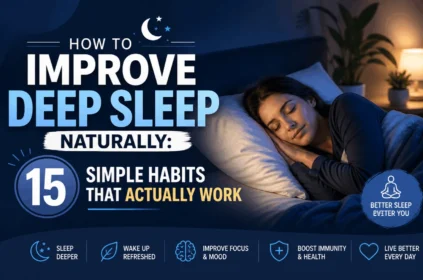
You spend roughly a third of your life asleep—but not all sleep is created equal. Deep sleep is the stage where your body does its most important repair work, yet most people have no idea how much they’re actually getting. If you wake up tired even after a full night’s rest, deep sleep might be the missing piece. So let’s break down what it is, how much you need, and what you can do about it.
What is deep sleep and why does it matter?
Sleep isn’t a single, uniform state. Your brain cycles through distinct phases throughout the night, and each one plays a different role. Deep sleep sits at the bottom of that cycle—it’s the most restorative and the hardest to wake from. During this stage, your heart rate slows, your breathing steadies, and your body shifts into full recovery mode.
Think of deep sleep as your body’s nightly maintenance window. It’s when your immune system releases infection-fighting cytokines, your muscles repair tissue, and your brain clears out metabolic waste. Without enough of it, you’re essentially skipping the most important part of sleep — and no amount of coffee will fully compensate for that.
The four stages of the sleep cycle
Your sleep architecture follows a predictable pattern. You move through four stages roughly every 90 minutes: Stage 1 (light drowsiness), Stage 2 (light sleep), Stage 3 (deep or slow-wave sleep), and REM sleep. Deep sleep falls in Stage 3, also called non-REM sleep Stage 3. Early in the night, you spend more time in deep sleep. As morning approaches, REM sleep takes over.
What happens in your brain and body during deep sleep
During deep sleep, your brain produces delta waves — slow, high-amplitude electrical signals that indicate profound rest. Growth hormone is released in its largest daily burst, supporting cell repair and muscle recovery. Your brain also consolidates memories and processes information from the day. It’s not just rest—it’s active, essential biological work happening while you’re completely unaware.
How much deep sleep do adults actually need?
Here’s the honest answer: there’s no single magic number. Deep sleep typically makes up about 13–23% of your total sleep time, according to Healthline. For most adults sleeping 7–9 hours, that translates to roughly 60–110 minutes of deep sleep per night. The key variable isn’t just duration — it’s quality. How much deep sleep adults need depends on age, health, stress levels, and sleep consistency.
What matters most is that your body naturally takes what it needs, provided your total sleep time is adequate. If you’re consistently getting less than 6 hours of total sleep, your body simply doesn’t have enough cycles to reach sufficient deep sleep. That’s where most people run into trouble — not because deep sleep is broken, but because total sleep time is too short.
The recommended range by age group
Age plays a significant role in how much deep sleep you get. Children and teenagers spend up to 20–25% of their sleep in deep stages. Adults between 18 and 60 typically average 15–20%. Once you pass 60, that figure can drop to 10–15% or lower. Older adults don’t lose the need for restorative sleep — their sleep architecture simply shifts, making it harder to reach and sustain deep sleep stages.
How deep sleep naturally changes as you get older
Age-related sleep changes are well documented and largely unavoidable. As you age, your body produces less growth hormone, which is closely tied to deep sleep. Sleep becomes lighter, more fragmented, and more easily disrupted. This doesn’t mean poor sleep is inevitable—but it does mean older adults need to be more intentional about sleep hygiene to protect the deep sleep they do get.
Signs you are not getting enough deep sleep
Feeling groggy after a full night’s sleep is one of the clearest warning signs. But the signals go deeper than tiredness. Many people assume they’re sleeping well simply because they’re in bed for 8 hours—without realizing that fragmented or shallow sleep can leave you just as depleted as a short night.
Sleep deprivation effects on health extend well beyond fatigue. Chronic deep sleep deficiency is linked to weakened immunity, impaired metabolism, elevated cortisol, and increased risk of cardiovascular disease. Your body keeps a running deficit—and unlike financial debt, you can’t always pay it back easily.
Physical symptoms to watch for
Common physical signs include waking up unrefreshed, persistent muscle soreness, frequent illness, and a sluggish immune response. You might also notice that minor injuries take longer to heal. These aren’t random — they reflect the body’s failure to complete its nightly repair cycle. Deep sleep is when tissue rebuilds and the immune system does its heaviest lifting.
Cognitive and emotional warning signs
When you’re short on deep sleep, your brain feels the impact first. Difficulty concentrating, poor memory recall, irritability, and low motivation are all classic signs. You may also find that managing anxiety and stress feels harder than usual—because it genuinely is. Sleep-deprived brains struggle to regulate emotions effectively, making everyday challenges feel disproportionately difficult.
What reduces deep sleep in adults?
Several lifestyle and environmental factors actively suppress deep sleep — often without people connecting the dots. Alcohol is one of the biggest culprits. It may help you fall asleep faster, but it significantly disrupts sleep architecture in the second half of the night, crushing deep sleep quality. Caffeine consumed after 2 pm can delay sleep onset and reduce total slow-wave sleep time. Evening screen exposure suppresses melatonin and delays your body clock.
Stress and anxiety are equally disruptive. Elevated cortisol keeps your nervous system in a low-grade alert state, making it difficult for the brain to descend into deep sleep stages. Poor sleep environments — too warm, too noisy, or too bright — compound the problem. Sleep quality vs. sleep quantity is a real trade-off: eight hours in a poor environment can still leave you depleted.
Lifestyle factors: alcohol, caffeine, screen time
The practical fix starts with your evening routine. Avoid alcohol within 3 hours of bed, cut caffeine by early afternoon, and dim your screens 60–90 minutes before sleep. These aren’t just wellness clichés—they directly protect the conditions your brain needs to enter delta wave sleep. Small changes here produce measurable improvements in how you feel the next morning.
Sleep disorders that disrupt deep sleep
Some causes go beyond habits. Sleep apnea, restless leg syndrome, and periodic limb movement disorder all interrupt the sleep cycle repeatedly throughout the night, preventing the brain from sustaining deep sleep. Sleep apnea in particular is chronically underdiagnosed—and its effects extend well beyond tired mornings. Research consistently links it to sleep disorders and weight gain, hormonal disruption, and cardiovascular strain. If you snore heavily or wake repeatedly, it’s worth investigating.
How to get more deep sleep naturally
The good news is that deep sleep responds well to consistent lifestyle changes. You don’t need supplements or devices—though some can help. What your body needs most is a regular sleep schedule, a cool and dark sleep environment, and a wind-down routine that signals to your nervous system that it’s time to shift into recovery mode.
Consistency is the cornerstone. Going to bed and waking at the same time every day—including weekends—stabilizes your circadian rhythm and helps your body allocate sleep stages more efficiently. Irregular sleep schedules are one of the most common and underappreciated causes of poor deep sleep in otherwise healthy adults.
Sleep hygiene habits that increase slow-wave sleep
Keep your bedroom cool (around 65–68°F is ideal), dark, and quiet. Avoid large meals within 2–3 hours of bedtime. Establish a 30-minute wind-down routine — reading, light stretching, or meditation all work. These habits lower your core body temperature and cortisol levels, which directly supports the transition into slow-wave sleep. Small, consistent steps compound quickly.
Exercise, diet, and bedroom environment tips
Regular aerobic exercise — even 30 minutes of walking — is one of the most powerful natural promoters of deep sleep. Aim to finish vigorous exercise at least 3 hours before bed. Your diet matters too. Eating foods rich in magnesium, tryptophan, and complex carbohydrates supports serotonin production and overnight recovery. For a deeper look at diet and sleep-supportive foods, the connection between what you eat and how you sleep is stronger than most people realize.
Can sleep trackers measure deep sleep accurately?
Wearable trackers like Fitbit, Apple Watch, and Oura Ring estimate sleep stages using heart rate variability and movement data. They’re useful for spotting trends but not clinically accurate. Sleep tracker accuracy has real limitations — only a polysomnography (PSG) test conducted in a sleep lab can definitively measure brain wave activity and sleep stages. That said, consumer trackers are good enough to flag patterns worth investigating. If your tracker consistently shows very low deep sleep, that’s a signal worth taking seriously—even if the exact numbers aren’t precise.
Frequently asked questions
Is 1 hour of deep sleep enough?
For most adults, 1 hour falls on the lower end of normal. If you’re sleeping 7–8 hours total and getting around 60 minutes of deep sleep, you may be fine—but consistently getting less than that can impair recovery, immunity, and cognitive function over time.
Can you catch up on deep sleep?
Partially. Your body does prioritize deep sleep after deprivation—a phenomenon called “rebound sleep.” But chronic deficits are difficult to fully reverse. The best strategy is prevention: protect your sleep consistently rather than banking on recovery nights.
Does napping increase deep sleep?
Short naps (20–30 minutes) rarely include significant deep sleep. Longer naps (60–90 minutes) can include some slow-wave sleep, particularly in sleep-deprived individuals. However, long daytime naps can reduce deep sleep pressure at night—so they’re a trade-off, not a fix.